| Author |
 Replies: 23 / Views: 3,151 Replies: 23 / Views: 3,151 |
|
|
|
Pillar of the Community
United States
1962 Posts |
Other thoughts:
The bust itself looks fairly "correct" from a (porous) distance... so at first glance, one might be tempted to say it's a simple cast mold of a genuine piece (as opposed to "hand-engraved"). HOWEVER, the legends are quite crude - in particular, note how crooked CAROLUS is! If a cast done from a genuine base coin, it wasn't executed very well and was touched up sloppily.
Interestingly, 1784 is a VERY sparse date for contemporary counterfeit reales (referring in general to known "engraved from scratch" designs, which are much more heavily pursued as opposed to simple casts). There are no known "Kleeberg-type" 1784 2R as far as I'm aware. For 8R, there's the 1784 illustrated in Riddell's Monograph, which is the only true contemporary Bob shows on his book CD, and checking my files, I've seen two others - so all (3) from different dies - and none match this.
Someone ping Bob and John on this.
|
|
Pillar of the Community
 United States
8056 Posts |
I am getting something like 5 cm for the die (block) width, which would give maybe 38-39 mm for the coin impression.
But as you say, better to get the exact measurement rather than an estimation/calculation that has photo artifacts.
|
|
Pillar of the Community
United States
1761 Posts |
Your thoughts on this item? The diameter is close to an 8R size impression and it seems to be some type of counterfeiter's set-up piece? 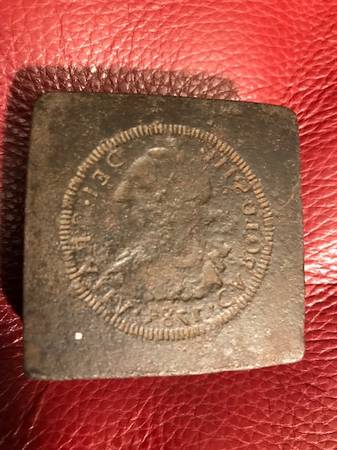 John Lorenzo New Jersey |
|
Bedrock of the Community
 United States
27514 Posts |
Here's an image of a 1787 1 real from Spain from ebay. The denticles are quite different from your potential die. 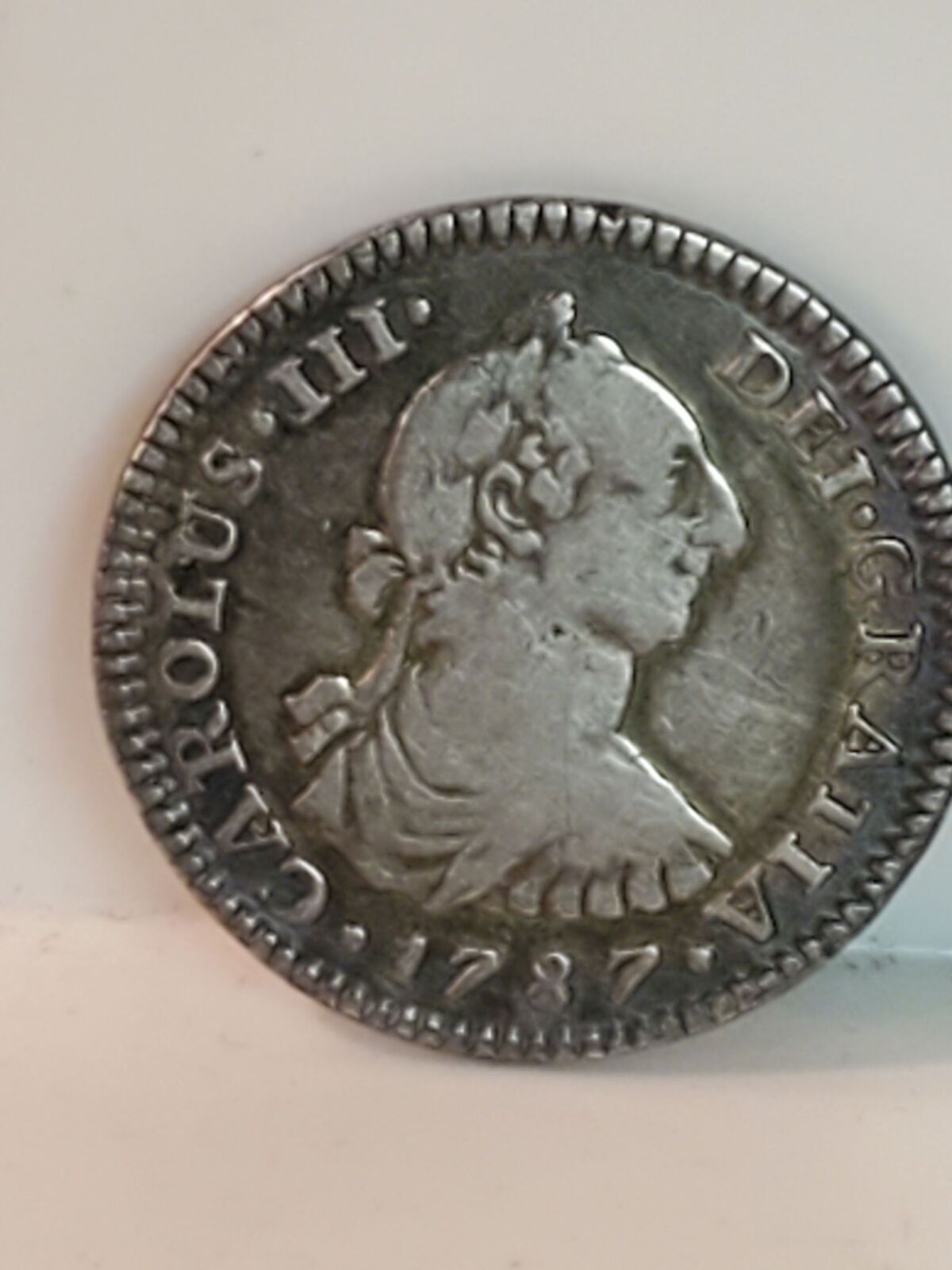 Inordinately fascinated by bits of metal with strange markings and figures
|
|
Pillar of the Community
United States
1962 Posts |
John, clearly it's a die/mold for a CC. Have you seen this before from Ringo's collection?: https://auctions.stacksbowers.com/l...ico-8-realesMods, can we fold this into the original thread? http://goccf.com/t/434291Also, as emphasis is always placed on proper titles here... the title of that thread really should be something like: Spanish 8 Reales - die for contemporary counterfeit? |
|
Moderator
United States
34560 Posts |
Quote:
Mods, can we fold this into the original thread? Done.  "If you climb a good tree, you get a push."
-----Ghanaian proverb
"The danger we all now face is distinguishing between what is authentic and what is performed."
-----King Adz
|
|
Pillar of the Community
United States
1761 Posts |
No realeswatcher thanks for the Ringo lot group which shows a similar counterfeit die mold which I forgot existed. Will do an XRF assay soon on this item. So for a counterfeit operation at this point I have just purchased this piece which was probably used to strike this counterfeit obverse and since similar to Ringo's pieces (obverse and reverse) perhaps in some drop hammer set-up and I also purchased thru Aureo & Calico high Pb set-up pieces for counterfeit production pieces. Also from Heritage: https://coins.ha.com/itm/spain/spai...3038-36675.s in my collection. So we see dies used in production as this item + set-up pieces with high Pb assays (i.e., a softer metal alloy) which IMO was used to test the die impressions prior to use in production. The Heritage lot was for legitimate dies IMO. I am sure you remember that 4R Matrix die sold by Sedwick awhile back for nearly 5K. JPL Edited by colonialjohn
11/11/2022 5:43 pm
|
|
Pillar of the Community
United States
1761 Posts |
Before this post closes since the counterfeit die was just received from the previous owner I can add this additional data to this thread:
Mike Ringo's obverse die measured at 43.4 mm X 45.7 mm X 26.8 mm (TALL). This die measures 40.2 mm (horizontal die axis) X 40.8 mm (vertical die axis) X 23.5 mm tall. Its weight is very heavy at 490.5 grams = 1.08 pounds. To be clear these measurements are not of the iron die itself but of the OUTSIDE coin dimensions imposed on the die. Outside meaning on the outer edge of the 360* dentilation. In Ringo's obverse die this is almost irrelevant to mention (as above) since the obverse die literally take the up the full dimensions of the die face.
It did not match any GNL Class I or II obverse dies. It has a very distinctive SEPERATION between CA & R in CAROLUS as its signature.
It appears to be of an iron alloy and since now retired a friend of mine does XRF assays for me once every 6-8 months ... so its pending. The surfaces are quite rough and old and it appears to be probably of the period IMO having viewed other older dies in museums several hundred years old.
John Lorenzo
Numismatist
Edited by colonialjohn
11/18/2022 3:57 pm
|
| |
Replies: 23 / Views: 3,151 |






 First Page


 Posted 11/03/2022 09:12 am


