Coin Community Family of Web Sites Join Thousands of Coin, Bullion, & Money Collectors
Royal Canadian Mint products, Canadian, Polish, American, and world coins and banknotes. Join Thousands of Coin, Bullion, & Money Collectors 300,000 items to help build your collection! Specializing in Modern Numismatics Coin, Banknote and Medal Collectors's Online Mall Vancouvers #1 Coin and Paper Money Dealer Shop for APMEX Bullion on eBay!


Username:
Password:
Save Password
Forgot your Password?


This page may contain links that result in small commissions to keep this free site up and running.

Welcome Guest! Registering and/or logging in will remove the anchor (bottom) ads. It's Free!

The Kangaroo Office. Fact Or Fantasy?

To participate in the forum you must log in or register.
Author Previous TopicReplies: 81 / Views: 8,364Next Topic
Page: of 6
Valued Member
billenben's Avatar
Australia
134 Posts
Bedrock of the Community
sel_69l's Avatar
Australia
21786 Posts
 Posted 01/09/2023  06:09 am  Show Profile   Bookmark this reply Add sel_69l to your friends list Get a Link to this Reply
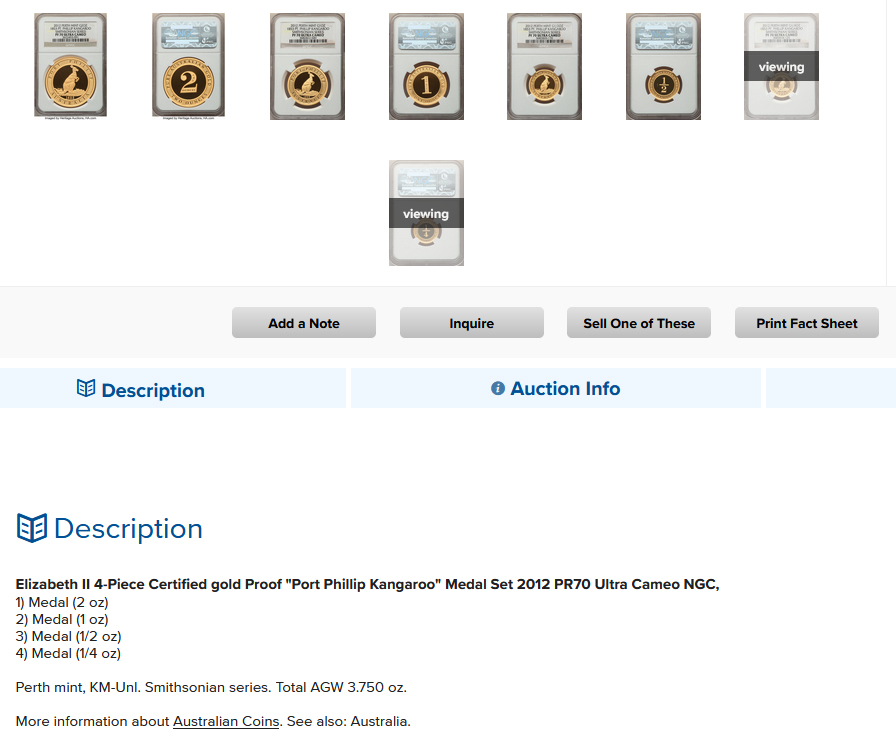
Obvious and deliberate die differences between the British Museum example, and the Perth Mint version.
Valued Member
billenben's Avatar
Australia
134 Posts
 Posted 01/09/2023  5:44 pm  Show Profile   Bookmark this reply Add billenben to your friends list Get a Link to this Reply

Quote:
Obvious and deliberate die differences between the British Museum example, and the Perth Mint version.


Well spotted but the point is that a Perth Mint replica set is as close as some might get to a set and Perth Mint sets aren't offered everyday of the week. If someone has been looking for a set then there is a set on offer at the moment.

Given they don't sell for much more than gold value they aren't such a bad buy because they open the door to talking about the Kangaroo Office. Coins have a big "show and tell" component; even if they aren't really coins as in this case.

Only reason I don't have a bid is I would prefer a Gee to a Perth Mint - much better story.


Pillar of the Community
Australia
852 Posts
 Posted 01/09/2023  9:46 pm  Show Profile   Bookmark this reply Add nealeffendi to your friends list Get a Link to this Reply
Slight nitpick, it isn't Rennicks but Renniks (Skinner in reverse).
Valued Member
billenben's Avatar
Australia
134 Posts
 Posted 01/09/2023  10:33 pm  Show Profile   Bookmark this reply Add billenben to your friends list Get a Link to this Reply
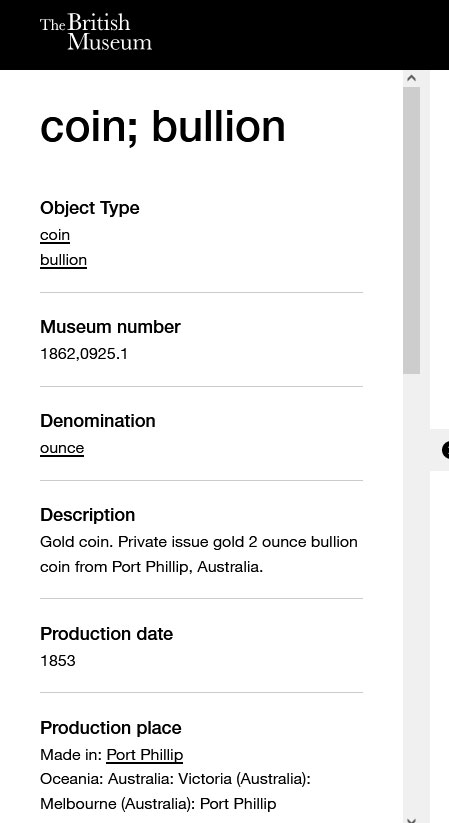
The Perth Mint call the real pieces "tokens".
I do like their use of inverted commas.
Not really a token but a bit like one.

https://www.perthmint.com/news/coll...at-rarities/

The Worlds largest Numismatic Auctioneer calls the modern reproduction medals, arguably because they are just a modern version of the 1853 medal / round / memento.

The-Kangaroo-Office.-Fact-Or-Fantasy?

But it is not a matter of what others say they are.
It is what an objective consideration of the available records show they are.
Valued Member
billenben's Avatar
Australia
134 Posts
 Posted 01/09/2023  11:14 pm  Show Profile   Bookmark this reply Add billenben to your friends list Get a Link to this Reply
The Worlds largest numismatic auctioneer and the legendary Kangaroo Office pieces, rightly, do not even rate a mention.

Yet W Roth (1895) claims they are "the most noteworthy" relics of Australasian economic history.

And what about Vaux's (1864) "hereafter"?
"...they will serve hereafter as an interesting record of what the most prosperous colony England ever founded intended as the type of their national coinage...."

It is just rubbish that lands us in 2023 with the hopelessly flawed narrative and a round as a feature item in Renniks coin catalogue.


https://coins.ha.com/world-coins-in...nSMP-111020" target="_blank" rel="nofollow"> br / https://coins.ha.com/world-coins-in...onSMP-111020
Australian Coins
History of Australian Coins
Currency and coins were not used in Australia prior to the arrival of the First Fleet in 1788, when the British established their Crown Colony at New South Wales. The colonists had no mints or official coinage of their own and were forced to use whatever coins they could find, British or foreign. Some colonists brought coins with them when they arrived on the island, but mostly they obtained these coins by trade with ships arriving in Australia. Coins from England, the Netherlands, Spain, and even India circulated frequently. This wide range of currencies made life difficult for the Australians, and so in 1800 Governor King declared official conversion rates for foreign coins. Known as the "Proclamation Coinage", he announced British values for all non-British coins used in the colony.
While these conversion rates made it simpler to use multiple currency systems simultaneously, the fact remained that the total quantity of coins available was insufficient to meet the colonist's needs.

What Are Australian Holey and Dump Coins?
In an attempt to remedy this problem, in 1813, Governor Macquarie imported 40,000 Spanish dollars. The governor employed a convict to punch out the centers of the coins, seeking a way to prevent the coins from leaving the colony quickly. The man tasked with cutting the coins, William Henshall, had been banished to the Australian penal colony for forging coins, and so was a natural choice for the assignment. The two parts of the coins circulated separately: the centers were known as "Dump" Dollars (worth 15 pence) while the outer rings became "Holey" Dollars (worth 5 shillings). A decade later, in 1825, the British government declared British currency the only legal currency in Australia, and the Holey Dollars and their Dump counterparts were abandoned.

How much is an Australian Holey Dollar worth?
Holey dollars sell from $10,000 to $500,000 depending on their condition. Rare holey dollars often sell at auction for hundreds of thousands of dollars.
How much is an Australian Dump worth?
The value of an Australian Dump coin varies by condition of the coin and the year minted, and starts at $5,000 for a lower graded coin up to $25,000 for very fine grade.

What Were the First Australian Coins?
Even though the British government banned the use of foreign currency in their colonies, they did not provide the Australian colonists with new coins to carry out their day-to-day business. In 1849, a local New South Wales grocer, Annand, Smith & Co., took matters into their own hands and ordered tokens from a private Birmingham mint. The practice soon caught on; a coin press was delivered to the colony, and companies began minting copper tokens on their own, mostly valued at 1 Penny or ½ Pence. Many tokens copied the Britannia reverse of British pennies, and nearly all contained the name of the issuing company in the legends. Since companies in England had been allowed to issue tokens in the late 18th and early 19th centuries (to alleviate a shortage of small-denomination coinage), the authorities allowed Australian companies to do the same. However, many of the issuing companies folded and could not back the value of their tokens, so in the 1870's the Australian government ordered that the production of these tokens be ceased. All remaining tokens were sold to the British government in return for coins of equal face value; the British melted the tokens and reminted them, making a profit in the process.

What Were the First Australian Gold Coins?
Extensive gold reserves were discovered in Australia in the 1840's. The Adelaide Assay Office began stamping this gold into ingots marked with their weight and fineness in 1852, and began minting "Adelaide Pounds" later that same year. The goal of minting these coins was twofold: to create an acceptable form for the gold to be exported and sold abroad, and to create coins sufficient for daily use in Australia. Relatively few of these coins were ever minted, however, because within a year British authorities had sent word that the Assay Office had no authority to issue currency.
British Colonial and Commonwealth Coinage
Following the closure of the Adelaide Assay Office, the British government finally recognized the need to create a comprehensive coin system in Australia, as well as the necessity for a mint on the continent. Three branches of The Royal Mint were opened in Australia - one in Sydney in 1855, another in Melbourne in 1872, and the last in Perth in 1899. At long last enough coins and enough denominations existed in Australia to meet the needs of the growing population.
Australia federated as an independent country in 1901, and while a decimal system of currency was considered the new Parliament decided to remain with the existing British monetary system of pounds, shillings, and pence. In 1965 the Royal Australia Mint opened in Canberra (not to be confused with the three Australian branches of The Royal Mint of London).
Australia converted to a decimal currency in 1966, and their official currency is now the Australian Dollar.


Valued Member
billenben's Avatar
Australia
134 Posts
 Posted 01/10/2023  9:32 pm  Show Profile   Bookmark this reply Add billenben to your friends list Get a Link to this Reply
From the Smithsonian:

"Thanks for sharing this information. We'll add a note in the object's record to reflect this information....."

Best,
Ellen


Dr. Ellen Feingold
Curator, National Numismatic Collection
National Museum of American History
MRC 609 #9474; P.O. Box 37012 #9474; Washington, DC 20013-7012
p: 202.633.4487 #9474; e: feingolde@si.edu

I think the information related to the Smithsonian claim the round (Kangaroo Office 2oz piece) was produced in 1853 when we know it was made in 1854 using a 1853 die.
I thought I would start small and build on it.
Once they accept their information is not right on that then they will be more open to accepting their other information could also be flawed.


Valued Member
billenben's Avatar
Australia
134 Posts
 Posted 01/11/2023  2:46 pm  Show Profile   Bookmark this reply Add billenben to your friends list Get a Link to this Reply
From the source of the myth comes a more realist view.
Some credibility is restore to the institution.
11/01/2023
Thank you for your feedback. I agree, they are not pattern-coins - but neither are they really tokens, because they have intrinsic value. I would be inclined to describe them as bullion coins. I have tidied up the records adding bullion as a descriptor and removing references to patterns.
Kind regards
Tom Hockenhull
(THockenhull@britishmuseum.org)

bullion coins = rounds.
Not pattern coins. That wasn't hard to work out.
What will Renniks do now?
Valued Member
billenben's Avatar
Australia
134 Posts
 Posted 01/11/2023  7:35 pm  Show Profile   Bookmark this reply Add billenben to your friends list Get a Link to this Reply
Anyone else notice they aren't called patterns anymore.
Said pattern coin yesterday.
Still need to get back to them on the date they were produced but making progress.


The-Kangaroo-Office.-Fact-Or-Fantasy?
Valued Member
billenben's Avatar
Australia
134 Posts
 Posted 01/14/2023  6:07 pm  Show Profile   Bookmark this reply Add billenben to your friends list Get a Link to this Reply
From the local press of the day.

The Argus 15 September 1854.
A Local Coinage - At the Chamber of Commerce yesterday, several tokens made of pure Australian gold were exhibited by Mr Khull, bullion broker. They were manufactured by Mr Scaife, and are to be exhibited at our Palace of Industry on the 20th inst. They are quarter ounce, half ounce, one ounce and two ounce respectively. On the reverse is a Kangaroo and on the obverse the weights are described, whilst around the rim on one side are the words "Pure Australian Gold" and on the other "Port Phillip, Australia". We really cannot speak to highly of the workmanship. It is perfect, and is a most satisfactory and most pleasing proof of the great advancement of art in Melbourne. We understand the artist intended to prosecute the manufacture of such tokens as a circulating medium, but the high price of cruse gold prevents this for the present. As objects of curiosity however and as fitting compliments to send to friends at a distance we doubt not they will be in demand and certainly the talented artist merits every possible encouragement.


Things to note.
The pieces are called tokens under the heading of coinage. Coinage in those days was coin of the realm and tokens. Called tokens because they are what they are.

Also note the difference of opinion of the quality of the tokens between the 1854 article and 1864 Vaux introduction. The article talks up the "perfect" workmanship while Vaux doesn't quite see it like that.
"The workmanship of this token (1823 Shilling) is good and much superior to that of the patterns (Port Phillip Pieces) above described"
W S W Vaux, Head of Coins and Tokens at the British Museum, in his 1864 introduction of the Kangaroo Office pieces to the numismatic world also talks about the Tasmanian Shilling of 1823.

Taylor, whose is not mentioned by name, is referred to as an artist and to some extent he is but it is a little stealth to use "artist" to describe a British die maker.

The next part is curious because it says the current high price of gold prevents pursuing prosecuting "the manufacture of such tokens as a circulating medium".
There is no need for a circulating medium with a minimum value of £1. The real need was small coinage. By the end of 1852 there is a lot of sovereigns in Australia, enough that there is no need for Adelaide Pounds to continue. Additionally there is still £1 14/ difference between the cost of 3¾ ounces of gold at full price (~£13 6/ @ 70 to 71 shilling per ounce) and the price the tokens were intended to be sold at, £15 a set. There is still good margin between the cost to make a set and the price the pieces were to be 1, 2, 4, and 8 pound (£) pieces.

Let's pretend the idea of the Kangaroo Office was primarily to make coinage for circulation then not only were the backers daft in not knowing, before the Kangaroo left, the gold price was stable but they doubled down on that by not knowing there was no need for pieces of the value they intended.

There is no doubt the pieces "will be in demand" but £15 back then is the same buying capacity as $3500 today. "
(I'll just buy a set and send them to my friend; I don't think so, not at that price)

It is an interesting article because roughly a week before the press piece Scaife (Manager of the Kangaroo Office) pens a letter which does not quite carry the same sentiment.

On Sept 9 1854 Scaife (the Manager) writes in a letter:
"With reference to the "Gold Business" in a private letter I wrote to P Tinsdall Jr. I mentioned that I had no objection to prosecute the scheme subject to being supplied with funds. He replied to my request for a remittance of £1000 made after my arrival, by saying "Such a thing was never contemplated" He, evidently is under the impression that I have caused the scheme to fail."

It seems the "Gold Business" is not funded. Scaife goes on to talk about the availability of gold from diggers but does not seem to have grievance with the price.

Edited by billenben
01/15/2023 04:22 am
Valued Member
billenben's Avatar
Australia
134 Posts
 Posted 01/25/2023  7:36 pm  Show Profile   Bookmark this reply Add billenben to your friends list Get a Link to this Reply
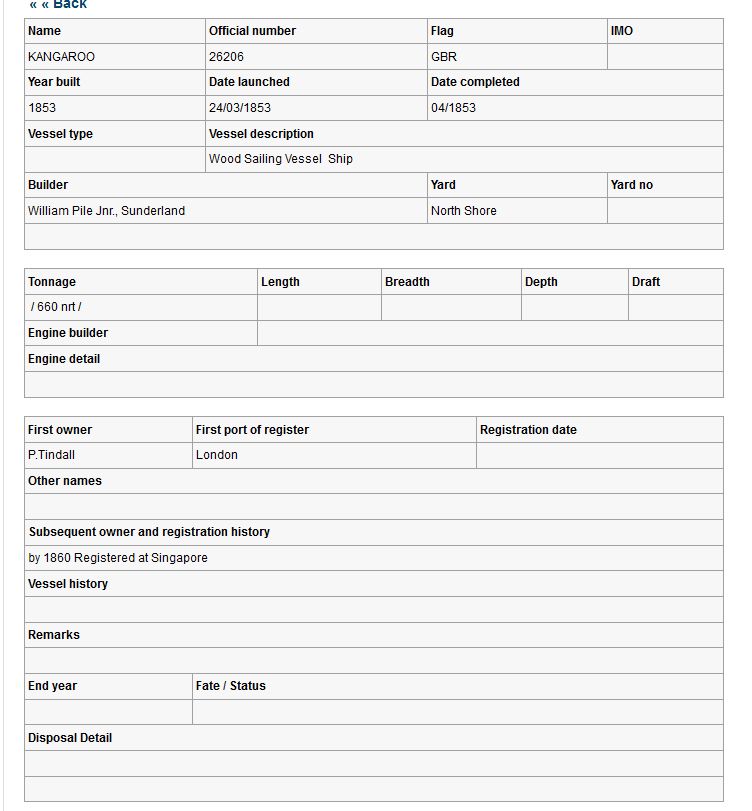
Who owns the boat (the Kangaroo)?
Tindall Senior.

The-Kangaroo-Office.-Fact-Or-Fantasy?
Valued Member
billenben's Avatar
Australia
134 Posts
 Posted 01/25/2023  7:58 pm  Show Profile   Bookmark this reply Add billenben to your friends list Get a Link to this Reply
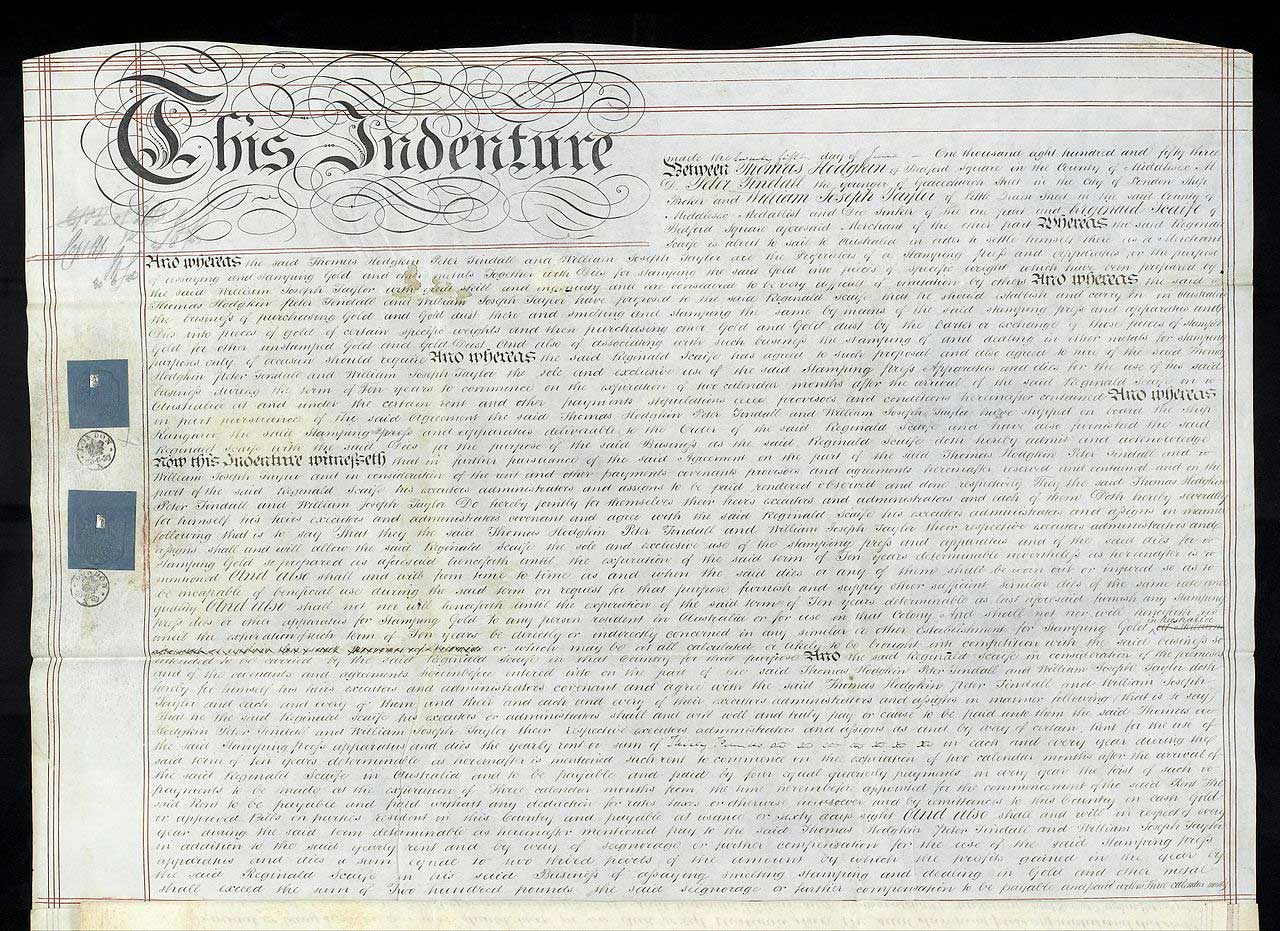
All the numismatic stories run along the line of Taylor sending a press to Australia to make money on a gold price differential and to introduce gold 'tokens' as a circulating medium but that whole concept flies in the face of the agreement between the 3 entrepreneurs and the Kangaroo Office manager (Scaife)

First thing to note in the agreement is that Hodgkin has top billing. His name comes before the other two. Hodgkin is followed by Tindall (Jnr), whose father owns the recently built Kangaroo, and then Taylor gets a mention.
Hodgkin is the philanthropist, Tindall Jnr the son of ship builders and owners, Taylor the medallist.

Note that all 3 own the press so it likely Taylor made some financial agreement with Hodgkin and Tindall in relation to the press. Taylor did not send a press, if anything the three sent a press but more accurately the 3 leased the press to Scaife.

As already suggested; it may well be Hodgkin is trying to set up his step son and wife in the colony and Tindall and Taylor are just players in that venture.

This is a complex arrangement. We have the son of the ship builder, it is most likely the Kangaroo is leased to the venture by Tindall Snr who is the owner of the Kangaroo. Taylor the medallist putting up a press in some arrangement that sees all three as the owners and the philanthropist, Hodgkin, whose son in law is going to manage a store full of colonial supplies for gold miners.

We don't see this in the boring "Taylor sent a press" narrative.


According to the agreement Scaife is renting the press and associated equipment. So Taylor is doing nothing more than, in conjunction with the others, putting up a press for hire. If anyone is looking to make money / tokens it is Scaife as per the agreement and there is a kick back for the 3 investors should things go well.


The-Kangaroo-Office.-Fact-Or-Fantasy?
Valued Member
billenben's Avatar
Australia
134 Posts
 Posted 01/25/2023  8:01 pm  Show Profile   Bookmark this reply Add billenben to your friends list Get a Link to this Reply

The-Kangaroo-Office.-Fact-Or-Fantasy?
Valued Member
billenben's Avatar
Australia
134 Posts
 Posted 01/25/2023  8:09 pm  Show Profile   Bookmark this reply Add billenben to your friends list Get a Link to this Reply
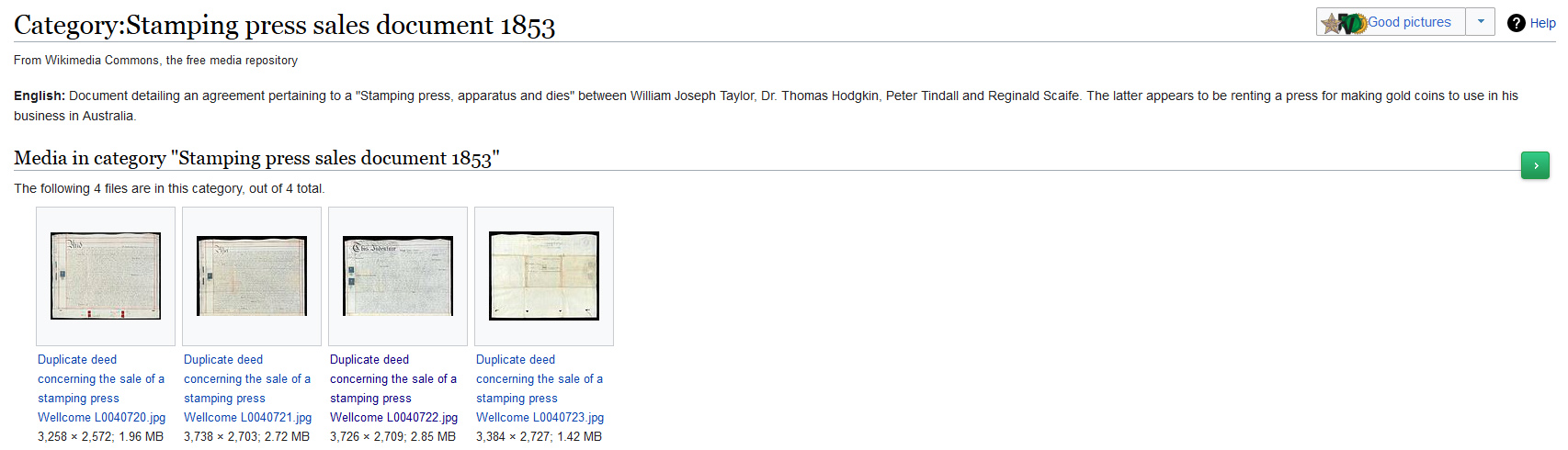
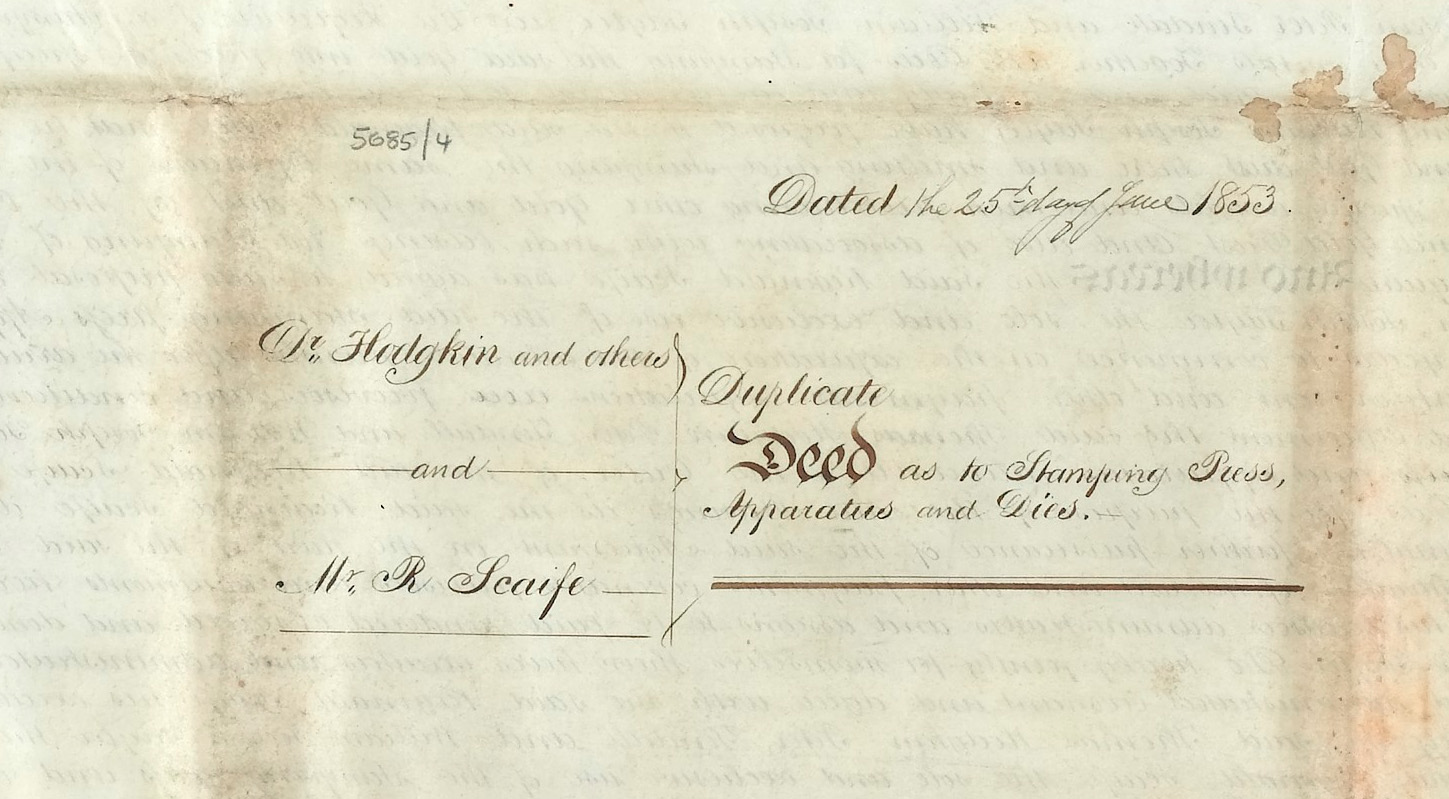
From the Stamping Press deed.
It says "Hodgkin and others"
Who is running this circus?
Was the Kangaroo Office just Hodgkin trying to set up his son in law in the colony?


The-Kangaroo-Office.-Fact-Or-Fantasy?
Valued Member
billenben's Avatar
Australia
134 Posts
 Posted 01/26/2023  4:13 pm  Show Profile   Bookmark this reply Add billenben to your friends list Get a Link to this Reply
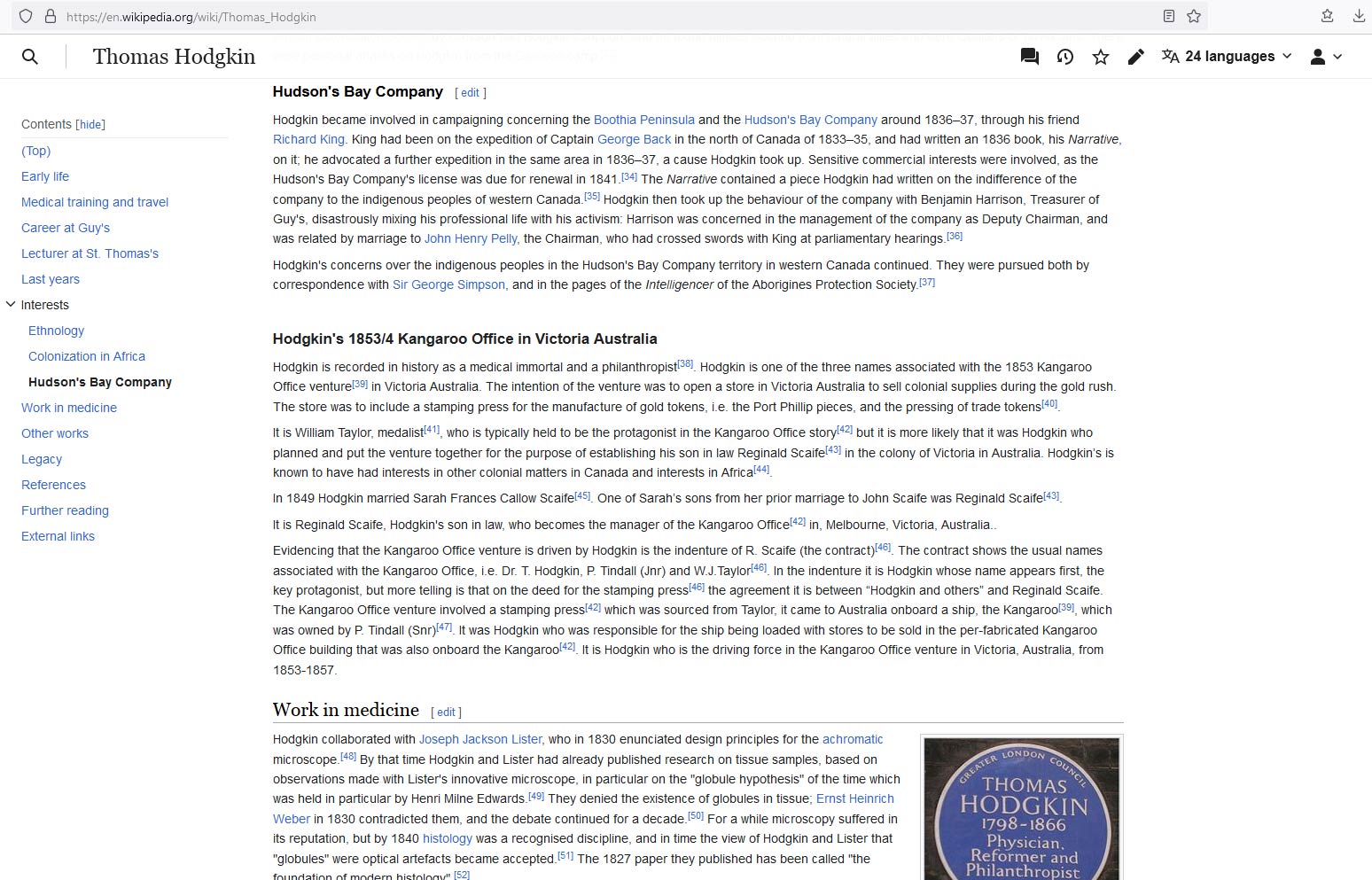
Wikipedia comes to the party.
Hodgkin is the protagonist in the Kangaroo Office story.

The-Kangaroo-Office.-Fact-Or-Fantasy?
  Previous TopicReplies: 81 / Views: 8,364Next Topic
Page: of 6

To participate in the forum you must log in or register.


Disclaimer: While a tremendous amount of effort goes into ensuring the accuracy of the information contained in this site, Coin Community assumes no liability for errors. Copyright 2005 - 2026 Coin Community Family- all rights reserved worldwide. Use of any images or content on this website without prior written permission of Coin Community or the original lender is strictly prohibited.
Contact Us  |  Advertise Here  |  Privacy Policy / Terms of Use

Coin Community Forum © 2005 - 2026 Coin Community Forums
It took 0.49 seconds to rattle this change. Forums