| Author |
 Replies: 42 / Views: 4,375 Replies: 42 / Views: 4,375 |
|
|
|
Moderator
 United States
195559 Posts |
Another tip: After a long soak in acetone, always rinse again with fresh acetone to get anything that may have redeposited back on the coin surfaces.
(I will assume Helder did this, but wanted to make it known to anyone who did not know.)
|
|
Pillar of the Community
 United States
790 Posts |
Thanks, everybody!
I really appreciate all the info!
|
|
Pillar of the Community
United States
7394 Posts |
Quote:
Another tip: After a long soak in acetone, always rinse again with fresh acetone to get anything that may have redeposited back on the coin surfaces. Just to add, jBuck is correct. I'm my case the coin was rinsed with acetone after the soak, par dry with a clean terry cloth, then a little Verdi care was added to each side and the coin dried. The Verdi care protects the coin. |
|
Pillar of the Community
 United States
8055 Posts |
Quote:
I put almost all raw coins in acetone as a preventive for getting finger prints.
My last raw coin had a sticky substance on the reverse, it went into acetone for about 24 hours. The acetone turned greenish yellow and the reverse lightened a little. That is always the issue with using any solvent. It can remove something that can show a lighter coin or hide corrosion. I think this is a very helpful comment. At the risk of insulting medical professionals, the first challenge we should pose when considering a chemical treatment of a coin (Yes, acetone is a chemical, so we are considering chemical treatment of a coin) is "DO NO HARM" So, always think it through ... Edited by tdziemia
12/06/2022 7:27 pm
|
|
Pillar of the Community
United States
790 Posts |
Thanks for the tip about the rinse! I'd seen other comments that recommended a dip in distilled water to remove any residue from the acetone. Necessary or no?
|
|
Pillar of the Community
United States
790 Posts |
Oh, also, I saw a recommendation that you use different acetone for different types of metal—so one for copper, one for nickel, one for silver, etc. Necessary or no?
|
|
Moderator
United States
195559 Posts |
Quote:
Thanks for the tip about the rinse! I'd seen other comments that recommended a dip in distilled water to remove any residue from the acetone. Necessary or no? Not necessary, the fresh acetone rinse will remove the residue. Also, fresh acetone is a better than distilled water for one big reason... it will air dry really fast, so there is no need to wipe or dab the coin to dry it.  |
|
Moderator
United States
195559 Posts |
Quote:
Oh, also, I saw a recommendation that you use different acetone for different types of metal—so one for copper, one for nickel, one for silver, etc. Necessary or no? There is only one kind of acetone to use, 100% pure. Just put a little acetone in a glass (never plastic) dish with the coin. Let it soak, or swish it (be careful to not let the coin rub abound the bottom). After a while, remove the coin and pour some fresh acetone over each surface. Inspect. Repeat as necessary, allowing a longer soak if needed. You should use a fresh batch of acetone for every coin, never reuse a soak. This will prevent stuff from one coin depositing onto another. With that said, I would only soak one coin at a time, not in batches, unless they are all the same type (I think that is what you were getting at). Always do the final rinse on one coin at a time. |
|
Pillar of the Community
United States
4620 Posts |
I have a 1921 Morgan dollar that had that horrible colorized pad printing done to it. I soaked it in acetone in a sealed glass dish, for a year before the last bits came loose to a toothpick poke. Changed the acetone every quarter. Only to find they had scratched the bleep out of the coin so the pad printing would adhere. It's my pocket piece. In twenty years it will probably straight grade as VG. -----Burton 50+ year / Life / Emeritus ANA member (joined 12/1/1973) Life member: Numismatics International, CONECA Member: TNA, FtWCC, NETCC, EveryCountry (online) coin club Owned by three cats and a wife of 40+ years (joined 1983) Author: 3rd Edition of the Sample Slabs book, https://www.sampleslabs.info/ |
|
Pillar of the Community
United States
790 Posts |
Great story about the colorized coins. Lord, I hate it when they do that.
Hey, hjfacinto, is VerdiCare safe on toned coins, or will it remove the toning?
Thanks!
|
|
Moderator
United States
195559 Posts |
Quote:
Only to find they had scratched the bleep out of the coin so the pad printing would adhere  Quote:
It's my pocket piece. In twenty years it will probably straight grade as VG.  |
|
Pillar of the Community
United States
4620 Posts |
Here it is... 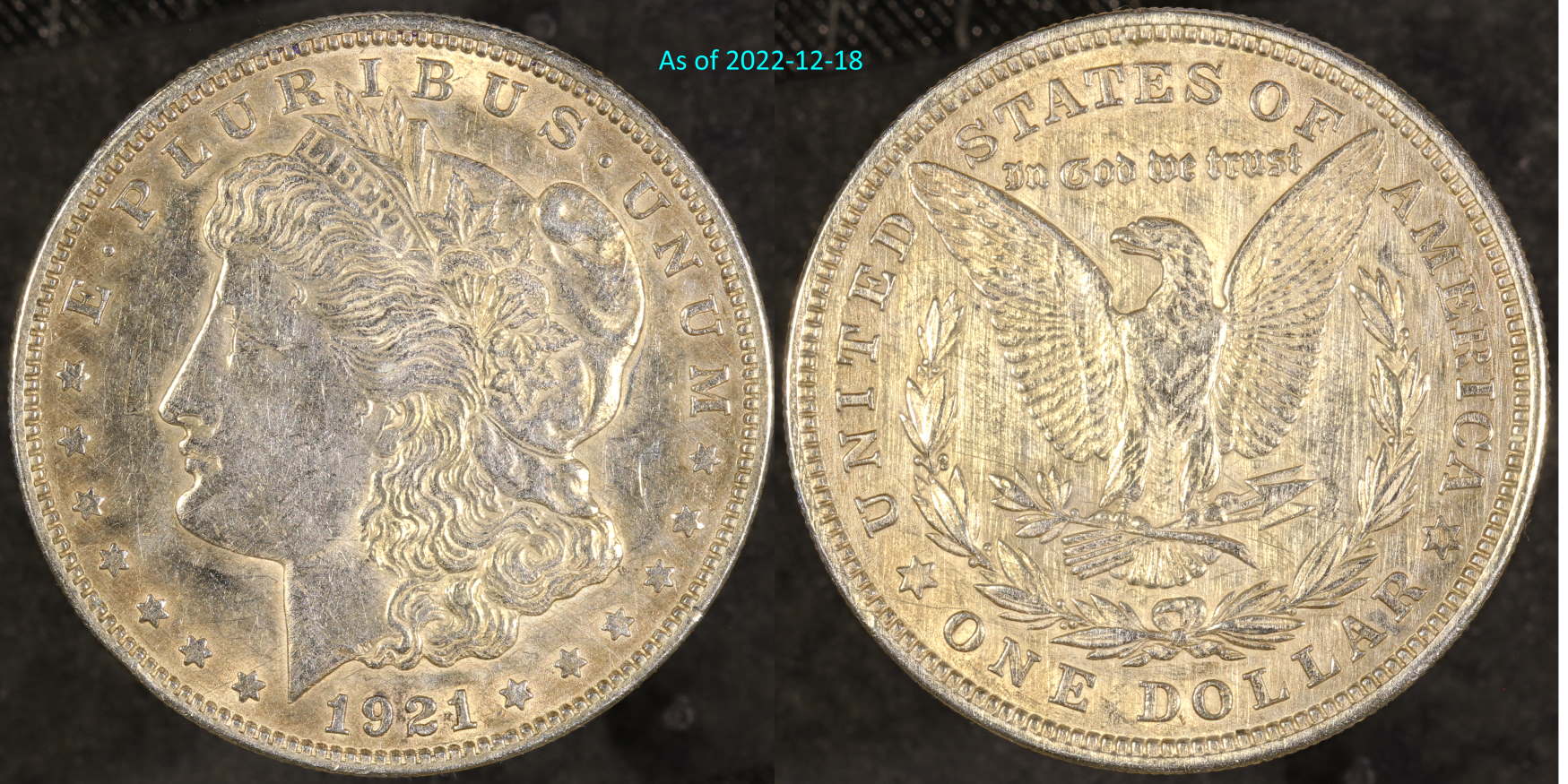 -----Burton 50+ year / Life / Emeritus ANA member (joined 12/1/1973) Life member: Numismatics International, CONECA Member: TNA, FtWCC, NETCC, EveryCountry (online) coin club Owned by three cats and a wife of 40+ years (joined 1983) Author: 3rd Edition of the Sample Slabs book, https://www.sampleslabs.info/ |
|
Bedrock of the Community
United States
94367 Posts |
You did all that work for a 1921 Morgan?  Edited by Coinfrog
12/18/2022 5:05 pm
|
|
Pillar of the Community
United States
4620 Posts |
Nah... I did all that work because I HATED the colorization.
Besides, it's was a matter of pouring out the old stuff and adding fresh acetone every couple of months. If that's a lot of work, then ...
And the toothpick poking took about 20m. I could probably have done THAT at 9 months. If somebody wants to give me another ugly colorized Morgan, I have more acetone :-)
-----Burton 50+ year / Life / Emeritus ANA member (joined 12/1/1973) Life member: Numismatics International, CONECA Member: TNA, FtWCC, NETCC, EveryCountry (online) coin club Owned by three cats and a wife of 40+ years (joined 1983) Author: 3rd Edition of the Sample Slabs book, https://www.sampleslabs.info/ |
|
New Member
United States
39 Posts |
Some organic materials are water soluble. Some organic materials are alcohol soluble. The trick is to know which to dissolve first. Thus, never clean coins unless you know what you are doing.
|
| |
Replies: 42 / Views: 4,375 |







 First Page


 Posted 12/06/2022 5:06 pm





