Nice idea for a thread!

Here is an early KM #1.
France 1602, 1/4 ecu for Bearn, Henry IV, Pau.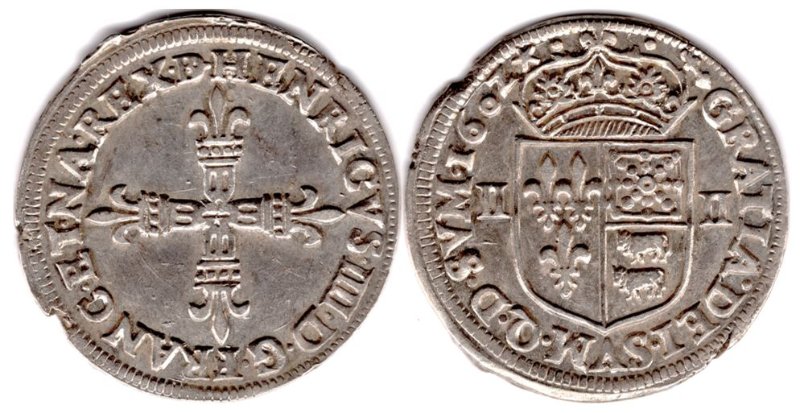
The value 1/4 is indicated with the Roman numeral II - II.
This was a regional issue for Navarre and Bearn and it differs in several ways from the regular royal issues:
- The shield has arms for France (fleurs-de-lis), Navarre (chains), and Bearn (cows), not just France.
- After the regular titles FRANCiae ET NAvarrae REX, there is a ligature of D and B, standing for Dominus Bearniae, that is, Lord of Bearn, a title that Henry brought with him from his time as king of Navarre only.
- Normally the reverse has the inscription SIT NOMEN DOMINI BENEDICTUM, but here it is replaced with the Bearn motto GRATIA DEI SUM id QuoD SUM: By Grace of God, I am what I am.
Next KM #1 is also from France, but exported to French Cochinchina where it was holed to look like the local cash coins.
1 centime, France, 1875. Holed in 1878 for use in French Cochinchina.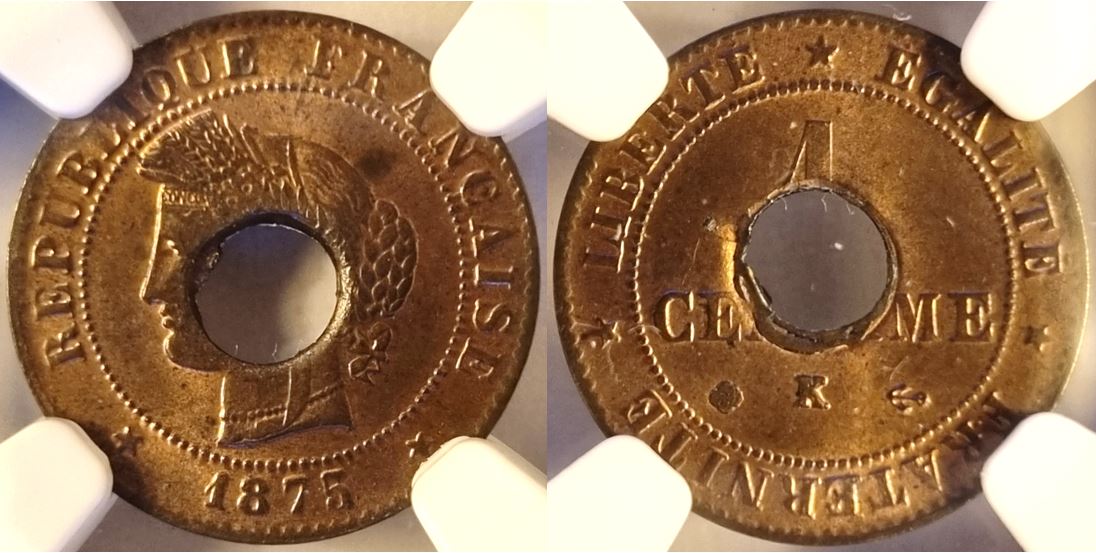
This odd
PMD exercise was part of a plan to introduce French coins in the recently acquired colony of Cochinchina. One million 1 centime coins were shipped from France, but the locals did not accept them, despite a lack of indigenous cash coins. An attempt to meet the local preferences was made by punching a hole in 10,000 of the 1 centime coins. They were assigned a value of 1/500 Spanish dollar, slightly better than the 1/600 that was common for cash coins. The effort only resulted in the locals feeling they were cheated of some of the copper in the coins, and again they refused.
Next KM #1 is from French Indochina (a colony formed in 1887 as an expansion of French Cochinchina).
1 centième, French Indochina, 1888.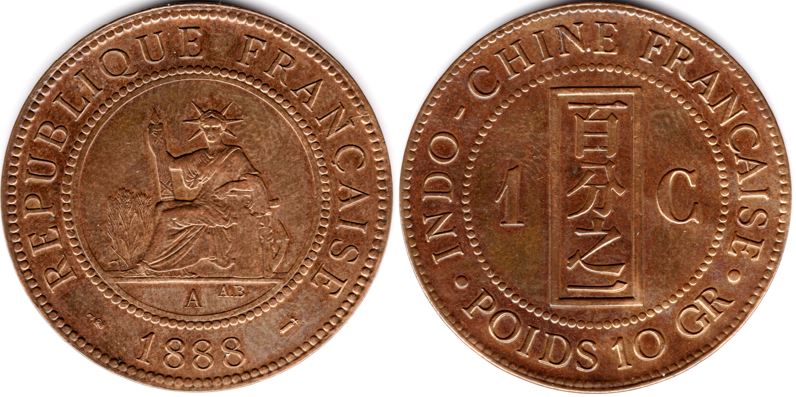
French Indochina got a proper coinage from start, although all coins were minted in Paris. The value, 1 centième, is 1/100 of a piastre (which equalled a Spanish dollar in value). The Chinese characters state the value: "Hundred part of one".
Staying in French Indochina, here is a local issue for Tonkin. This is the only coin minted, so it has the single KM number #1.
1/600 piastre, Tonkin, 1905.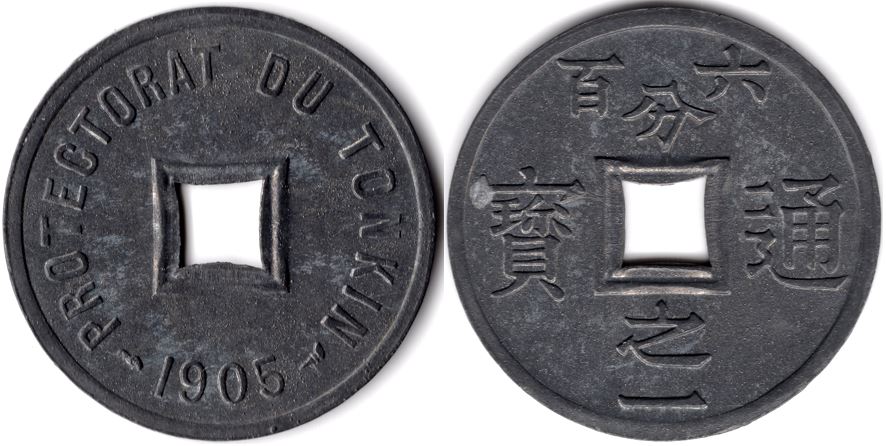
A single coin and a single issue in 1905, but 60 million of these were minted. It was an initiative by local merchants to alleviate the constant lack of small cash, which the local cash coins - the form of currency still preferred by the locals - could not meet. Made of zinc from the local zinc deposits - like traditional Vietnamese cash coins - and with the denomination 1/600 piastre in Chinese characters only, the thought was that it would be gladly accepted. Perhaps it would have been, had it not had the text "Protectorate of Tonkin", which in the eyes of some Vietnamese was a provocation since it underlined the French hegemony over Tonkin, a fact that was never fully accepted by the Vietnamese emperor. Only about one tenth of the 60 million coins ever left the Hanoi treasury, the rest more or less self-destructed in the treasury vaults.
Staying in the Far East, but moving a bit to the northeast, to Hong Kong. Their KM #1 looks like this:
1 mil, Hong Kong, 1863.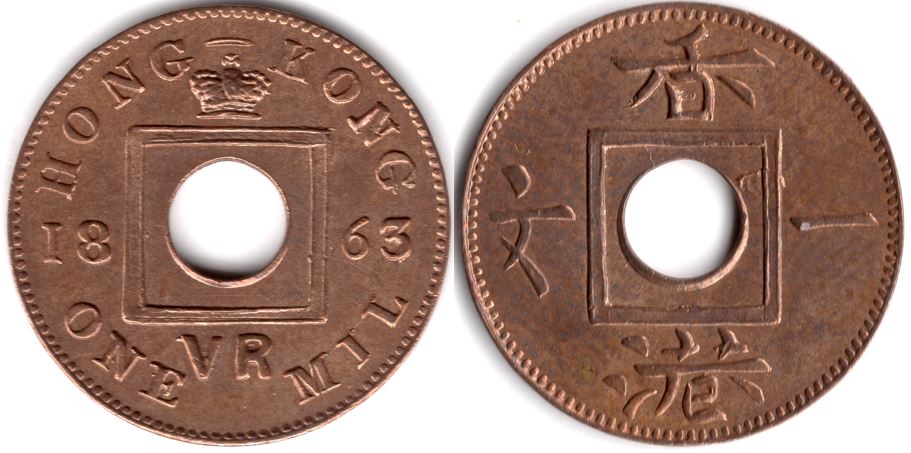
The British too wanted to take control over the coinage, in their colony of Hong Kong. Cash coins were around there too, of course, and the British wanted to emulate that. Making a correctly aligned square hole in a struck coin is non-trivial though, so they settled for a circular hole in a square marking.
Now back to Europe. KM #1 for Guernsey:
Guernsey, 1 double, 1830.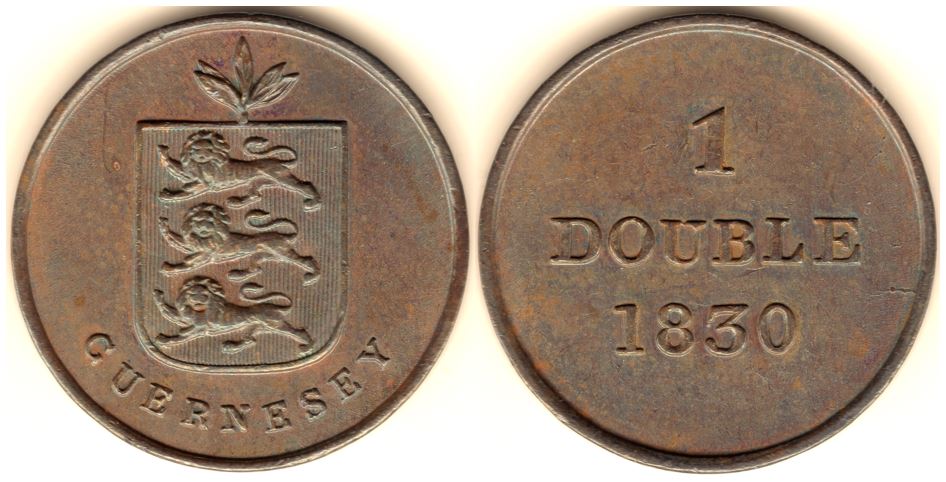
The smallest denomination in the monetary system introduced in 1830, to replace use of coins in the ancient French livre-sous-denier system. The islanders did not want to use the French francs introduced in 1795 following the French revolution, and the need for pre-revolutionary coins was becoming hard to satisfy. Neither did they want to move to the British pound, so they invented their own system, based on the French (1 double equalled 1/4 sous, which corresponded to 5/42 of a British penny).




 First Page
 Previous Page



 Posted 01/16/2024 7:01 pm