| Author |
 Replies: 398 / Views: 21,307 Replies: 398 / Views: 21,307 |
|
|
|
Pillar of the Community
  United States
3735 Posts |
My lone acquisition in today's Heritage auction. Cotton Plant, Arkansas, is a small town about halfway between Little Rock and Memphis. The area was settled in the 1820's and the town of Richmond was eventually formed. Cotton was introduced in the 1840's and did very well, and the town name was changed to Cotton Plant sometime afterwards. The town's population peaked in the 1950's, but now has only about 500 residents. During the issuing period the population was between 1000 and 1500. The First National Bank of Cotton Plant, charter 10723, was the town's only issuing charter and was fairly short-lived; the bank was chartered on April 9, 1915 and entered receivership on April 7, 1922. During that time the bank issued $10 and $20 1902 Date Back and 1902 Plain Back notes. A total of 2,000 Date Back notes were issued, along with 14,208 Plain Back notes. The NBN census currently lists a total of four notes, two each of $10 DB and $10 PB. This example is the highest graded of the four, and it's a serial number 1. While small size s/n 1 nationals are not too uncommon for Arkansas, with a total of 41 listed in the census, there are only 13 large size s/n 1 notes (5 of those 1902 DB notes) listed across all 114 issuing charters and 123 different titles for the state. It appears this note had been folded and stored for a long time, and you can tell how it had been folded by the varying discoloration on the different sections of the note. Signatures of Cashier H.C. Argo and vice-president F.P. Hill. 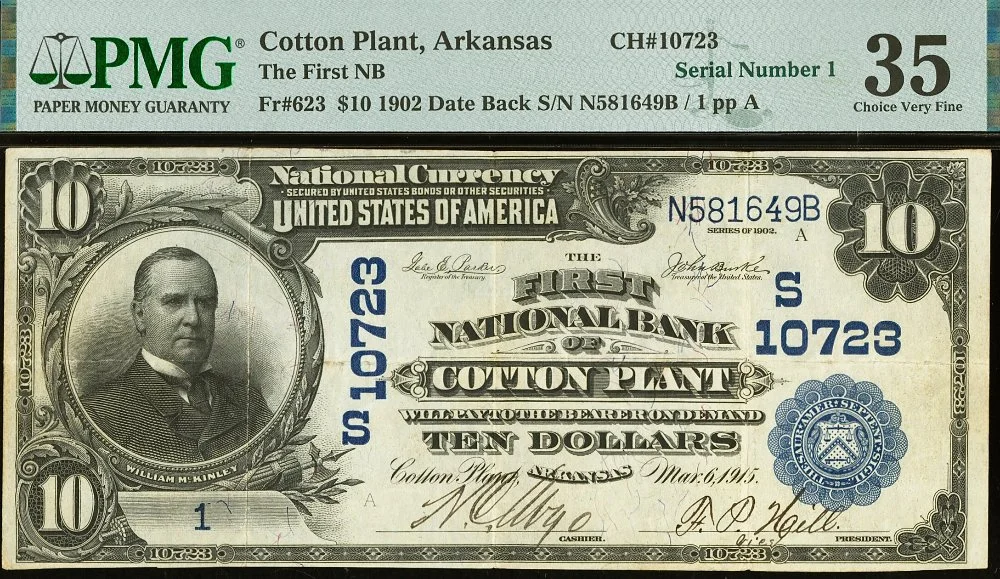 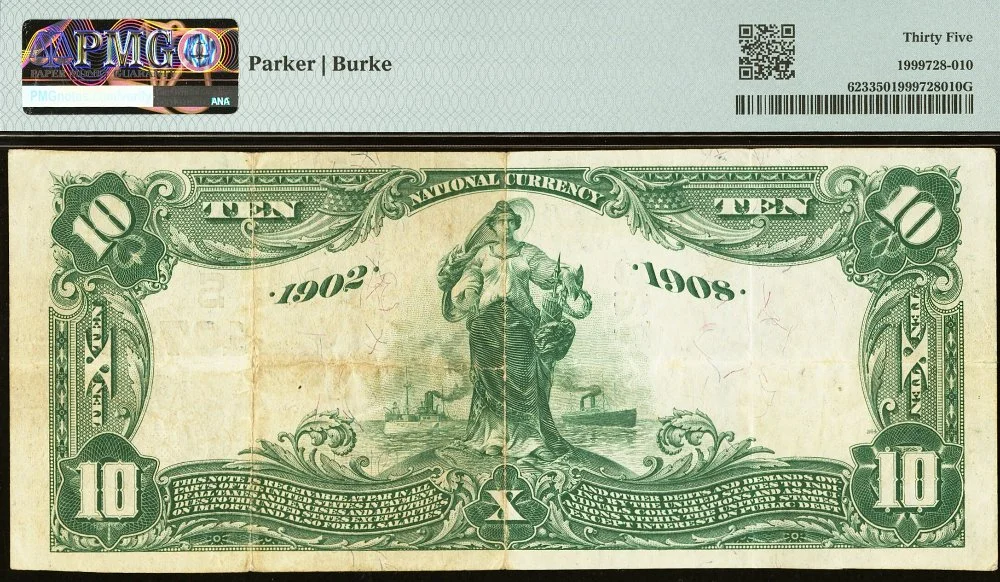 Edited by hokiefan_82
01/14/2026 7:01 pm
|
|
Valued Member
United States
160 Posts |
That Cotton Plant serial number 1 is an amazing note. Do you consider that a top 10 note for the entire state? How long have you had your eye on that one?
|
|
Pillar of the Community
United States
3735 Posts |
Thanks, CoolBreeze! I knew Cotton Plant was a very tough charter, but no note has come up for public sale for many years. So, it was on my radar, but only when this one showed up in the upcoming auctions a while back did I really decide to pursue it. With it being a s/n 1, that made it even more desirable. Excellent question on whether I consider this a top-ten note for the state. Other than the 1882 Brown Back notes, all the series prior to the 1902 notes are extremely rare - there are three Original, two 1875, three 1882DB and a single 1882VB in the census for the state. All of these notes are incredibly desirable and demand premium prices on the rare occasion they come up for sale. For small size notes, there is only one small-size $50 and one small-size $100 note for the state in the census, both of those from the FNB of Lawrence County of Walnut Ridge. In fact, that was the only charter in the state which issued those denominations, and it happens to be the town where I was born. An example of either of those would be on my top-ten list, and if they come up for sale again in my lifetime I'll be chasing them. There are several banks with only a single known example or no known examples - any of these that happen to turn up would attract a great deal of attention. So, with all that and even with the scarcity of this bank and with it being one of the few s/n 1 large size notes, I'd say it's probably not a top 10 note. However, I would put it in the top 20. Just my personal and biased opinion, however!  |
|
Moderator
United States
192764 Posts |
Outstanding!  |
|
Pillar of the Community
United States
3735 Posts |
|
|
Pillar of the Community
United States
3735 Posts |
Member of SPMC, FCCB, ANA and ANS. My U.S. Classic Commemorative Complete Set: https://www.NGCcoin.com/registry/co...sets/278741/ |
|
Moderator
United States
102537 Posts |
outstanding notes Hoki! |
|
Valued Member
United States
160 Posts |
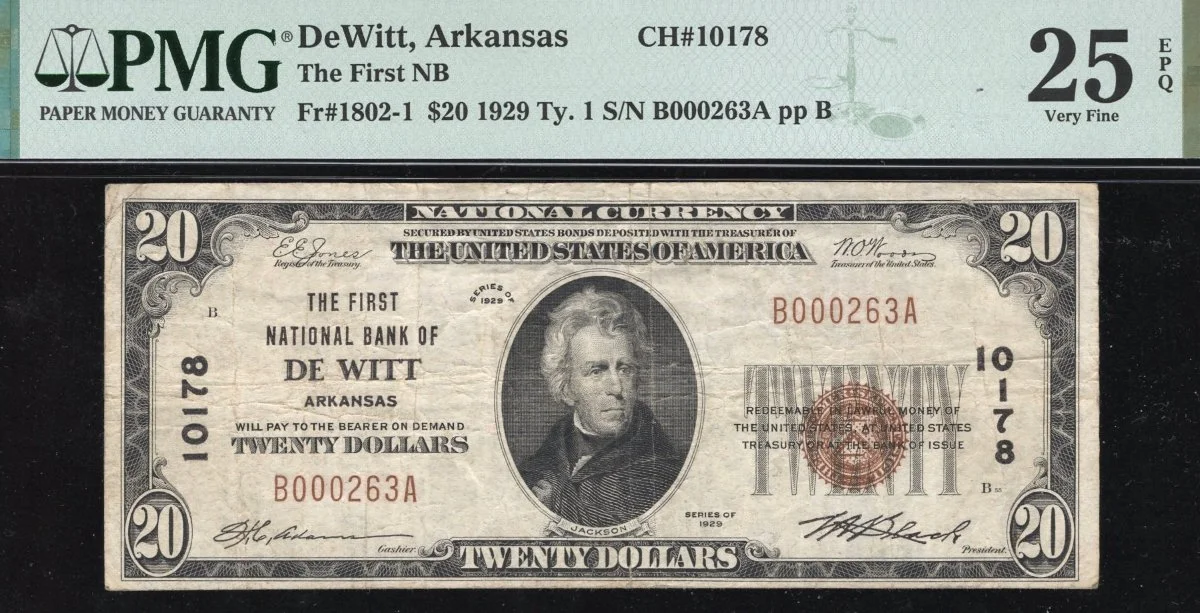
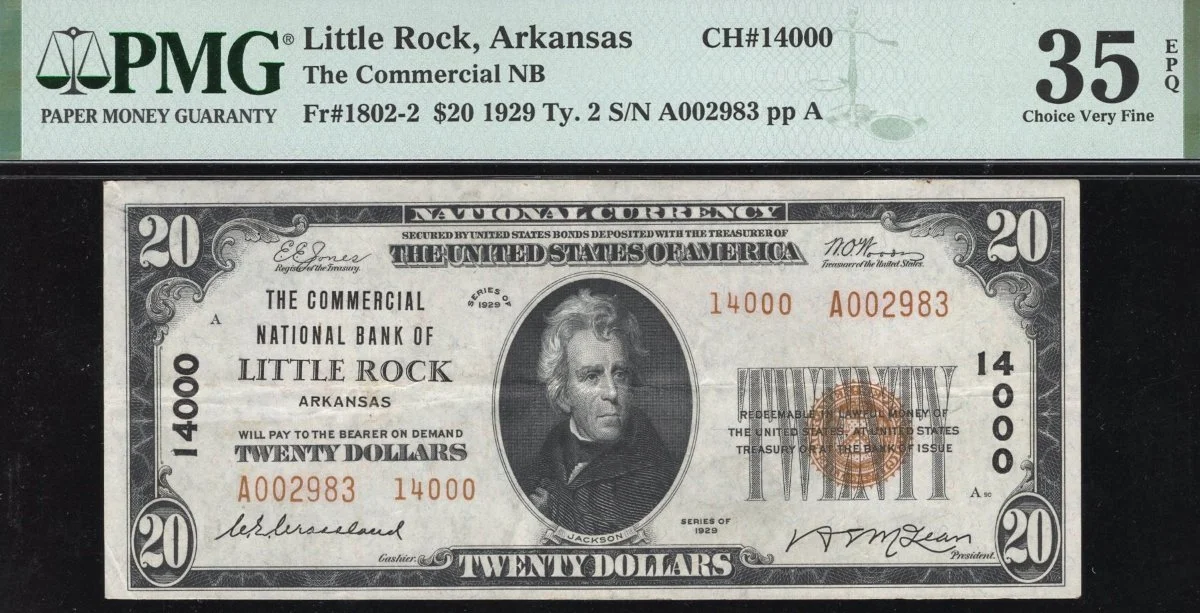
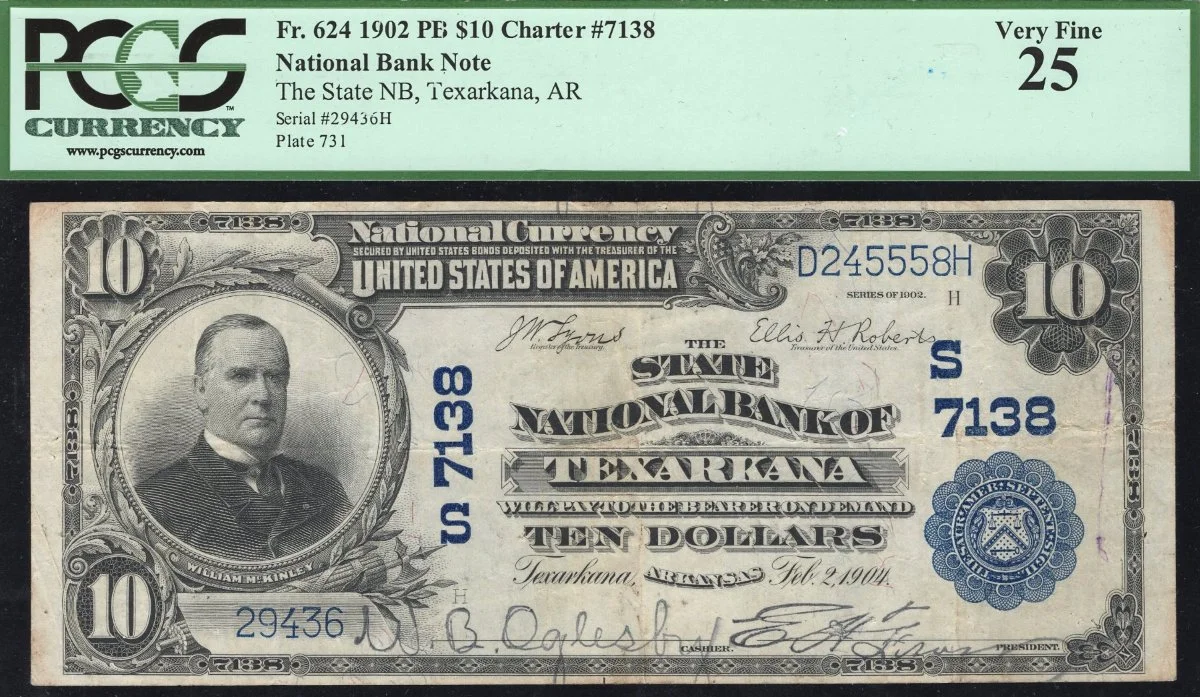
You have a large size DeWitt Arkansas national? Don't see that one much. Normally when I see a DeWitt national, I'm expecting it to be on Iowa. Nice trio of notes you've added. Two with the Q.
|
|
Pillar of the Community
United States
5029 Posts |
More excellent notes Hokie!
Your Cotton Plant note is fantastic.
Edited by scopru
01/17/2026 07:51 am
|
|
Pillar of the Community
United States
3735 Posts |
Thank you very much Dearborn, CoolBreeze and scopru!
@CoolBreeze - yes, I do have a large size DeWitt note (it's on page 8 of this topic). It's a $10 1902DB, and is one of only two 1902 Date Back notes in the NBN Census for this charter.
Both of those PQ notes I just shared were purchased raw by the dealer friend I got them from. He has a good eye for quality notes.
Member of SPMC, FCCB, ANA and ANS. My U.S. Classic Commemorative Complete Set: https://www.NGCcoin.com/registry/co...sets/278741/ |
|
Moderator
United States
192764 Posts |
Nice examples! |
|
Pillar of the Community
United States
3735 Posts |
Thank you, jbuck!
Member of SPMC, FCCB, ANA and ANS. My U.S. Classic Commemorative Complete Set: https://www.NGCcoin.com/registry/co...sets/278741/ |
|
Pillar of the Community
United States
3735 Posts |
I picked up a few more Arkansas obsolete notes on Heritage last night. I missed out on a few tough Bank of the State of Arkansas notes, but as my budget is still recovering from that Cotton Plant note I decided to pass on them... The first is a $2.50 note from Holcomb & Barnard, operators of a drug store in Fayetteville, Arkansas. I already have a $1 note from this issuer, but of a different slightly later design. This note was issued on January 17, 1862, just ten days earlier than my other note. As with my other note, this one is signed by Holcomb on the face and endorsed by Barnard on the back. Holcomb & Barnard issued a large variety of note designs and denominations; this note is listed in Rothert with catalog number 198-12. 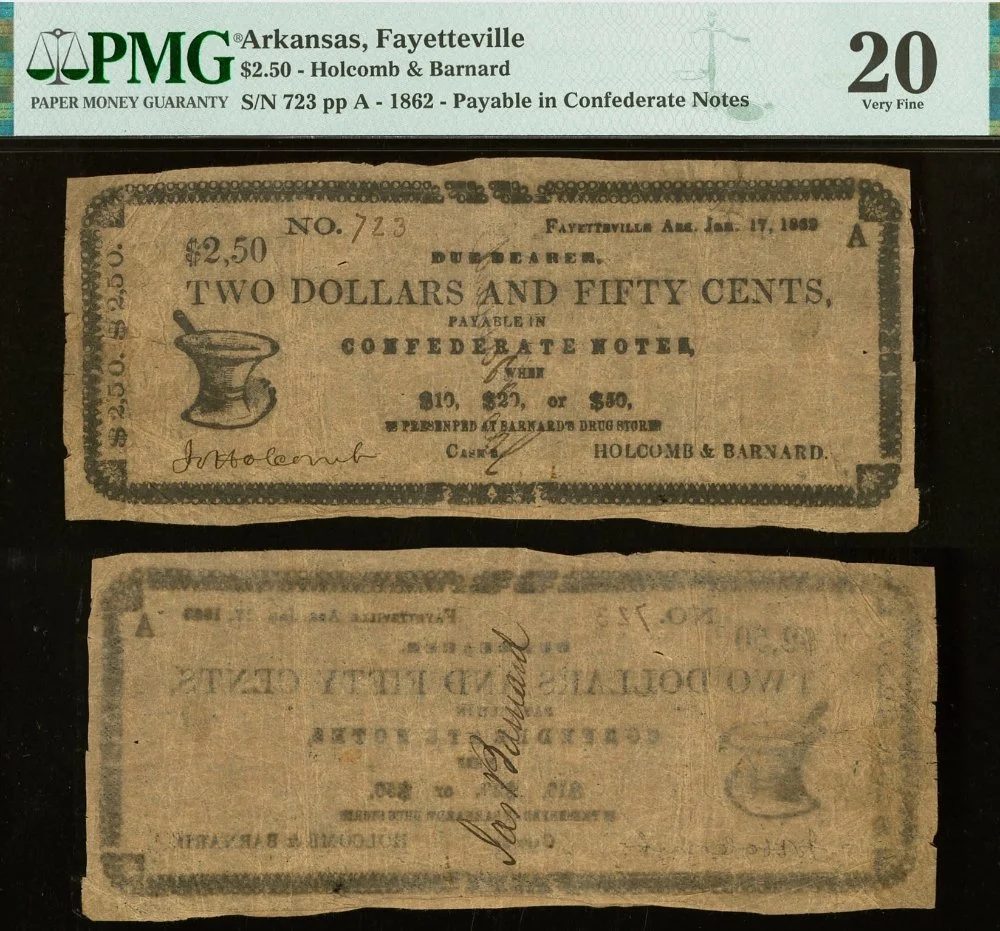 The next note was issued by D.W. Fellows in Camden on March 28, 1862. Dan Fellows came to Camden in 1848 and started a general store around 1860. He became a fairly prominent businessman and lawyer, and served as the county treasurer from 1864 to 1866. While PCGS attributed this note as Rothert 95-2, that is incorrect and it's actually unlisted. While this note is very similar to 95-2, and even has the same date, it has a large green "Twenty-Five Cents" overprint; 95-2 has a much smaller "Twenty-Five Cents" printed above the "Redeemable" clause. 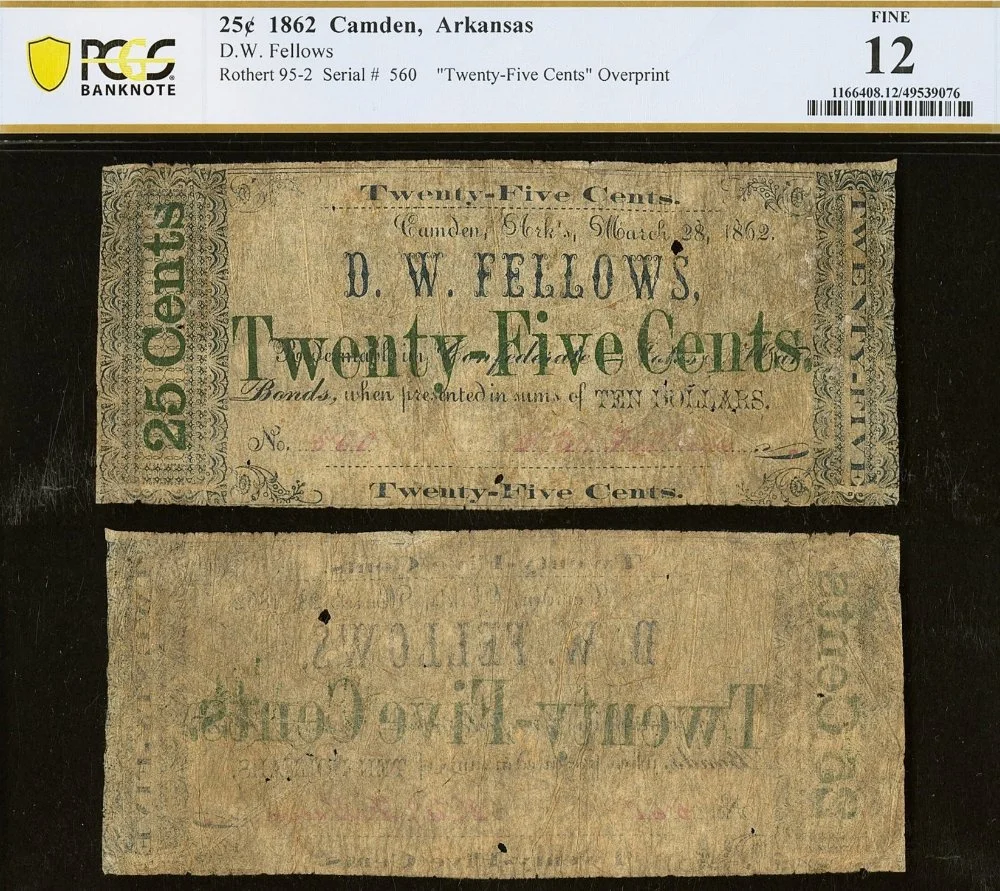 This next note I found interesting for several reasons. It was issued by the Fort Smith Exchange in Fort Smith, Arkansas, which was established by M. Mayers & Bro. in March of 1862. At the time banks were outlawed so Exchange Companies were organized as a substitute. They carried out duties and services similar to a bank. While I have an earlier merchant note from M. Mayers & Bro., this if my first from any exchange company. I found the blue colored paper quite unusual. This note is Rothert 235-1. It's not illustrated in Rothert, but he describes this as similar to the 75c note from the same issuer. That illustrated 75c note had an additional vignette of an Indian princess to the left of the soldier on horseback, and Heritage speculates that that portion of the note was removed at some point. There is no mention of in on the PMG holder, though. 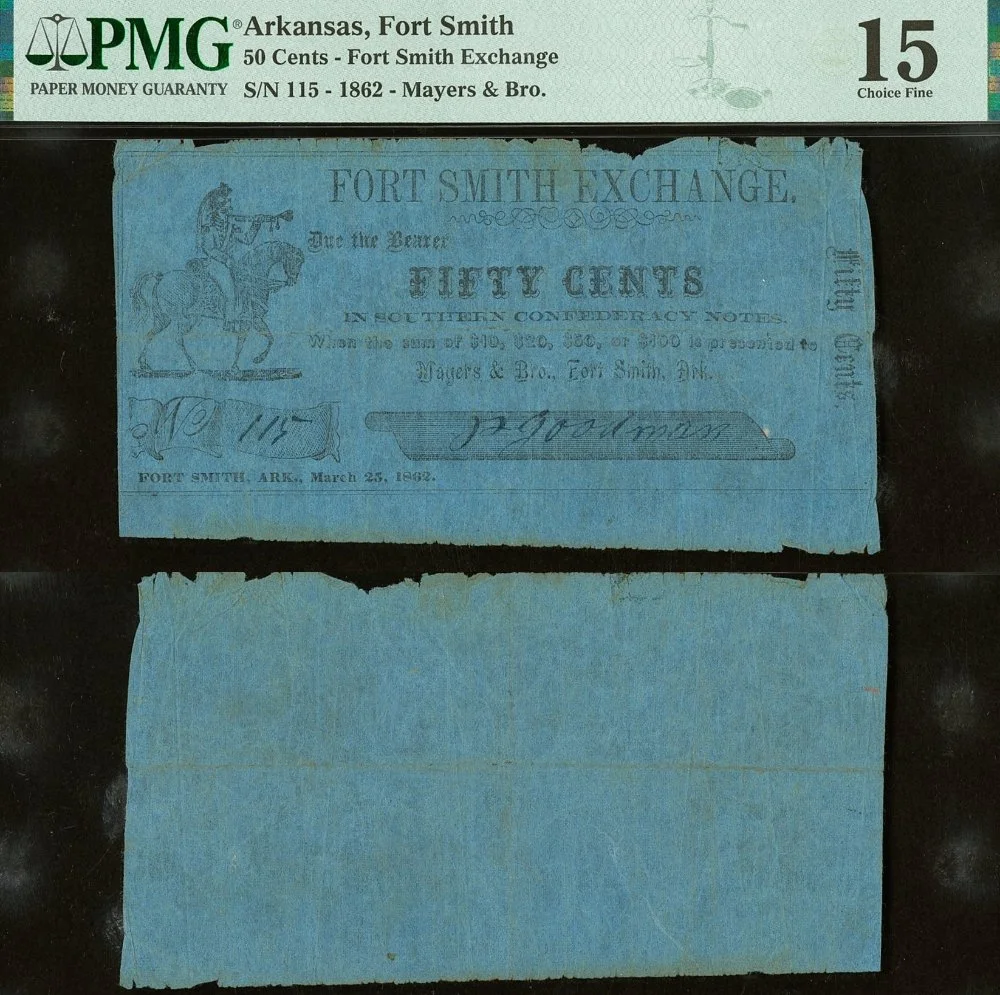 The last note I found quite fascinating, as well as being an interesting design. F.A. Peterson was listed in the 1869 Federal census as being a merchant and slaveowner in Champagnolle, Arkansas, a river port town on the Ouachita River in southern Arkansas. He also had an office in New Orleans, where this note was issued. This note was issued on April 21, 1862, just a week before New Orleans was captured by Union forces, and was payable in Champagnolle. Champagnolle was an important early-1800's port town and peaked in the 1850's. The Civil War had a devastating effect on the town, but afterwards it slowly began recovering. As was the story of so many river port towns, it was bypassed by the railroads in the early 1890's and within a few years all the businesses closed and nothing remained of the town but a few houses in the area. I like the blue and red print colors and Peterson's elaborate signature. I thought it interesting he wrote "his" over "their" in the "Will Pay at..." statement. 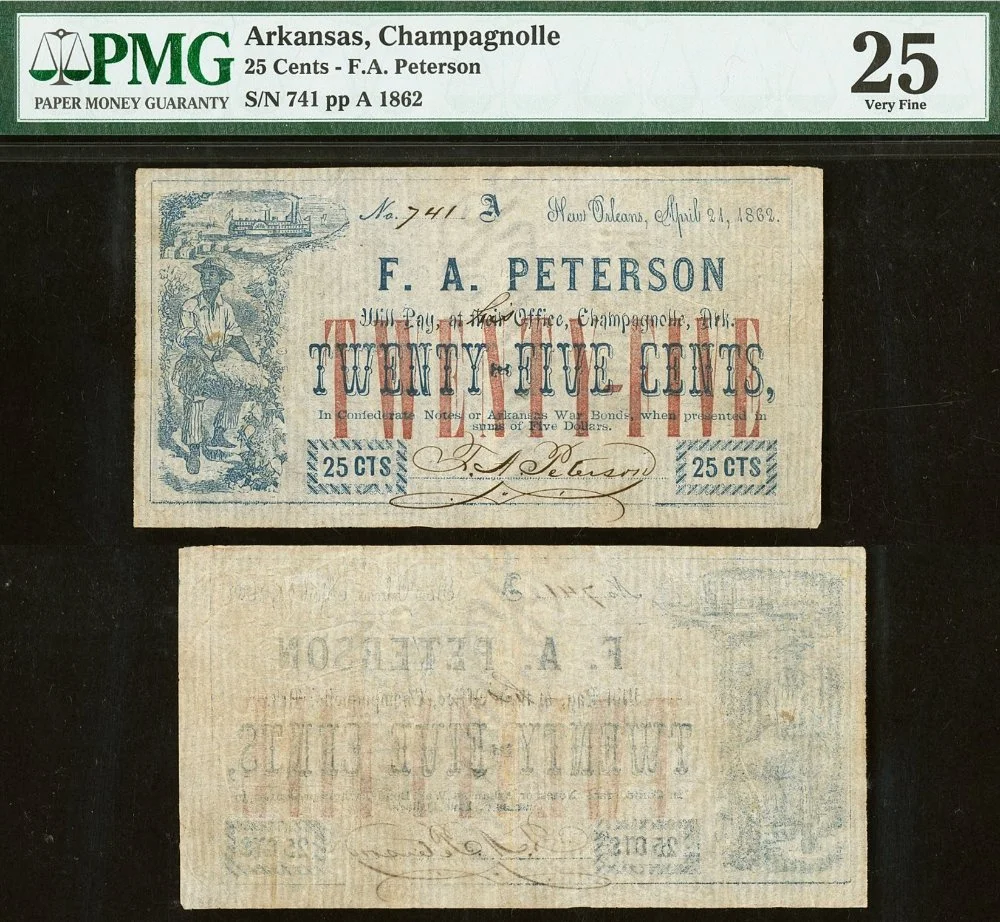 Edited by hokiefan_82
01/26/2026 3:48 pm
|
|
Moderator
United States
192764 Posts |
Nice acquisitions! |
|
Pillar of the Community
United States
3735 Posts |
|
| |
Replies: 398 / Views: 21,307 |







 First Page
 Previous Page


 Posted 01/14/2026 11:11 pm