| Author |
 Replies: 803 / Views: 42,150 Replies: 803 / Views: 42,150 |
|
|
|
Bedrock of the Community
United States
76465 Posts |
Nice additions.  Errers and Varietys.
|
|
Moderator
 United States
101349 Posts |
|
|
Pillar of the Community
United Kingdom
2913 Posts |
Today I can add this coin. It's not pretty - on that I think we can all agree - but hopefully it is interesting. It is a Clement VIII 1595 1 Douzain (at least the date is quite clear) from (probably) the Avignon mint. The reverse shows a scalloped cross, cantoned at 1 and 4 quadrants with Jerusalem cross and at 2 and 3 with a rampant lion. The Numista example shows a lot more detail - https://en.numista.com/catalogue/pieces58767.html However the interesting (to me) thing is the countermark of a fleur-de-lis within oval. I'm not familiar enough with what was going on here at the time to know what this represents. 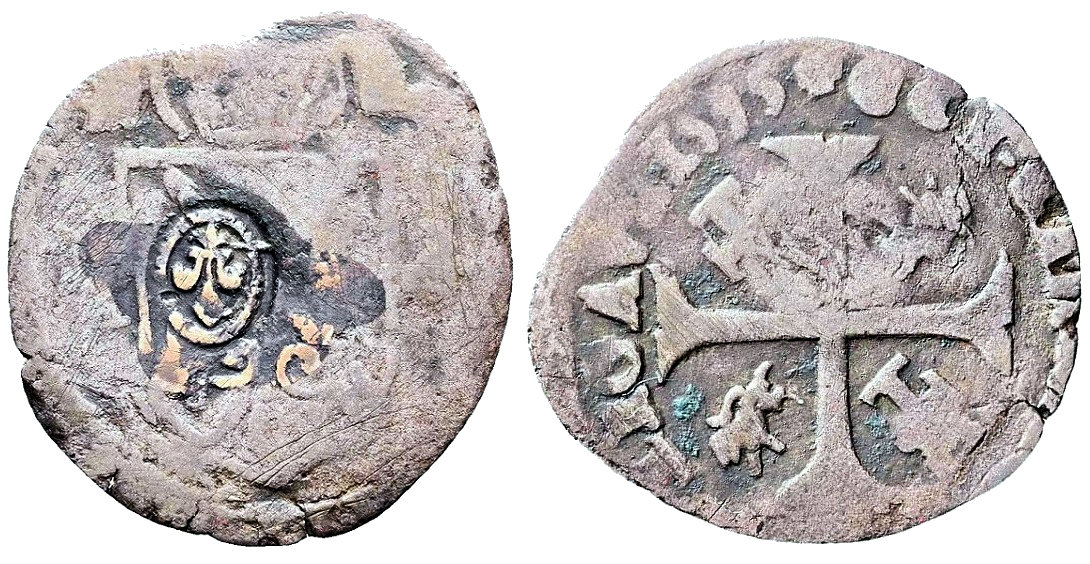 |
|
Moderator
United States
192106 Posts |
Very interesting! |
|
Bedrock of the Community
United States
76465 Posts |
Very nice addition, Bacchus2! Errers and Varietys.
|
|
Moderator
United States
101349 Posts |
indeed, that is an interesting coin. |
|
Pillar of the Community
  United States
7992 Posts |
That is really a great coin! First, some political background ... Near the beginning of the thread there is a map of the (Italian) Papal States, but I neglected to mention that the pope also held territory in the south of France from around 1300 (which was added to in the 1340s) called the Comtat Venaissin. When Philip IV of France was able to engineer putting a Frenchman in the papacy (Clement V in 1305), the papal residence was moved from Rome to Avignon for most of the 14th century (1309-1377) before moving back to Rome. But the popes continued to hold the enclave of the Comtat Venaissin, which was eventually surrounded by the Kingdom of France. And coins continued to be struck there under papal authority until this territory was "repatriated" by French Revolutionaries in 1791. I don't have any reference books for this part of France, but was able to find this auction listing for a countermarked coin like yours: https://www.acsearch.info/search.html?id=8803339Based on the description, it looks like this papal douzain was valued as a French quinzain by the reign of Louis XIII, so my guess is that the countermark is the mark that signifies this coin would be accepted as legal tender when it circulated in France? |
|
Pillar of the Community
United Kingdom
2913 Posts |
Oh wow. Thanks very much for all that extra info. I had reasoned that the countermark was to dignify something French (it's a very French type symbol) but wasn't sure of exactly what "issuing authority" was being superimposed.
The coin is dated 1595, and the acsearch reference seems to suggest that the countermarking authority was Louis XIII (1610-1643). As the coin is really worn that suggests it circulated for quite some time before being countermarked (that part is really quite fresh in comparison) so perhaps that means it was countermarked at the latter part of Louis XIII's reign (or even after that) just to give enough time to actually wear the coin down. The acsearch example seems to show a coin where the wear of the coin and the countermark is much more even.
|
|
Pillar of the Community
Russian Federation
5186 Posts |
It looks like the counterstamping happened in (or shortly after) 1640, which is, indeed, "at the latter part of Louis XIII's reign". TL/DR: an edict in 1640 revaluated the old douzains to 15 deniers (quinzain), and the coins were counterstamped to represent the revaluation. It appears that most of the counterstamped coins were 16th century French ones, but there were enough "feudal" (including papal) examples for those to also be relatively common. They can get even more worn than this. There's actually an entry on Numista, which repeats some of the same details: https://en.numista.com/catalogue/pieces37353.html |
|
Pillar of the Community
United States
7992 Posts |
Last call for any additional coins from reigns up to and including Clement VIII (1592-1605). Thanks to Bacchus2 we had a really nice selection last week!
Later today let's move on to this interesting group: three "short-timers" (cumulative reigns of just 13 months!):
Innocent IX (1591)
Gregory XIV (1590-1591)
Urban VII (1590)
... followed by
Sixtus V (1585-1590)
Gregory XIII (1572-1585)
Pius V (1566-1572)
If we start to see fewer contributions this century, we will advance to the next group or popes before next weekend.
|
|
Pillar of the Community
United Kingdom
2913 Posts |
I have nothing else to add unfortunately until it's the turn of Sixtus V. But looking forward to seeing something from those short-lived rulers.
|
|
Pillar of the Community
United States
7992 Posts |
Likewise, I have nothing from the first three ...
Innocent IX reigned only 62 days, and struck very few coins. CNI Vol. XVI (p. 116) says none were struck in Rome, CNI Vol. X says only a 2 scudo coin was struck in Bologna.
A few types were struck in the 2-week sede vacante of 1591: a Bologna quattrino, a testone and scudo in Rome.
More types were struck during Gregory XIV's longer (10 month) reign, at four mints: Rome, Bologna, Fano and Macerata
And somewhat shockingly, three types were struck in Bologna during the 12-day reign of Urban VII !.
I think it's a testament to the effectiveness of the papal money-making "machinery" that coins of so many different reigns and in so many mints were struck in such a short time.
Since I doubt we will see any of these, please go ahead with your Sixtus coin(s) whenever you like (I have coins from the next two).
Edited by tdziemia
04/13/2025 3:15 pm
|
|
Pillar of the Community
United Kingdom
2913 Posts |
Quote:
I think it's a testament to the effectiveness of the papal money-making "machinery" that coins of so many different reigns and in so many mints were struck in such a short time. I've thought exactly the same thing. Even the variety of types struck seem to change annually and by city mint. Not in the same league as German Notgeld variety of course but almost trending in that direction. This is my Sixtus V coin. It is a ND (1585-1590) 1 Baiocco from the Montalto delle Marche mint. The reverse shows the Holy Spirit in the form of a dove, flying upwards, radiant. Like many of my coins from the Papal States it's very dark and tricky to photograph. Again I don't think it's on Numista. . 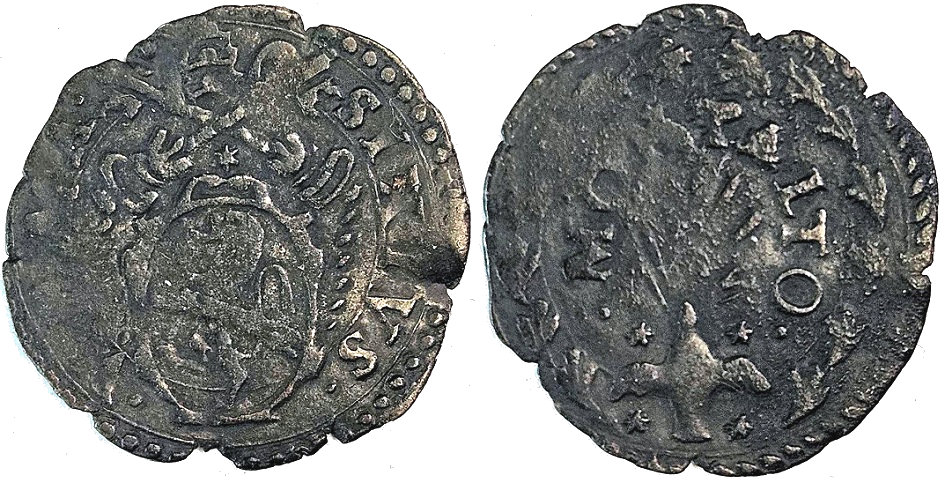 *** Edited by Staff to add Quote tags. [quote][/quote] Please use them in the future. *** Edited by Staff to add Quote tags. [quote][/quote] Please use them in the future.  *** ***Edited by Bacchus2
04/14/2025 03:07 am
|
|
Moderator
United States
101349 Posts |
Very nice add, Bacc |
|
Pillar of the Community
United States
7992 Posts |
Super coin! I don't have anything struck at Montalto, and possibly never will. That part of Italy (the region of Marche) stands out by having an enormous number of mints, even by Italian standards (OK ... I probably should have done more research before making that claim, but I don't think anyone is going to check  ) Since I don't think many Americans are familiar with this part of Italy ... Marche is a region on the Adriatic (east) coast of Italy, just east/southeast of Tuscany. It's only 3600 square miles; that's two thirds the size of Connecticut, or about the size of Devon + Cornwall. In the 15th-16th centuries, these cities/towns had active mints striking Papal coins for some period of time: Ancona Ascoli Camerino Fabriano Fano Fermo Macerata Montalto Pesaro Recanati I was able to squeeze most of them on this map of the region (leaving some reference points for Tuscany and Umbria, with which most collectors are more familiar) 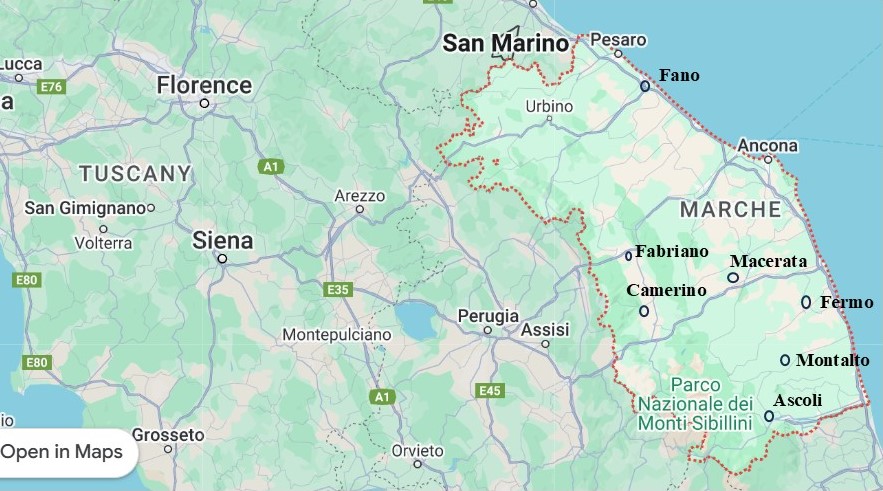 Edited by tdziemia
04/14/2025 09:10 am
|
| |
Replies: 803 / Views: 42,150 |








 First Page
 Previous Page


 Posted 04/10/2025 3:56 pm


 Uncirculated American Silver Eagles


