|
This page may contain links that result in small commissions to keep this free site up and running.

Welcome Guest! Registering and/or logging in will remove the anchor (bottom) ads and the security checks. It's Free!
To participate in the forum you must log in or register. | Author |
 Replies: 26 / Views: 12,743 Replies: 26 / Views: 12,743 |
|
|
|
Moderator
 Australia
17000 Posts |
OK, to sum up (largely copied from Biokemist's post):
1) Souvenir church pilgrimage token, probably somewhat modern
2) Keytag from a Masonic Lodge member
3) Masonic initiation medallion
4) Masonic penny, uninscribed
5) Temperance Movement abstinence pledge token, probably from 1800s
6) Celluloid Starch discount token - Nhv23
7) This is the only one no-one else has commented on yet. "Kishmet" (normally spelled "kismet") means "fate" or "destiny" in Turkish; the star-and-crescent and the stylized Ottoman-style toughra on the other side all indicate something Turkish. It might be an advertising token for a Turkish restaurant, or a Turkish good luck charm.
8) So-Called Dollar, HK-289(brass) official medal for the Pan American Expo held in Buffalo, NY in 1901
9) Met Life advertising token from 1939 New York World's Fair
10) Coin: Egypt 10 qirsh AH 1293 Year 30, = 1904 AD. KM# 295
11) WWI era Treasury employee award for Liberty Loans(war bonds), unassigned
12) Same as #11 above, but awarded to an employee
13) Massachusetts Tercentenary medallion, probably privately minted, 1652 Pine Tree shilling tribute on reverse
14) Another Temperance Movement token
15) Hard Times token with Andrew Jackson - HT69, R1 (common), issued 1837
16) A barber shop trade token from St Louis
17) A brass copy of an Ottoman gold coin
18) Hard Times Token from Attleboro, Mass. Rulau HT #152 (aka Low 75). Rarity level R2
19) Civil War Token (Store Card) -- NY 890B-9b. Rarity level R1.
20) Civil War Token (Patriotic type) feauring USS Monitor. Fuld 239/422a, rarity level R2.
21) "Evasive" trade token struck for Canadian provinces, 1825-1835.
Since most of the items are tokens and medals, I'm moving the whole thread to the Exonumia forum. Russia1981, next time could you please post separate threads for each coin? it makes it easier to tell which coins have been identified and which haven't.
Don't say "infinitely" when you mean "very"; otherwise, you'll have no word left when you want to talk about something really infinite. - C. S. Lewis
|
|
Valued Member
 United States
150 Posts |
|
|
Pillar of the Community
Canada
598 Posts |
Quote:
17) A brass copy of an Ottoman gold coin
Could someone give me any details on how this coin/token is determined to be brass... from a picture?  I'm aware Ottoman gold coins were often holed. I have handled a few that were tested(you know... rubbed on a slate and the trail acid tested: eg. scratch and burn). But I've never acquired any ability to read them. And the comparisons using text/coin books I find tedious, so I'm asking what gives this away as a brass token?  >>> edit/ pix. VVV 1 CEDID TURKEY GOLD MAHMUDIYE 1839? Any other info would also be appreciated... like that I didn't get ripped off!  Hole to the top?... ah, watdoino Hole to the top?... ah, watdoino  Edited by IBGolden
09/13/2009 12:57 am
|
|
Pillar of the Community
United States
645 Posts |
IBGolden, Compare yours to this one, it doesn't look good to me, but I'm no expert. http://www.coinarchives.com/w/lotvi...511&Lot=1110Pictures aren't real clear, but I read the date as AH1223/25-AD1831, a date that Krause doesn't list. #17...Anything is possible, but it's unlikely that a fake of such poor quality would be made out of gold. Fantasy/Jewelry copies of ottoman coins are very common, usually done in brass, so assuming a bad fake is brass is usually a safe bet. |
|
Moderator
Australia
17000 Posts |
#17 is "fake" because it's dated 1222 Year 78; the "1222" is supposed to be 1223 (the script on the coin is just generally not written very well). AH 1223 was AD 1808, and the sultan that came to the throne in that year was Mahmud II. He only reigned until 1839, 31 years, so a coin claiming to be from his 78th year of reign is obviously fake.
I assume it's brass because I see evidence of corrosion; most noticeably, green spots on the reverse rim at 12 o'clock and black spots on the toughra in the centre obverse. Gold shouldn't do that.
Don't say "infinitely" when you mean "very"; otherwise, you'll have no word left when you want to talk about something really infinite. - C. S. Lewis
|
|
Pillar of the Community
Canada
598 Posts |
Actually, the coin I pictured above was tested over 18 kt... that's the highest acid that was available at the time, the higher values were too old/aired to be usable, but it didn't cost me anything to test... so long as it was solid gold. A needle file was used through the existing hole to test, so plating (if any) wouldn't skew the test. Is the date the lowest writing on the bottom picture of the coin? It appears to match the linked to picture you provided. In other words, doing my look by look comparison method, the writing does indeed match the linked to picture... or correct any obvious errors me tired eyes looked past.  |
|
Moderator
Australia
17000 Posts |
On these coins, the layout on the reverse is very similar to this Egyptian coin I made an explanatory graphic for some time ago: 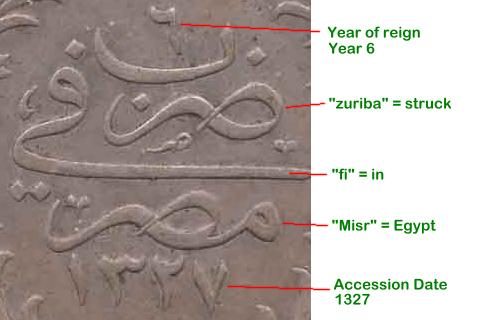 These gold coins say "Qustantiniyah" (Constantinople) rather than "Misr" (Egypt), but otherwise they're much the same, from top to bottom: regnal year, "struck", "in", the mint name, then the accession year. If IBGolden's coin is a fake, it's a much better fake than the one in the OP. If it tests good for gold, then it's probably fair dinkum. Don't say "infinitely" when you mean "very"; otherwise, you'll have no word left when you want to talk about something really infinite. - C. S. Lewis
|
|
Pillar of the Community
Canada
598 Posts |
>>> Something happened to my/CCF's connection last night, and I kinda didn't get a chance to, well... Sap, your extensive knowledge has not fallen on deaf ears. I typically do not collect such items. I am aware of the belly dancer type "coins". I bought this coin from a high rated feedback seller who's history is in such coins... other bidders were checked as being frequent bidders on such items. I basically relied on their history as "proof(?)" the coin was real... a bad idea I know, but I like to get some variety in my collection and damaged or holed examples are an economical part, but a small part of my collection. I prefer marked as to content coins... esp. liking South America or that ilk. If in doubt, esp. with scrap, I like to get it tested. I can get the odd test done free but without the assay certificate, but that's fine with me just having that knowledge. I am also aware that a heavily plated coin might fool the test, so an "inner" sample is required. And this testing is not really a good way to go on a pristine piece. Hence, that's why I usually shy away from what I don't know that well... but sometimes an area type piece is nice to have. I do have a book to translate this type of coinage script but it is poorly organized (it seems to me) and it's something that although interesting, I have had little call for and I'd rather not do. That's why the "blink" comparison with the real deal is my best technique, but even then subtle changes in a formed letter I might not perceive, and this subtlty may (as you've pointed out) make a huge difference. I 'spose I was looking for too simplistic an answer on identifying these fakes. Like the bear/armadillo/? on California fractional gold, pretty much indicates a modern token. On closer inspection I 'spose the green marks wouldn't be a good thing. I appreciate your opinion on my coin(which I don't have immediately handy for better pictures), and the info you've provided. It is easier to refer back here if need be, than seeking out this info again. Thank You! I will find a "fair dinkum" picture and post it here VVV. VVV Bilby!... One of the Little Dinkums VVV  So Sap, you then agree the coin I posted a picture of is indeed a "1 CEDID TURKEY GOLD MAHMUDIYE 1839" from the appearance of the pictures only?... in other words the pictures reflect that identification(or a very good copy of such)? Edited by IBGolden
09/17/2009 10:01 pm
|
|
Moderator
Australia
17000 Posts |
I can't quite read the regnal date on your coin - If I had to guess which of the possible options listed in the catalogue (26 to 32), I'd guess 28. Year 28 would equate to AH 1250, or AD 1834.
I also can't tell just from the pic whether it's a 1 cedid mahmudiye or a ½ cedid mahmudiye, since they have the same design. An intact cedid mahmudiye should weigh 1.6 grams and be about 18mm diameter.
But from those pics, the design looks authentic enough to me.
Don't say "infinitely" when you mean "very"; otherwise, you'll have no word left when you want to talk about something really infinite. - C. S. Lewis
|
|
Pillar of the Community
Canada
598 Posts |
1.58 grams/18 mm is listed on my specs for it... sorry, didn't think of mentioning the weight etc because I somewhat hijacked this thread. I 'spose the authenticity was more of a concern, but it's nice to have the correct date/classification/etc of any piece. I will correct it's pedigree with your once again much appreciated info.  |
|
New Member
Canada
8 Posts |
#21 is known as a Bust and Harp Token and several varieties can be found in Charlton as previously stated. There is also a publication devoted to these tokens, "The Bust and Harp Tokens of Canada" First Edition 2004, by Gregory S. Ingram & Branko Marelic. Some are quite scarce.
|
| |
Replies: 26 / Views: 12,743 |
To participate in the forum you must log in or register.
Disclaimer: While a tremendous amount of effort goes into ensuring the accuracy of the information contained in this site, Coin Community assumes no liability for errors. Copyright 2005 - 2026 Coin Community Family- all rights reserved worldwide. Use of any images or content on this website without prior written permission of Coin Community or the original lender is strictly prohibited.
Contact Us | Advertise Here | Privacy Policy / Terms of Use
|
| Coin Community Forum |
© 2005 - 2026 Coin Community Forums |
| It took 0.33 seconds to rattle this change. |
 |
|
| |
| |







 First Page


 Posted 09/04/2009 5:04 pm


