| Author |
 Replies: 1,992 / Views: 287,884 Replies: 1,992 / Views: 287,884 |
|
|
|
Pillar of the Community
Canada
1610 Posts |
No, I would love to, but Québec isn't really the place to get medieval coins... unless you go to Montreal, but there you would get really screwed. I have never found a good deal in that place. I'm probably going to Europe this summer, there will surely be opportunities to get some European coins in..umm...Europe.
|
|
Pillar of the Community
United States
2764 Posts |
Thank you everyone for sharing their coins. I have none at this stage.
I am just curious, how did the lion come on to the coin; I mean lion is not a predominant animal in Europe, more of an exotic animal right?
|
|
Moderator
 Australia
16996 Posts |
My turn again. 1669 - from the Silesian duchy of Liegnitz-Brieg, 3 kreuzer. 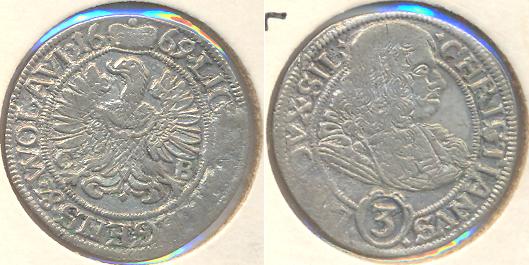 Quote:
SA4H said:
I am just curious, how did the lion come on to the coin; I mean lion is not a predominant animal in Europe, more of an exotic animal right? Lions have featured on coins since ancient times - the very first coins, from Lydia, feature a lion's head, and there aren't any lions in western Turkey either. The lion is symbolic of power, strength and courage in battle, and Bible generally speaks favourably of lions, especially in comparison with the biblical kings. Lions therefore are common heraldic animals. Lions have featured on the coats of arms of the English kings since the Norman Conquest. Quote:
biggfredd said:
That particular "V" is called a stonecutter's "U", because it's easier to carve straight lines than curved. Rarely seen on coins, but often on buildings, memorials and sometimes tombstones. It might be called that in English, a language with two separate letters U and V, but the language on this coin, as on most European coins of this period, is Latin. In Latin, the letter "V" has the same functions as both the letters V and U; it's pronounced as either a consonant or a vowel, depending on the context. When Latin is written today, "U" is substituted for "V" when a vowel sound is intended (for example, the name "Vespasianus", but the ancient Romans did not have this concept. The "round" or "Lombardic" U was not used for Latin until the 1300s. Coins usually have either "Latin V" or "Lombardic U", depending on the artist's preference, but almost never both. Don't say "infinitely" when you mean "very"; otherwise, you'll have no word left when you want to talk about something really infinite. - C. S. Lewis
|
|
Pillar of the Community
United States
3345 Posts |
Well I havent been to this thread in a while and you guys seemed to be in sort of a lull for awhile back there. Looks like the coins are coming fast again! Nice coins!  Someday I'm gonna assemble a set with a coin from every year as far back as I can go-but with a date on it. How far do you think I could get? |
|
Pillar of the Community
Norway
510 Posts |
Quote:
Someday I'm gonna assemble a set with a coin from every year as far back as I can go-but with a date on it. How far do you think I could get?
rachums107, that depends how picky you are. If you want different types of coins for every year it will become difficult much sooner than if you settle for, say, Dutch duits and Hungarian denars every chance you get. As for 1668, this is a 1/84 gulden from Deutcher Orden, or Teutonic Order as they are known in English. This coin actually does not appear in Krause. At least not in the 3rd edition. It is a part of my unusual denomination-collection. The grade is not especially high, but a fun coin nonetheless. 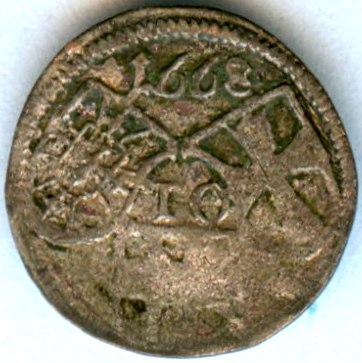 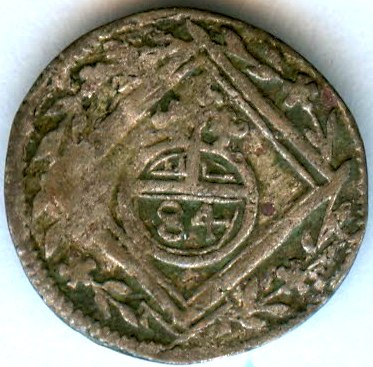 |
|
Pillar of the Community
 United States
1908 Posts |
Quote:
"Someday I'm gonna assemble a set with a coin from every year as far back as I can go-but with a date on it. How far do you think I could get?" I have been working on exactly this same project
since getting back into coin collecting a year ago after a 40+ year hiatus. I prefer attractive, undamaged coins, with as much variety as possible, dated in a prominent manner that any English schoolchild could read- none of the obscure, hard-to-decipher alphabets or dating-by-ruler type of thing. The oldest I have seen that fits these personal parameters is from the mid-15th century. I'm hoping this thread will eventually show me exactly what I am seeking. I'm working on creating my own Dansco-style albums for housing and display of these treasures. So far it has been a fun but expensive project. I do not have a single century, or even a single decade, completed at this point. Good luck, rachums107; the longer you wait to start this, the more expensive it is going to become, as I have learned. |
|
Pillar of the Community
United States
2703 Posts |
|
|
Bedrock of the Community
United States
10045 Posts |
Litotes...1/84 Guilden? That is an interesting one! The bankers and moneychangers must of had complicated book-keeping. Here is my only 1667: from Sweden, a 1/6 Ã-r  Quote:
Lions have featured on coins since ancient times - the very first coins, from Lydia, feature a lion's head, and there aren't any lions in western Turkey either. On the subject of lions, they were once widespread in Asia Minor, the Near East, and even Greece/Macedonia. They were rapidly hunted to extinction, as a form of sport. Even the Romans imported lions for their coloseum games, which no doubt hastened their demise across the eastern Mediterranean. That may partly explain the enduring imagery of lions in post-Roman Europe. Edited by DVCollector
11/17/2011 10:15 pm
|
|
Pillar of the Community
Norway
510 Posts |
Quote:
1/84 Guilden? That is an interesting one! The bankers and moneychangers must of had complicated book-keeping.
DVCollector, finding a lot of unusual denominations in the past I have wondered the same. I guess weight was what they were checking most thouroughly. The French have a host of odd denominations like 44 sols that was never given on the coin. You just had to know it was a 44. Or a 33. Or a....whatever. |
|
Pillar of the Community
Norway
510 Posts |
1666I actually found several 1666s in my collection, but since I am - after all - a Norwegian, I chose a Norwegian coin this time. A 2 marck to be precise. A medium-size silver coin, weight about 10,7 grams. 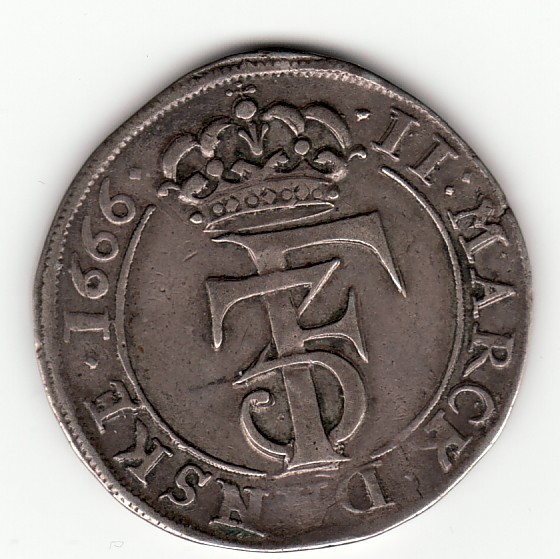 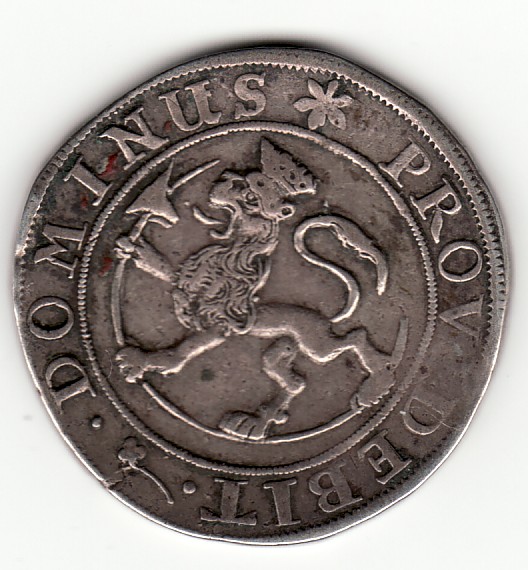
Edited by Litotes
11/18/2011 3:38 pm
|
|
Pillar of the Community
Canada
1610 Posts |
Wow, nice coin. That is one cute little kitty. (:
|
|
Pillar of the Community
United States
2764 Posts |
Make me really want to just get a few EU Medieval coins just to be "in the loop".....
|
|
Bedrock of the Community
United States
10045 Posts |
I like the lion on that 2 Marck!  Is the mintmark the symbol below the lion? |
|
Pillar of the Community
United States
2703 Posts |
Fantastic looking 2 marck, Litotes!  |
|
Pillar of the Community
United States
2703 Posts |
Quote:
Coins usually have either "Latin V" or "Lombardic U", depending on the artist's preference, but almost never both. 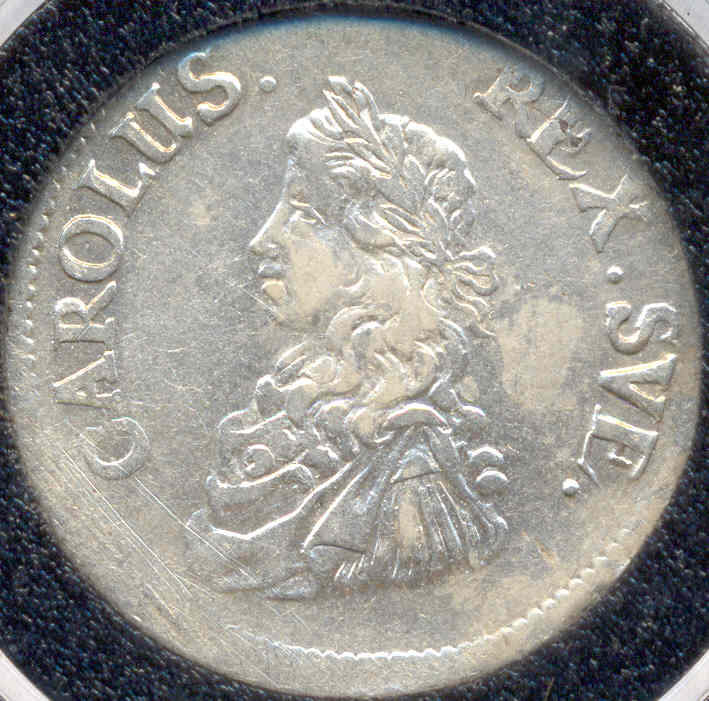 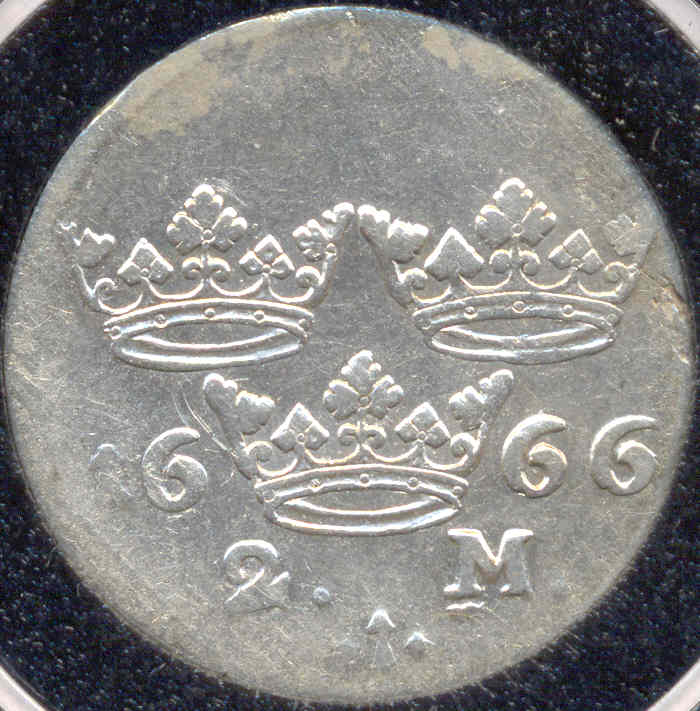 Sweden Sweden1666 2 Mark of Charles XI This seems to be an example of a mixed use of the "Latin V" and "Lombardic U" for the vowel "U." CAROLUS REX SVE[CIAE] |
| |
Replies: 1,992 / Views: 287,884 |








 First Page
 Previous Page


 Posted 11/17/2011 01:07 am