| Author |
 Replies: 17 / Views: 2,609 Replies: 17 / Views: 2,609 |
Page 2 of 2
|
|
|
|
Pillar of the Community
Australia
3841 Posts |
It might be possible that it was struck on a cent planchet. But for measurement sake, you might want to weigh it and compare it against a typical 5 cent nickel coin. Who knows if it was some sort of experiment to copper plate it.
|
|
Member
United States
3242 Posts |
quote:
Originally posted by suvoth
What would a 1970something Canadian Nickel be worth if it was struck on a penny planchet (I think that's what it's called). My mother in law saw someone and they told her it happens all the time and it isn't worth much. Is this true? P.S I would post a pic, but my digital camera sucks. I will try tomorrow...
Its Called A mule I think ? some U S coin are worth a lot and I am sure some Canadian have a extar value to. |
|
Bedrock of the Community
United States
14454 Posts |
a mule is a obverse of one coin mated up with a reverse of another, not wrong planchet errors
|
|
Valued Member
United States
383 Posts |
For comparison for a U.S. nickel struck on a cent you could expect $200.
|
|
Valued Member
 Canada
83 Posts |
Sry bout that guys, went out for the day and just got back. Gonna scan a pic right now...give me 20 mins..LOL
|
|
Valued Member
Canada
83 Posts |
Ok, here it is 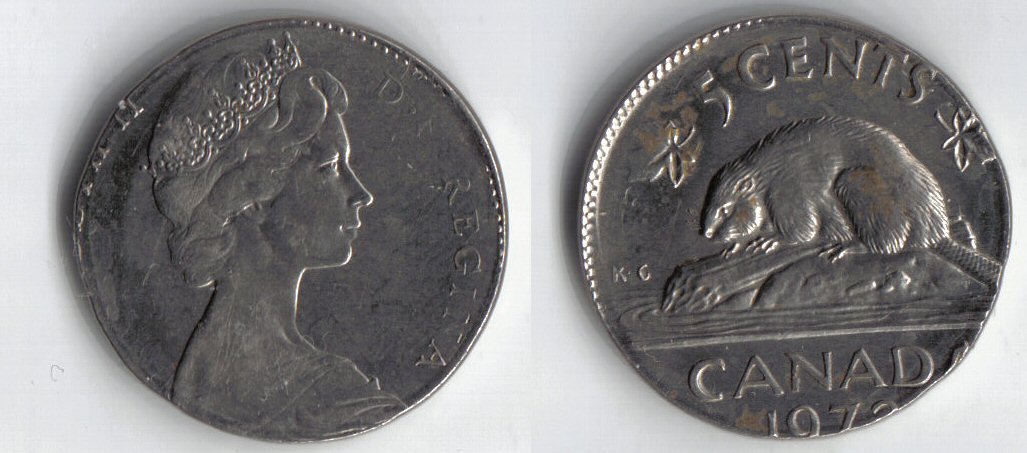 |
|
Pillar of the Community
United States
7123 Posts |
Hi suvoth
The coin looks authentic to me,, the size difference is reflected in the detail.
This coin should be sent for authentification and certification.
very nice find !!
Rick
|
|
Valued Member
Canada
83 Posts |
Thanks! Now, when you say "authentication and certification"..where exactly do I send that? LOL I'm such a newb
|
|
Valued Member
Canada
83 Posts |
Oh, also, for my own learning experience....is that "C" a double die? Is that what it would look like?
|
|
Pillar of the Community
United States
7123 Posts |
Hi suvoth I know that canada has their own grading service, but if this were my coin and I was going to submit it my choice would be anacs,, but before we get to far ahead, let some of the other folks respond,, I have only posted one mans opinion, I think its always best to get several responses there are some very sharp folks in the forum, whose opinion I respect. Rick what I see on the C looks like Mechanical Doubling in the pics,we would need specific and larger pics of the C to be sure. Edited by Metalman
07/30/2006 10:04 pm
|
|
Pillar of the Community
United States
5362 Posts |
suvoth - nice scans.
The Canadian mint uses a three die (closed coining chamber) press with a full collar. The hammer die is (I believe) set for a travel distance that matches the planchet that should be in the coining chamber. So if it was set for a 5 cent piece and a cent or dime planchet gets mixed in there should be a few standard features that show on the off planchet coin.
Some three collar presses do not control travel - you need to know for sure if the Canadian mint press(s) makinging 5 cent coins did. The limited travel would result in a weak strike such as I see here.
The smaller than normal planchet would not contain enough metal to fill the chamber if the die did not travel beyond the normal limits. The weakest point should be at the perimeter. When there is no such limitation, the die travels further and the coin strikes up well. But not right at the edge.
The design on this coin seems to extend right to the perimeter of the coin. Note in particular the date. It appears to run right to the perimeter. That could possibly point to a fraudulent coin. There is a mark on the partial A in Canada that also appears suspicious.
I would start my exam of this coin by precisely weighing it and then measuring the Specific Gravity to see if it matches the cent planchet. My concern would be that it might be a cut down 5 cent coin.
The second thing I would examine is the edge. It should show a bulge caused by the pressure of the strike. If this was a cent planchet it would most likely have been through the upsetting mill. So there should be very few traces of vertical cut lines. Raw blanks (before upsetting) would not normally get into a planchet hopper. But a hopper may have a left over cent planchet or two (from a previous run) that is normal. The upsetting process removes most of the traces of the original blanking mill.
|
|
Pillar of the Community
United States
5362 Posts |
If the edge is smooth - that is good. Does it bulge out slightly at the center or is it straight up and down? From the color of all the coins - it looks to me like a dime planchet. Remember a dime gets squashed quite a bit and gets much bigger than it originally was. I think I would send it to ANACS to be sure.
|
|
Valued Member
Canada
83 Posts |
Hmmmm I don't feel a "bulging" some areas seem thicker than others however. Something I just noticed... On one side of the coin, you can see "grooves". Faded, but they are there and worn out. Now, nickels and pennies both wouldn't have those groves right? Only the dime would I think..I always thought this might have been from a penny "planchet" I'm guessing I'm wrong if it's authentic.
|
|
Pillar of the Community
United States
5362 Posts |
The "groves" on the edge of a dime are only there AFTER the coin is struck. They are made at the same instant the planchet is struck by the dies that produce the two sides. The groves are called reeds and they are on the surface of the collar die that encloses the planchet during the strike. The collar keeps the coin round - adds the edge design and insures an exact diameter all at one time.
Therefore just because there are no REEDS on the edge does not mean it was not supposed to be a dime!
Perhaps you need to know the steps used to make a coin today. In a nut shell here goes.
1. Metal ingots are rolled to metal sheet of a thickness based on the coin being produced. It is just slightly thicker than the final product. At this point there are often lines on the metal surface running the length of the sheet caused by the rollers. They are normally obliterated totally by the later steps.
2. Then the sheet of metal goes through a Blanking machine (like a big cookie cutter) that makes BLANKS. These are just slightly smaller in diameter than the finished coin. But the weight is correct. At this stage the blank has a sharp edge with marks from the cookie cutter. These new striations are usually removed by step 3. I am leaving some steps out but it is hardly possible for a blank made in step 2 to end up being struck.
3. The Blanks are now UPSET. This machine squeezes the edge of the coin causing the very edge of the blank to get slightly THICKER. Both faces of the blank become slightly concave. The reason is so that the final coin will be well struck at the edges. If you don't upset the blank you get weak outer legends. At this point the Blank has become a PLANCHET.
4. The planchets get a bath and go to the press.
5. The strike. There are two dies one for each face of the coin. One die is usually fixed (the anvil die) and the other is mounted in the traveling portion of the press (the hammer die). The names go back to the times when coins were actually struck with hammers on an anvil, but that is another story. The third die involved in a modern coin press is the collar die. The planchet is placed on top of the anvil die by mechanical fingers. Then the collar die rises up to keep the planchet in place. The hammer die is pressed onto the planchet. The force is so great that the planchet metal extrudes into every nook and cranny of the THREE dies. When the hammer die backs off, the collar drops and the fingers remove the coin.
That is a quick explaination of the process. Errors happen when things go wrong. The value of the error is a function of how often the error happens and how closely the inspectors check for that particular error.
If anything is not clear - please ask.
|
|
Valued Member
Canada
83 Posts |
Wow, that's awesome. Thanks for the info!
|
|
Page 2 of 2
|
Replies: 17 / Views: 2,609 |
Page 2 of 2
|








 First Page

 Posted 07/30/2006 2:02 pm


