| Author |
 Replies: 13 / Views: 222 Replies: 13 / Views: 222 |
|
|
Valued Member
Canada
156 Posts |
Well, after 30 years I tried to clean my first coin. Reviewing advice and experience from members I started with a circulated coin that isn't in great condition and even if it was it's not worth much. And it had pretty cruddy surfaces. According to Numista the coin is aluminum bronze. I couldn't really tell from looking at the coin what sort of crud it might be so I thought I'd start slow and see what happened. I followed the polarity ladder by first soaking in distilled water - dry - and then a half hour soak in acetone. The picture below shows before (top) and after pictures. They almost look backwards to me. As you can see the results weren't dramatic. I've read a number of posts about others experiences. I have an idea what verdigris and PVC damage look like from others posts. Still it's not always obvious to me. This coin had a kind of blackish gunk on it. I suppose it's just having seen lots of coins with various kinds of gunk to have an idea what you might be dealing with and what might work best. It seems to me that both the coins composition and how long the gunk has been there can impact what it looks like. Is there a better approach to recognizing the gunk and choosing the best method of dealing with it? 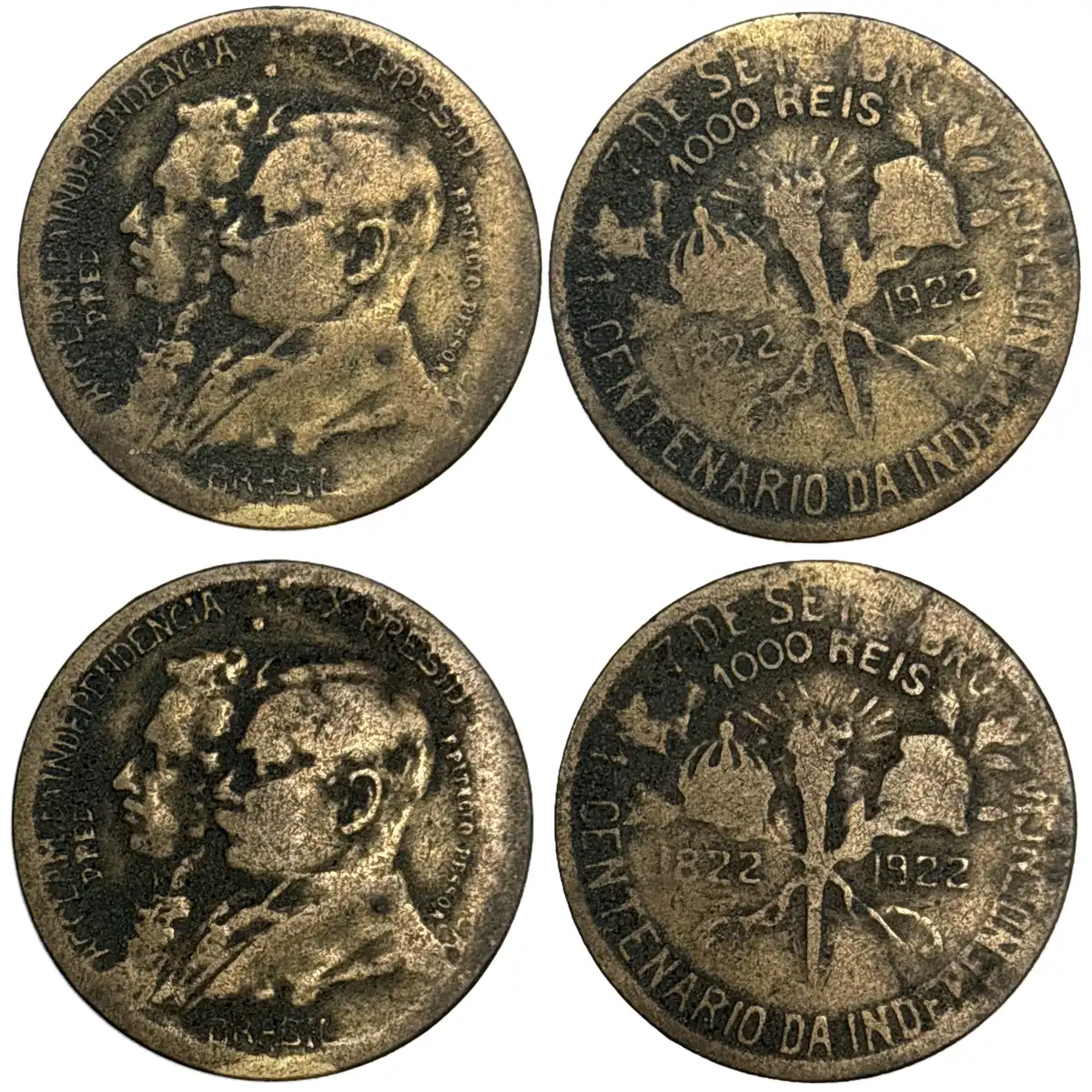 |
|
|
|
Valued Member
Italy
288 Posts |
Since you removed the thin dirt patina which was on top of both the bare medal and the gunk, the contrast between the two now looks more prominent. How long did you soak? I would leave it soaked for like a day on several runs. Keep in mind that oxidation won't be removed by either water or acetone (and that is why we like both!). You need to observe the surface under some magnification to see whats going on and the difference between soaks. Since this is an inconsequential coin, I would also advise to try soaking a qtip and work the surface very gently after a soak, just to teach yourself what happens; patting or then gently rotating the tip. This is obviously not good for coins you want to restore in mint state but it's a valuable learning experience to try to distinguish gunk vs oxidation or to give you reasonable expectations on what soaks will remove. Hope this helps  Edited by joe_77
Yesterday 02:53 am
|
|
Valued Member
 Canada
156 Posts |
Quote:
Hope this helps @joe_77 it sure does help and I appreciate your help. It's always hard for me to tell what kind of gunk I might be dealing with on the coin. I know different treatments work on different substances. This one soaked for only a half hour and I didn't figure it would get rid of it all but I was hoping for a little better results. I've got the acetone and the time so I will let it soak for a few days and see what happens. I'll try the q-tip a little but I don't want to get in the habit of using that method. Although as you said we're not talking mint state coins here. I guess just soaking is not considered cleaning but it still feels funny to be doing it. I've always tried to avoid cleaning period. The substance on this coin looks dark. I'm not sure if that has to do with the substance, some interaction with the coin's composition, or just age. Appreciate the help though and I'll keep reading and experimenting some. [One quick edit: Do folks generally soak multiple coins at once?] Edited by lahave56
Yesterday 12:05 pm
|
|
Valued Member
United States
71 Posts |
You have to attack different conservation problems from specified angles. This may be outside the realm of acetone and into the realm of naphtha. Either are acceptable but do different things. Same with MS70. Also; for cases of organic encrustations, long acetone soaks are required. You'll need a lidded glass jar (not plastic) since acetone evaporates very quickly.
|
|
Valued Member
Canada
156 Posts |
Quote:
Also; for cases of organic encrustations, long acetone soaks are required. Thanks LandonM. I've got it back in a lidded jar for a few days. Quote:
This may be outside the realm of acetone and into the realm of naphtha. Had not even considered that. That's the first I've seen it mentioned. Makes sense that different solvents may be needed though. Both naphtha and acetone are highly flammable. Haven't seen much about experience with MS70 that I recall. Need to look into it. Thanks for the help. |
|
Moderator
 Australia
16887 Posts |
If the surface of an aluminium-bronze coin has turned black and bubbly, that's almost certainly due to corrosion, rather than "gunk". So I strongly suspect that any simple solvent soak is going to be ineffective. I would presume this coin to be a "ground find", by metal detector or some other means. In terms of "the coin looks worse after a water soak", what has probably happened is that the "dirt", or corrosion, had dried out over recent decades, and has now been thoroughly re-hydrated by its water soak. I would equally suspect that if you placed it in a cool oven (80 to 100 deg C) for an hour or so, the paler colour would reappear as the crust dries back out again. Quote:
I guess just soaking is not considered cleaning but it still feels funny to be doing it. I've always tried to avoid cleaning period. As a chemist, the difference between "soaking a coin in a solvent" and "soaking a coin in something that will cause a chemical reaction" is obvious to me, but I can understand that such processes can seem very similar to the uninitiated: "coin goes into liquid, comes out of liquid maybe looking different". This is why the general advice for new collectors is always "don't clean coins". Solvents remove "foreign matter" - this is when something that is not-coin has attached itself somehow tot he surface of a coin, but has not actually reacted chemically with it - all of the metal that was part of the coin is still there, underneath the dirt. This is simply washed off by the solvent, leaving the coin unreacted and unaffected. Acids, alkalis and chelating agents remove "corrosion byproducts". In this case, a foreign substance has attached itself to the coin as before, but there has now been a chemical reaction between the substance and the coin, such that the "goo" is now a mixture of atoms originally from the coin and atoms from the goo. This is usually not removable by solvents, since it is chemically bonded with the coin's surface. The chemical reagent can attack, dissolve and remove the corrosion, but some of the original metal will be dissolved too. Such chemicals also usually attack the toning/tarnish/oxidation.patina on the coin's surface, since toning/tarnish/oxidation/patina are just fancy words for different forms of corrosion - only those forms of corrosion are wanted, because collectors think they look nice. If used carelessly, such chemical agents will remove ALL of the corrosion, including the bits of corrosion we might have wanted to keep; the result is a "stripped" coin that looks unnaturally clean. Don't say "infinitely" when you mean "very"; otherwise, you'll have no word left when you want to talk about something really infinite. - C. S. Lewis
|
|
Moderator
Australia
16887 Posts |
Quote:
One quick edit: Do folks generally soak multiple coins at once? If the coins all have "the same problem", then a simultaneous soak can be done. For example: suppose you've got an entire page of coins sitting in a PVC-laced coin album, every coin will probably need to be taken out of that page and given an acetone soak - and at least for the initial stage, they can probably be easily treated in batches. You'll still want to do the final rinse for each coin separately in fresh acetone. Coins of different metals should not be soaked together, especially in water, as you can get some odd electrochemistry happening when different metals come into contact in a solution - you might even end up making the corrosion worse, or get some kind of weird colour change happening when dissolved metal from one coin chooses to deposit itself onto another coin of a different metal. Don't say "infinitely" when you mean "very"; otherwise, you'll have no word left when you want to talk about something really infinite. - C. S. Lewis
|
|
Valued Member
Italy
288 Posts |
Awesome guidelines Sap!  I'll also add for lahave56 to remember that temperature will also increase the effectiveness of the solvent so when I do these kind of things I usually try to place the soaks near a radiator or a warm place. Conversely doing it outside in the winter will probably be not a great idea. Obviously beware of acetone which you want to keep outside, so if you place it inside the house (and in a warm place nonetheless) then make sure that the container is sealed properly. |
|
Valued Member
Canada
156 Posts |
@Sap Thank you for explaining the science behind the subject and addressing my questions in a way that is understandable for me.
The challenge for me is recognizing the likely composition of the "gunk" I'm dealing with and then choosing the most appropriate method to address it.
In my case rule #1 is don't do any more damage to the coin no matter how valuable it might be. I think for me at this point that means choosing a solvent that may work but will not do further damage and observing the so-called polarity ladder. That ladder includes distilled water, acetone and xylene (one other I forget) I think and perhaps naphtha now. Am I correct that something like Verdi-Care also falls into the group of safe and effective
(gunk dependent) treatments ? I am not sure where it falls on the polarity ladder if at all.
Further to the extent that one knows the source of the contamination that would inform the choice of effective methods and when to use them.
@joe_77 Right now I take what I intend to soak to my shed where I have a clear work area so other than a hot day I don't have a source of heat. I don't like the idea of using flammable materials inside the house although with proper precautions it may be okay for someone with experience.
Appreciate the insights!
|
|
Moderator
United States
190823 Posts |
Very interesting experiment. Thank you for sharing with us. If it matters, the cameo look is somewhat appealing to me.
|
|
Valued Member
Canada
156 Posts |
"If it matters," (can't get quote feature to work on my ipad)
@jbuck certainly does thanks for pointing that out
|
|
Moderator
United States
190823 Posts |
Quote:
can't get quote feature to work on my ipad) You can type [ q] and [/ q] out manually. Quote:
@jbuck certainly does thanks for pointing that out My pleasure.  |
|
Valued Member
Canada
156 Posts |
Quote:
You can type . out manually. @jbuck yes you can if you have a good memory or a helpful member! Edited by lahave56
Today 41M ago
|
|
Moderator
United States
190823 Posts |
Quote:
@jbuck yes you can if you have a good memory or a helpful member!  |
| |
Replies: 13 / Views: 222 |
|









 Posted Yesterday 10:05 am


