







 Replies: 3 / Views: 85




 Posted Yesterday 9:45 pm


Lithuania is, of course, a small Baltic country, wedged in between Poland and Russia. Following the disintegration of the Russian Empire, it became independent along with its small Baltic neighbours Latvia and Estonia. During World War II, the Soviet Union made a secret deal with Nazi Germany to divide up eastern Europe between them - and the Baltic states found themselves on the Soviet side of the line. As a result, the Soviet Union kept them after "liberation" during WWII and they didn't become independent again until 1991 when the Soviet Union disintegrated; Lithuania was the first Soviet state to leave. The world (including the United Nations) never formally recognized the Soviet annexation but couldn't do anything about it because, well, Russia got nukes. Baltic Legations acted as de-facto voices of the governments-in-exile.
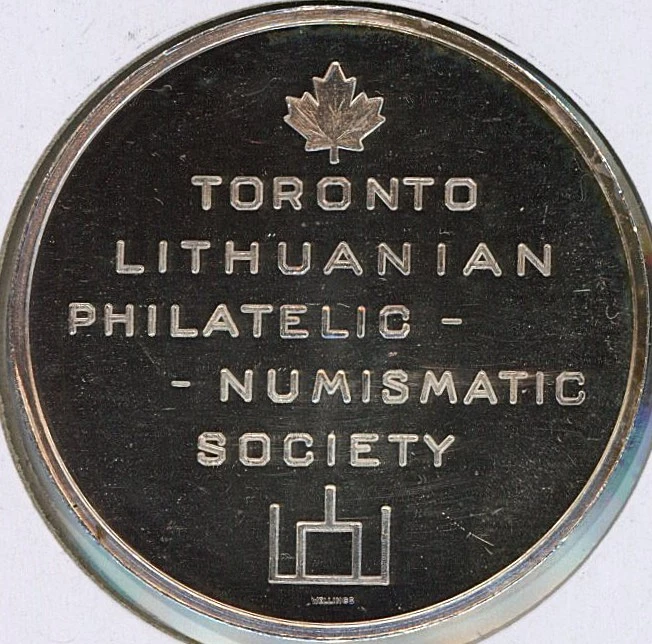
The Baltic diaspora in other countries (such as Canada) were small but vocal in their assertions of nationality and their lobbying to get the United Nations to do something about the Soviet occupation. Most ethnic Lithuanians living in Canada lived in Ontario at the time. I would assume this coin club to be a part of that nationalistic movement. I assume the focus of this society was the collection of Lithuanian coins and stamps, both from the 1918-1940 period as well as coins from Lithuania's earlier incarnations as half of the Polish-Lithuanian Commonwealth (1569-1795) and pre-Commonwealth coinages, as well as the sponsoring of production of nationalistic medals such as this one.
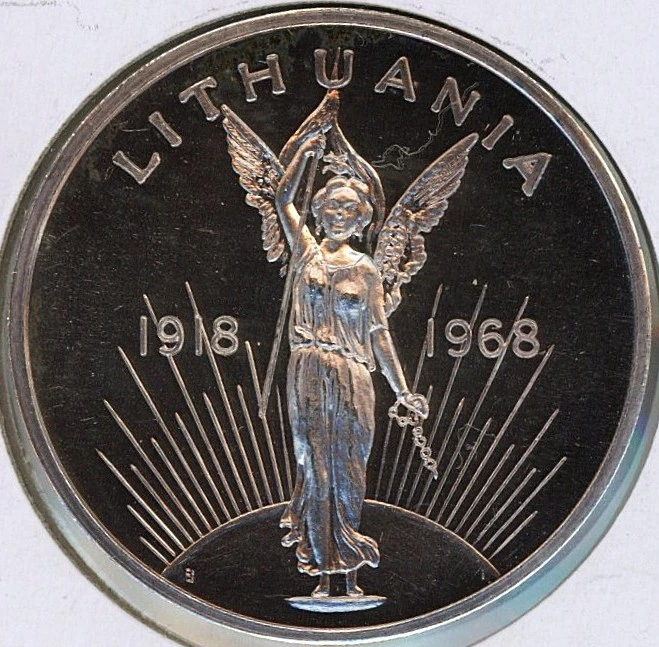
The medal commemorates the 50th anniversary of Lithuanian independence, though of course makes no mention of the fact that it de-facto wasn't independent any more. The small symbol that looks kind of like a "gun turret from a Space Invaders arcade game" is in fact the Columns of Gediminas, an early and traditional badge or symbol of Lithuania and was featured on many 1918-1940 Lithuanian coins as well as some mediaeval coins. I don't think the image of Victory is meant to represent a real physical statue of Victory in Lithuania.
The "1918" date does not itself represent the victory date; 1918 was when independence was declared, but Lithuania fought and won three wars between 1918 and 1920 in order to actually attain their independence.
The Society does not seem to still exist (at least, they do not have a website anywhere in the top Google hits) but they still existed in 1998, when society members donated a collection of rare stamps to a war museum in now-independent-again Lithuania.
The Baltic diaspora in other countries (such as Canada) were small but vocal in their assertions of nationality and their lobbying to get the United Nations to do something about the Soviet occupation. Most ethnic Lithuanians living in Canada lived in Ontario at the time. I would assume this coin club to be a part of that nationalistic movement. I assume the focus of this society was the collection of Lithuanian coins and stamps, both from the 1918-1940 period as well as coins from Lithuania's earlier incarnations as half of the Polish-Lithuanian Commonwealth (1569-1795) and pre-Commonwealth coinages, as well as the sponsoring of production of nationalistic medals such as this one.
The medal commemorates the 50th anniversary of Lithuanian independence, though of course makes no mention of the fact that it de-facto wasn't independent any more. The small symbol that looks kind of like a "gun turret from a Space Invaders arcade game" is in fact the Columns of Gediminas, an early and traditional badge or symbol of Lithuania and was featured on many 1918-1940 Lithuanian coins as well as some mediaeval coins. I don't think the image of Victory is meant to represent a real physical statue of Victory in Lithuania.
The "1918" date does not itself represent the victory date; 1918 was when independence was declared, but Lithuania fought and won three wars between 1918 and 1920 in order to actually attain their independence.
The Society does not seem to still exist (at least, they do not have a website anywhere in the top Google hits) but they still existed in 1998, when society members donated a collection of rare stamps to a war museum in now-independent-again Lithuania.
Don't say "infinitely" when you mean "very"; otherwise, you'll have no word left when you want to talk about something really infinite. - C. S. Lewis


