Coin Community Family of Web Sites Join Thousands of Coin, Bullion, & Money Collectors
Specializing in Modern Numismatics 300,000 items to help build your collection! Join Thousands of Coin, Bullion, & Money Collectors Royal Canadian Mint products, Canadian, Polish, American, and world coins and banknotes. Royal Estate Auctions - $1 Coin AuctionsCoin, Banknote and Medal Collectors's Online Mall Vancouvers #1 Coin and Paper Money Dealer


Username:
Password:
Save Password
Forgot your Password?


This page may contain links that result in small commissions to keep this free site up and running.

Welcome Guest! Registering and/or logging in will remove the anchor (bottom) ads. It's Free!

Could This Be A New England Massachusetts Colony Token Or Coin?

To participate in the forum you must log in or register.
Author Replies: 5 / Views: 178Next Topic  
New Member

United States
4 Posts
 Posted Yesterday   11:29 pm Show Profile   Bookmark this topic Add FreiherrVonNumis to your friends list Get a Link to this Message Number of Subscribers
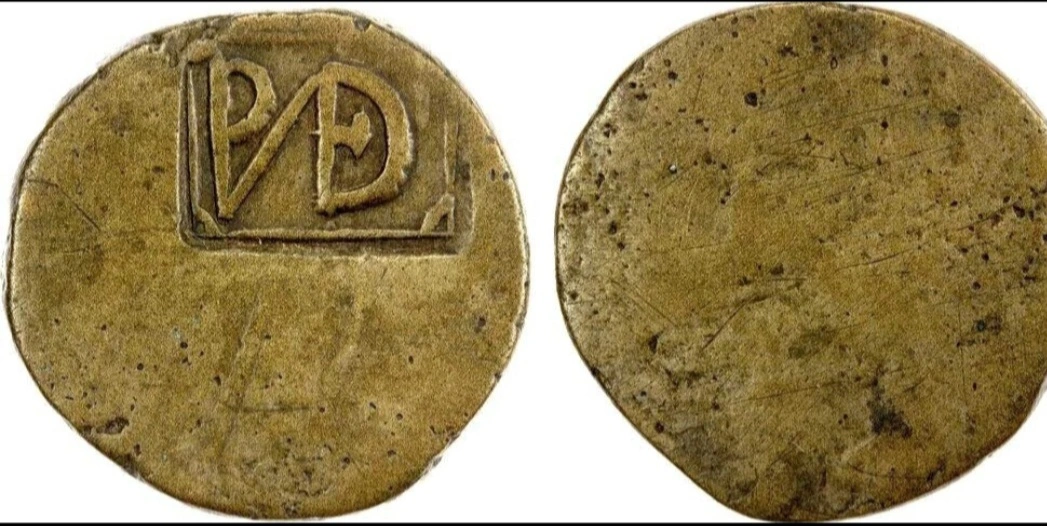
The coin/token as pictured below, has an uncanny similarity to the first Colony of Massachusetts shillings, sixpences and threepences.
Interesting that it has been struck near the edge like them.
The stamp reads P, retrograde N, E, D
This could be interpreted as Penny, New England, Denarius.
There were tokens in use at the Colony of Massachusetts contemporaneously on which both "penny" and/or "P" and/or "D" for "denarius" were displayed.
Another possibility is that the stamped cipher pertains to P for Samuel Paddy, and D for Jeremiah (Jeremie) Dummer, both apprenticed to the Colony of Massachusetts' mintmaster John Hull, a silversmith, in 1659. Paddy and Dummer were tasked with making coin dies for the Colony. The stamp is redolent of a silversmith maker's mark. More on this later.
I have studied the Colony's coins extensively and the history around them and have been of the opinion that the production of a farthing, half penny and penny must have been considered and actioned, especially as there was a dire shortage of coinage, and especially so the low denominations.
Appears to be feasibly 17th century.
Diameter is 21mm.
Weight is 6.39g
The weight corresponds to that of penny tokens of that period.
Appears to be bronze, brass, or latten. (to be tested)
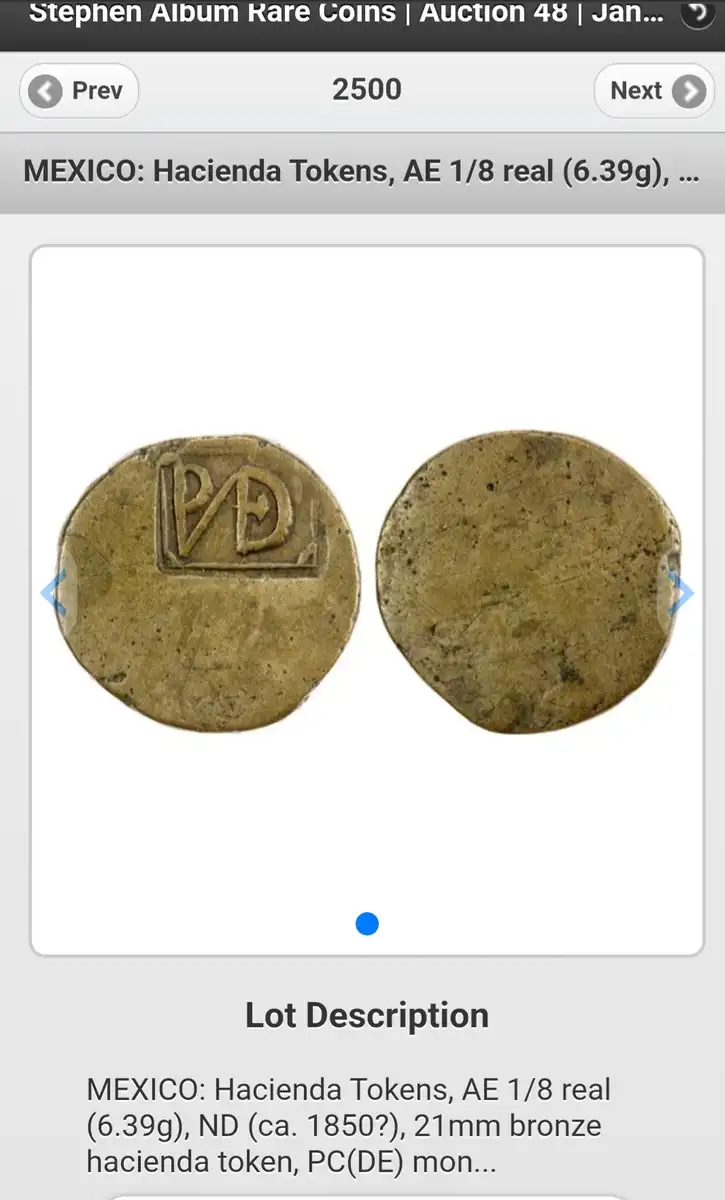
This was originally sold with early American coins as a hitherto unknown Mexican Hacienda token unlisted in Grove, Rulau, Ekland/Noe. That description was obviously a shot in the dark by the seller. It actually bears little resemblance whatsoever to any listed hacienda token.


Could-This-Be-A-New-England-Massachusetts-Colony-Token-Or-Coin?
Edited by FreiherrVonNumis
Today 13H 5M ago
New Member
United States
4 Posts
 Posted Yesterday   11:37 pm  Show Profile   Bookmark this reply Add FreiherrVonNumis to your friends list Get a Link to this Reply
I am not saying that it is an early Colony of Massachusetts penny, but am here to seek opinions.
I do realise that the chances are slim but I do think there is a chance that it could be an important pattern.
Even if it was an important early colonial proving it would obviously be a monumental task.
Edited by FreiherrVonNumis
Today 17H 6M ago
Moderator
Learn More...
Spence's Avatar
United States
34507 Posts
 Posted Today  11H 0M ago  Show Profile   Bookmark this reply Add Spence to your friends list Get a Link to this Reply
@frei,first welcome to CCF.


Quote:
That description was obviously a shot in the dark by the seller.


Second, with regard to SARC, I'm not saying that they are infallible, but without any evidence to the contrary, I'd generally believe their hunches as to attribution.
"If you climb a good tree, you get a push."
-----Ghanaian proverb

"The danger we all now face is distinguishing between what is authentic and what is performed."
-----King Adz
Moderator
Learn More...
Dearborn's Avatar
United States
101822 Posts
New Member
United States
4 Posts
 Posted Today  6H 5M ago  Show Profile   Bookmark this reply Add FreiherrVonNumis to your friends list Get a Link to this Reply
Thank-you for the welcomes to CCF. Much appreciated.
If XRF metallurgical analysis matches known mid to late 17th century profiles then that would exclude any known Mexican tokens by a minimum of 150 years. The metallurgical profiles of such tokens are highly distinctive.
The metallurgical profile could also indicate whether my item is 17th century or not.
Edited by FreiherrVonNumis
Today 5H 54M ago
Pillar of the Community
ExoGuy's Avatar
United States
4424 Posts
 Posted Today  1H 10M ago  Show Profile   Bookmark this reply Add ExoGuy to your friends list Get a Link to this Reply
FWIW, in my seventy years of collecting, I've not before seen the like of this curious piece. It'd be interesting to know the metallic content.

My hunch is that it may be a circa 1700's era church penny or IOU of sorts ... redeemable in private treaty. I've a pair of early c/s'd pieces that appear tp have served similarly.
  Replies: 5 / Views: 178Next Topic  

To participate in the forum you must log in or register.


Disclaimer: While a tremendous amount of effort goes into ensuring the accuracy of the information contained in this site, Coin Community assumes no liability for errors. Copyright 2005 - 2026 Coin Community Family- all rights reserved worldwide. Use of any images or content on this website without prior written permission of Coin Community or the original lender is strictly prohibited.
Contact Us  |  Advertise Here  |  Privacy Policy / Terms of Use

Coin Community Forum © 2005 - 2026 Coin Community Forums
It took 0.21 seconds to rattle this change. Forums