| Author |
 Replies: 12 / Views: 2,408  |
|
|
Pillar of the Community
Canada
2533 Posts |
New acquisition. 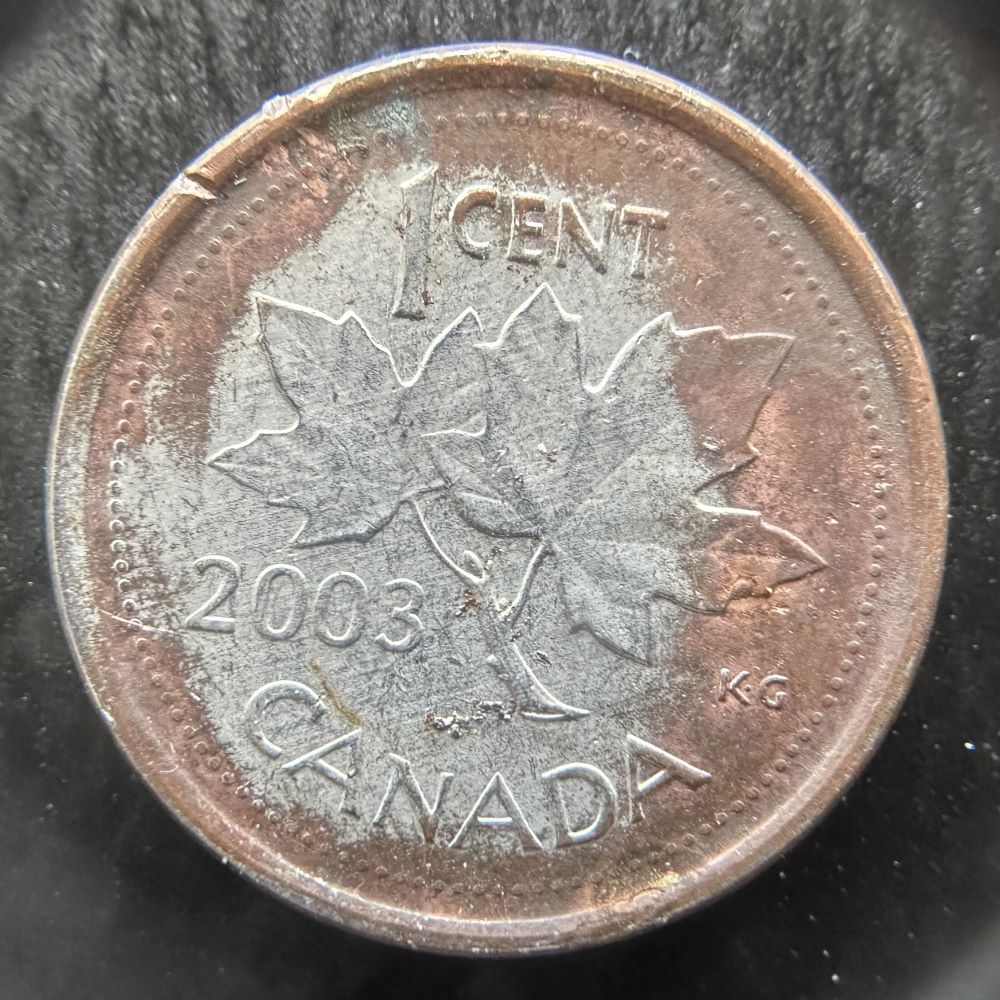  Raised striations on the surface of a plated coin is an indicator that the coin was plated before it was struck. What this cannot tell you though, is whether the coin was un-plated outside of the mint afterwards. What does, is the "pull-away" effect where the plating has split towards the rim immediately adjacent to the designs, which indicates a too-thin plating at the time of striking; easily seen under CANADA and beside D G REGINA. The pattern of plating deposition is unpredictable in a diffuse plating error, but a "bullseye" effect (either inwards or outwards) is sometimes seen. This coin has a steel core (magnetic). I had it tested with an XRF and the results were: White part: 0.1% Cu, 72.5% Ni, 27.3% Fe Red part: 60% Cu, 33.5% Ni, 6% Fe An excerpt from a brochure by the Royal Canadian about Mint Multi-ply plated steel coinage (emphasis mine): Quote:The Royal Canadian Mint's multi-ply technology ... consists of thin, alternating layers of metal that are electroplated to the steel core of a coin blank ... Red coins are made using a two-layer process. The first layer is nickel and the second is copper.  It's corroded and badly scratched, which makes it not a candidate for grading in this condition, but a nice find nonetheless. |
|
|
|
Pillar of the Community
 Canada
5677 Posts |
It looks like someone took steel wool to it, but what do I know.
Edited by okiecoiner
07/06/2025 09:17 am
|
|
Pillar of the Community
 Canada
2533 Posts |
I originally thought some form of PMD, but upon closer inspection I have to say it's legitimate. The striations are too clean, straight, and parallel to be anything other than rolling marks; and the "pull-away" plating split only occur on the areas near the border of the bullseye pattern--exactly where the copper plating would be deficient in the first place. The latter would be very difficult to fake, even if someone really know what they were doing. The right side tips of the maple leaves, for example, do not exhibit this split plating. Meanwhile, the very top left tip of the left maple leaf does. |
|
Pillar of the Community
Canada
2430 Posts |
Perhaps it was a zap of intense heat and or a small drop of a aggressive chemical in someones science experiment.
|
|
Moderator
 United States
200424 Posts |
|
|
Pillar of the Community
Canada
2533 Posts |
Not artificial toning--the metals themselves are different on different parts of the coin. Furthermore, AT would not discriminate in the elevation of the design. There would be no red/white split adjacent to design elements; everything would flow together.
Surfaces look otherwise original, no pitting or irregularities otherwise that it has been stripped. No more mint luster in this state, but it looks like any other circulated coin.
|
|
Pillar of the Community
Canada
1487 Posts |
 Having seen your coin today reminded me of this coin of mine. When the coin is plated but then not annealed properly the letters may not flow equally? Because mine was struck previously and then not annealed it really shows. Nice meeting you! |
|
Pillar of the Community
Canada
2533 Posts |
Very dramatic! Those plating splits show very nicely. A finished coin getting thrown in the wrong hopper at the mint?
In my opinion, the split plating is not mainly from improper annealing (although it could be a factor), but from being struck twice. During the first strike, the copper plating expands and flows following the devices on the Barbados coin. Then on the second strike, the copper plating was forced to expand beyond a diameter that it designed for, splitting along where it's already thin (like the back of the pelican's head) or getting stretched so far it just breaks and pulls away (around the lettering and denticles, towards the rim).
Either way, it produces cool results.
Nice meeting you too, and thanks for the great show and tells!
|
|
Moderator
Canada
10482 Posts |
I think it is legit. Shame that it had a bit of a hard life before you found it. See this thread as well: https://goccf.com/t/356561"Discovery follows discovery, each both raising and answering questions, each ending a long search, and each providing the new instruments for a new search." -- J. Robert OppenheimerContent of this post is licensed under a Creative Commons Attribution-NonCommercial 3.0 Unported License. See: http://creativecommons.org/licenses...0/deed.en_USMy eBay store
|
|
Moderator
United States
200424 Posts |
|
|
Pillar of the Community
Canada
2533 Posts |
SPP, if you are either at the Trajan show or Expo, I can bring this for you to see in hand. I saw your threads as part of my research on my coin.
|
|
Moderator
Canada
10482 Posts |
Definitely not at the Trajan show, and not sure about Expo. It's been a busy year with work.
"Discovery follows discovery, each both raising and answering questions, each ending a long search, and each providing the new instruments for a new search." -- J. Robert OppenheimerContent of this post is licensed under a Creative Commons Attribution-NonCommercial 3.0 Unported License. See: http://creativecommons.org/licenses...0/deed.en_USMy eBay store
|
|
Pillar of the Community
United States
1807 Posts |
Yes. In principle, this Canadian cent appears analogous to a U.S. copper-plated zinc cent struck from an improperly plated planchet exhibiting a bullseye-style plating distribution error. The difference is that a U.S. cent has a copper-plated zinc core, whereas the Canadian multi-ply plated steel cent has a steel core with a nickel underlayer and copper outer layer. In both cases, non-uniform plating thickness prior to striking can produce a concentric or diffuse bullseye appearance, with the thinnest regions stretching and exposing the underlying layer during striking. Here, the XRF supports that interpretation because the reddish areas are copper-rich while the whitish areas are nickel-rich, exactly matching the Royal Canadian Mint's copper-over-nickel plating sequence. Thus, the coin behaves much like a classic plated-zinc bullseye error, except the exposed layer is nickel rather than zinc. |
| |
Replies: 12 / Views: 2,408 |
|







 Posted 07/05/2025 8:57 pm


