|
This page may contain links that result in small commissions to keep this free site up and running.

Welcome Guest! Registering and/or logging in will remove the anchor (bottom) ads and the security checks. It's Free!
To participate in the forum you must log in or register. | Author |
 Replies: 35 / Views: 4,985 Replies: 35 / Views: 4,985 |
|
|
|
Pillar of the Community
United States
992 Posts |
Just like the Weimar currency, the government could not keep up with printing postage stamps, either. A 1/2 Pfennig stamp would mail a postcard across a city, but inflation rapidly changed that cost to over a billion marks. The stamps of the era are generally available unused, since they were made useless for postage in just a few days. An envelope that required a single stamp in the morning might take two or three the next day, and by the end of the week the envelope wasn't large enough to hold the stamps required to mail it.
Germans who lived along the borders were able to make do by crossing into France or Denmark, say, and selling some family possession to purchase food, then bring it back to Germany. People living in the interior had no such luck.
|
|
Pillar of the Community
 United States
4883 Posts |
What came out on the other side of the demise of the nearly worthless Papiermark of late 1923 was the Rentenmark. With crushing debt and no gold reserves, the Weimar government actually had a sensible idea, which was to issue a revised currency backed by what assets tha nation could muster, which turned out to be land and industrial facilities. To a degree, this construct was rather fanciful, but a populace weary of fiscal insanity was more than ready to accept such a plan, and the Rentenmark (which cost 1 trillion of the hyperinflated mark being discarded) exchanged hands at rates almost identical with the pre-WWI mark. While it was never intended to be more than a stopgap measure (the equally valued Reichsmark was introduced in 1924 as the permanent new currency), the Rentenmark actually retained its utility and worth and remained in circulation all the way into 1948. Pictured below is a 2 Rentenpfennig coin from late 1923, reassuringly of a size and composition, and more importantly with the buying power, of what a generation of Germans had come to expect of such a denomination. The "D" mint mark indicates it was struck in Munich. 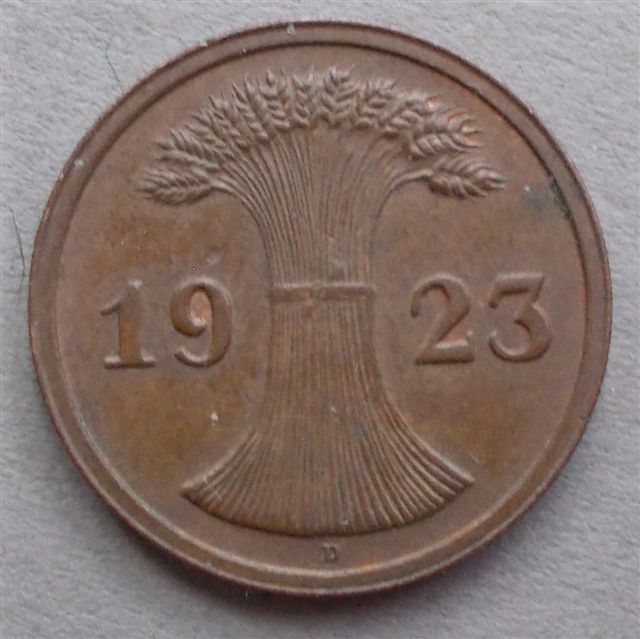 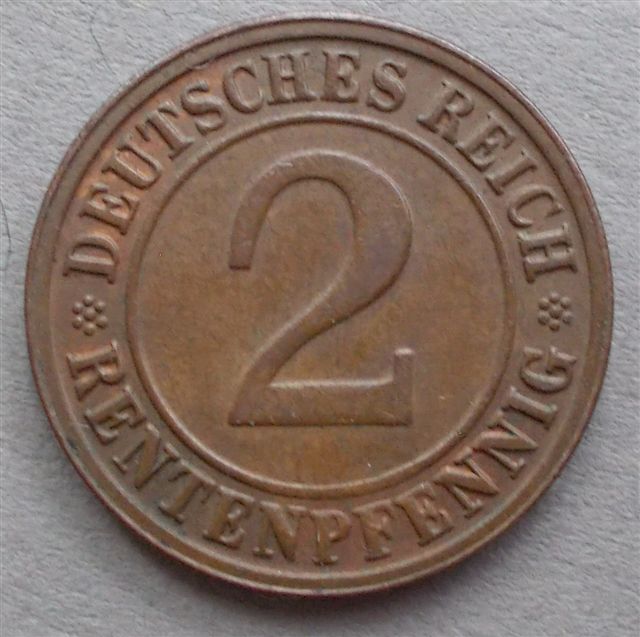 Colligo ergo sum
|
|
Bedrock of the Community
United States
12057 Posts |
Westphalian dialect of German. Säärland/Sauerland. Note the "dat" vs. "das" (Westphalian word-final "t" to standard German "s", see also "bat" vs. "was")
The 2m. Mark:
(obv.)
säär: Bat cost dat?
de: Was kostet das?
en: What does that cost?
(rev.)
säär: Geld stoyf over nix te boyten
de: Geld genug, aber nichts zu bissen (beissen)
engl: Gold enough, but you bite nothing (more literal)
engl: Plenty of money, but nothing to eat (free translation)
5m. Mark
säär: Ik ame Kääl
de: Ich (bin) armer Kerl
engl: I (am) a poor guy
säär: Et is im ollen lechte, bat sall dat gieben!
de: Es ist im alten Licht, was soll das geben! (Good luck translating that)
Hope this helps. A native speaker would be able to provide more insight and probably much better translations, if you can find one. (Much like my grandmother's Schwäbisch, the various German dialects can be quite a chore to understand, even for Standard German speakers, and my "standard" German is rather inadequate as it is! My dad, who was born in Germany, learned Standard German, and couldn't understand his own mother sometimes.)
Member ANA - EAC - TNA - SSDC - CCT #890 "Most of the things worth doing in the world had been declared impossible before they were done." -- Louis D. Brandeis Edited by paralyse
07/19/2016 01:32 am
|
|
Pillar of the Community
Poland
3201 Posts |
Thanks for translating the inscriptions on the Menden notgeld!  So, Lucky Cuss was correct as to the meaning of the first one. The last phrase though  |
|
Pillar of the Community
Norway
1358 Posts |
Sorry to have missed the progress on this thread, please let me help out a bit here. The Saar dialect is actually very close to some of the Dutch dialects, so it's not too difficult for me to understand. Quote:
säär: Et is I'm ollen lechte, bat sall dat gieben!
de: Es ist I'm alten Licht, was soll das geben! It's a sort of expression, a complaint from the common man, or 'the poor man' from the obverse. The literal translation is: 'It's in the old light, what will it give!' and that doesn't make any sense. The meaning is among the lines of: 'how things are standing now, what will the future bring!' |
| |
Replies: 35 / Views: 4,985 |
To participate in the forum you must log in or register.
 
- Post Your Coins / Medals / Bank Notes With Marine Mammals
- Post Your Coins And Medals With Trees
- Coinstar Finds! (Including Bank Counters And Other Machines)
- Continuing List To Show Everyones Latest Acquisitions
- 1956 Lincoln Wheat Cent Peel And Floating
- 1988 Mexico - 50 Pesos, 10-15% Off-Center Strike
- How Far Back Can We Go? Ninth Edition!
- 20 Questions! (Forum Game) 11/04/24
- Deer, OH Deer, OH Deer!
- Show Off Your Bi-Metallic Coins World Wide
- Post Your Coins With Coats Of Arms, Shields, Crests, Crowns, Etc.
- Post Your Coins With A "five" Denomination
- Post Your Aluminium & Zinc Coins
- 1973-S Clad Eisenhower Dollar, Double Struck Error, 40% Center Off Second Strike, PCGS PR-68-DCAM
- Seamonkey's Jefferson Nickels
- 1942-S Dime On Ebay For $12, Probable Imm FS-504.
- An Old Advert In One Of My Old Books.
- Guess The Price - Season 96 - Round 4
- 1956 Lincoln Wheat Cent RIDB Unlisted
- Commems Collection Classic: What If? Phantom 1948 Wright Brothers Memorial
Disclaimer: While a tremendous amount of effort goes into ensuring the accuracy of the information contained in this site, Coin Community assumes no liability for errors. Copyright 2005 - 2026 Coin Community Family- all rights reserved worldwide. Use of any images or content on this website without prior written permission of Coin Community or the original lender is strictly prohibited.
Contact Us | Advertise Here | Privacy Policy / Terms of Use
|
| Coin Community Forum |
© 2005 - 2026 Coin Community Forums |
| It took 0.29 seconds to rattle this change. |
 |
|
| |
| |




 First Page
 Previous Page


 Posted 07/18/2016 9:33 pm


