CANADA printed by the
Bank of
Canada (BoC):
The QEII banknote portrait to be used in the 1954 new design was taken by Yosuf Karsh. He was the same photographer who took B&W portraits of Winston Churchill, Ernest Hemingway, Grace Kelly, Albert Einstein & among many other celebrities back in the day. George Gundersen of the British American Bank Note Co engraved the portrait which appeared on all denominations (
I've highlighted the P-codes and used (brackets) for the Charlton BC-codes):
Devil's Face 1954Green
One Dollar P-66 (BC-29a,b)
https://en.numista.com/catalogue/note201742.htmlRed
Two Dollar P-67 (BC-30a,b)
https://en.numista.com/catalogue/note201763.html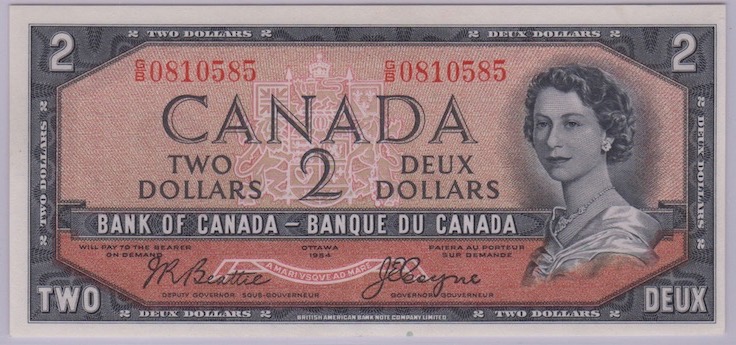
Blue
Five Dollar P-68 (BC-31a,b)
https://en.numista.com/catalogue/note201777.html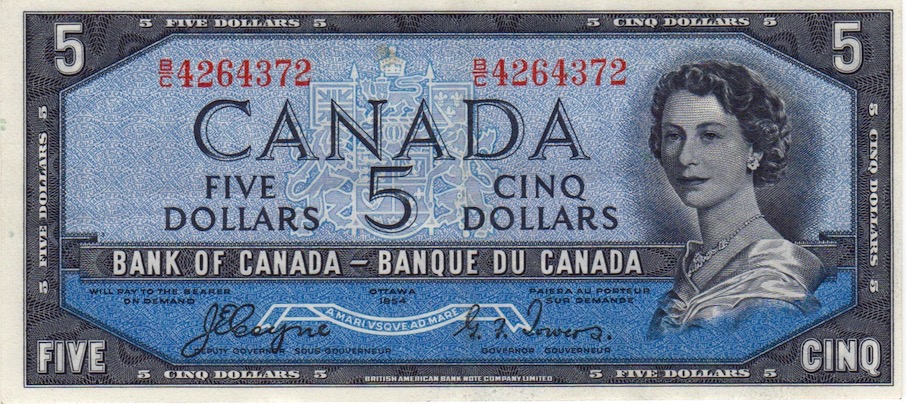
Purple
Ten Dollar P-69 (BC-32a,b)
https://en.numista.com/catalogue/note201886.htmlOlive green for the
Twenty Dollars P-70 (BC-33a,b)
https://en.numista.com/catalogue/note201889.html br /
Orange brown for the
Fifty Dollars P-71 (BC-34a,b)
https://en.numista.com/catalogue/note201889.htmlTan brown for the
One Hundred Dollars P-72 (BC-35a,b)
https://en.numista.com/catalogue/note201895.htmlRose pink for the
One Thousand Dollars P-73 (BC-36)
https://en.numista.com/catalogue/note201896.htmlThis QEII series had
Coyne-Towers signatures and Governor Towers was soon replaced by his senior deputy the following year. The second signature combo was
Beattie-Coyne and many collectors like to have examples of both. 10,000,000 notes were printed for each fractional prefix (ie prefix A/D for the $10) and 19 prefixes were released for the $1.00 By the second year of their production, gossip had reached London that a sinister face appeared in the QEII's hair. It was the first time that asterisk serial numbers designated replacements. Collectors were unaware of this till much later so far fewer * replacements prefixes were released or caught. By 1956 the engravers modified the plates in order to remove the offensive "Devil's Face." Many years later, researchers discovered that most of the replacements (*A/A for the $1; *A/B for the $2; *A/C for the $5; *A/D for the $10 & *A/E for the $20) were recalled, so only a slim fraction of the low # printed were actually released into circulation & caught by a few lucky individuals.
Since replacements were seldom seen, signature change-overs (prefixes
H/A & T/A for the
$1; prefix
D/B for the
$2; prefix
C/C for the
$5; prefix
E/D for the
$10; prefixes B
/E & E/E for the
$20) were eagerly sought by Canadian collectors. There were no replacements for the $50, $100 or $1000 denominations and the highest denomination only had the first Coyne-Towers signature. Both the Canadian Banknote Co (CBNC) & the British American Bank Note Co (BABN) produced the notes and they were shipped to the
BoC for distribution. World demand for these "scandalous" Devil's Face notes slowly emerged well after they were replaced by the modified notes.
Modified 1954:In 1956, the new modified plates were used as were the previous prefixes. This created seldom seen design change-overs:
T/A for the $1;
I/B for the $2;
I/C for the $5;
J/D for the $10 &
E/E for the $20. The design change-overs were not a factor for the minor number of $50, $100 & $1000 but the Beattie-Coyne notes were often preferred over the later signatures. Most collectors I know do not prefer the BABN produced notes over the CBNC notes & I have no idea why Charlton (& SCWPM) created separate tables/codes for these two imprints. It only becomes relevant once, with the production of the first 88,000 Beattie-Coyne
R/C notes by the
BABN which are scarce (as the remaining 9.9M printed by the CBNC are the majority)
Replacements:The custom of using asterisk prefixes to replace gaps (where damaged sheets of notes existed) continued with the Modified 1954 series & has remained a popular focus for many specialists. It would be much later that collectors realized that the BoC released tough asterisk replacements for the TWENTY & lower denominations. Some replacements for the ONE & TWO denominations can be next to impossible to find (*V/V or *C/I for the $1 & *Z/Z for the $2). Many of the tough replacements are seldom offered but retain low Charlton Book Values, that in comparison to larger nations, I believe are very inexpensive. To examine the actual prefix letters and their numbers issued you should refer to Charlton or
https://www.coinsandcanada.com/bank...ce&id_cat=20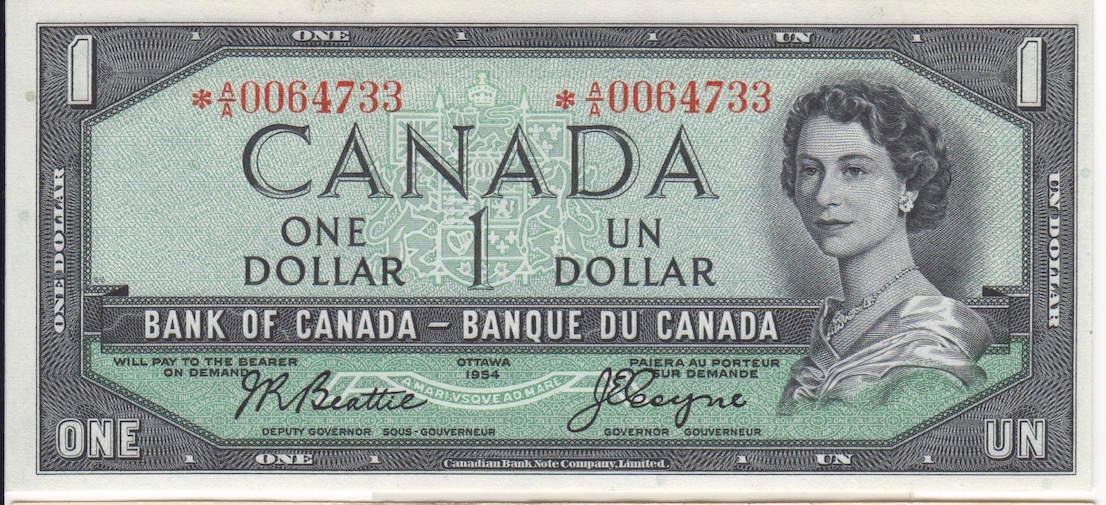
 Test Notes:
Information on "mysterious batches of $2" emerged over the years. S/R ranges were reported for the middle three signature combos. According to Charlton "certain $2 notes of series E/R, G/R and N/R are also test notes." (P-240). These batches were used to test either inks or the durability of a certain paper substrate and are mostly the realm of the specialist.
1967 Centennial Issue: P-84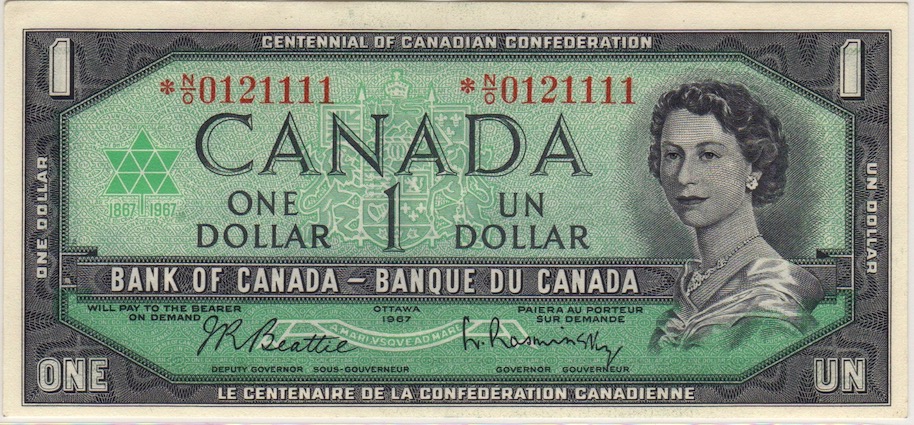
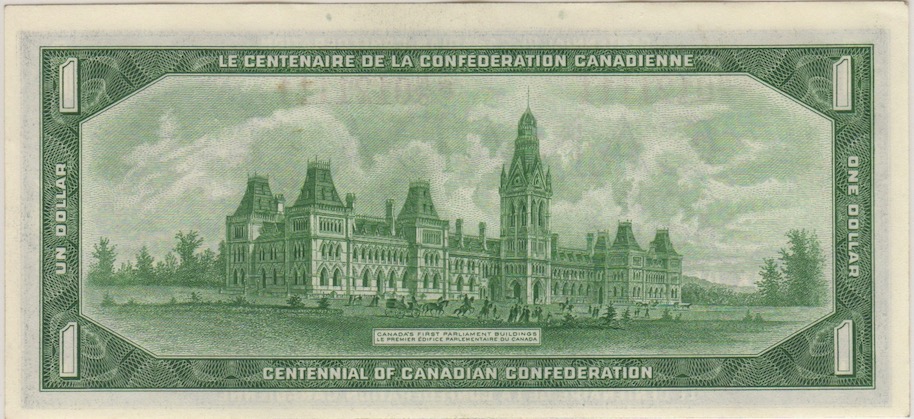
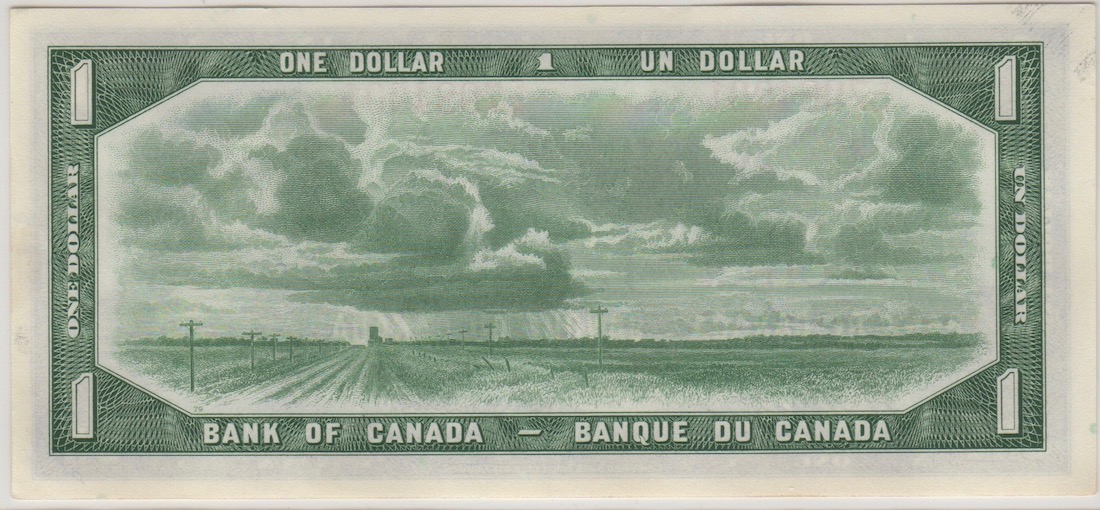
12,000,000 notes with the "1867-1967" date replacing a regular serial number were issued and hoarded by many Canadians. As such their collector value has remained "cool to cold." Ten times as many banknotes were produced with serial numbers but most were circulated and not hoarded, so regular serial numbered Centennial notes are preferred. The printers are produced four replacement prefixes (*L/O, *N/O, *B/M & *F/P) which are often sought after most. These can be quite popular amongst world collectors since their reverse design of the parliament buildings is a nice departure from the western prairie sky.
https://en.numista.com/catalogue/note201714.htmlFor World collectors:Beattie-Coyne signature combinations are typically a little more dear due to high world demand. World collectors may want examples of the later signature combinations:
Beattie-Rasminsky; Bouey-Rasminksy & Lawson-Bouey and these all remain cheap compared to other nations. The
Thiessen-Crow signature only appeared on the $1000 well after the new Multicolour series replaced the use of denominations below $100 & this note is dear. There has been an increase desire for low and special serial numbers (radars, repeaters and ladders) of the Modified series. The prices of these Devil Face and Modified notes typically outpace the catalogues.
The Multicolour Series (1970 to 1985):1969 TWENTY DOLLAR P-89(BC-50ab)
QEII's portrait was updated when a new TWENTY (BC-50ab) was released in 1970. It was later seen in 1973/74 on the $1 & $2 but dropped for the $5, $10, $50 & $100. Fractional prefixes were replaced by two & three-letter prefixes but asterisks continue to denote replacement function. Most of the $20 replacements are tough in higher grades while the $1 and $2 have replacements that can range from easy to near impossible to source.
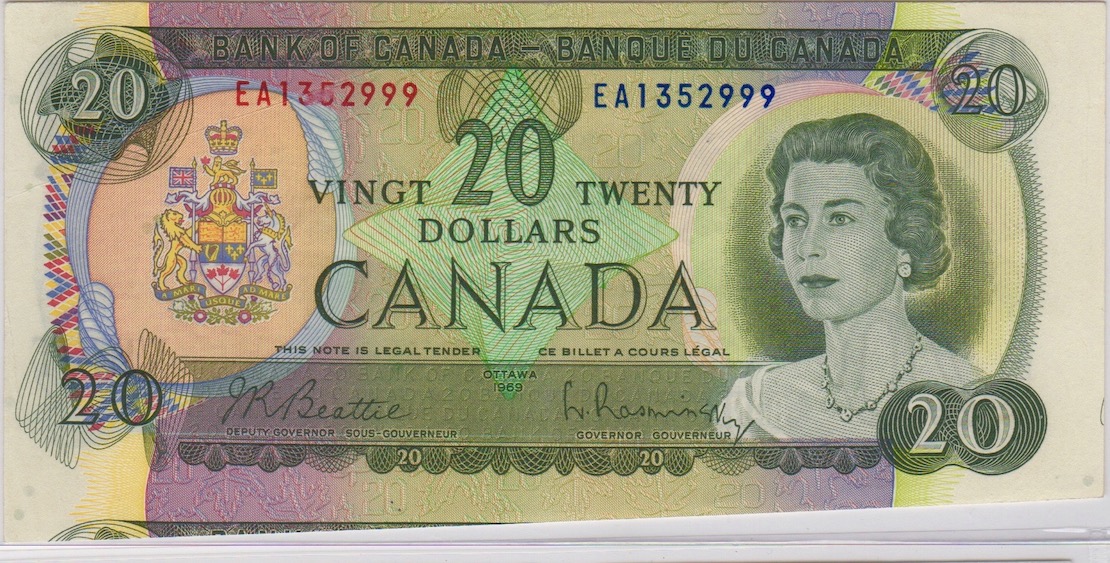
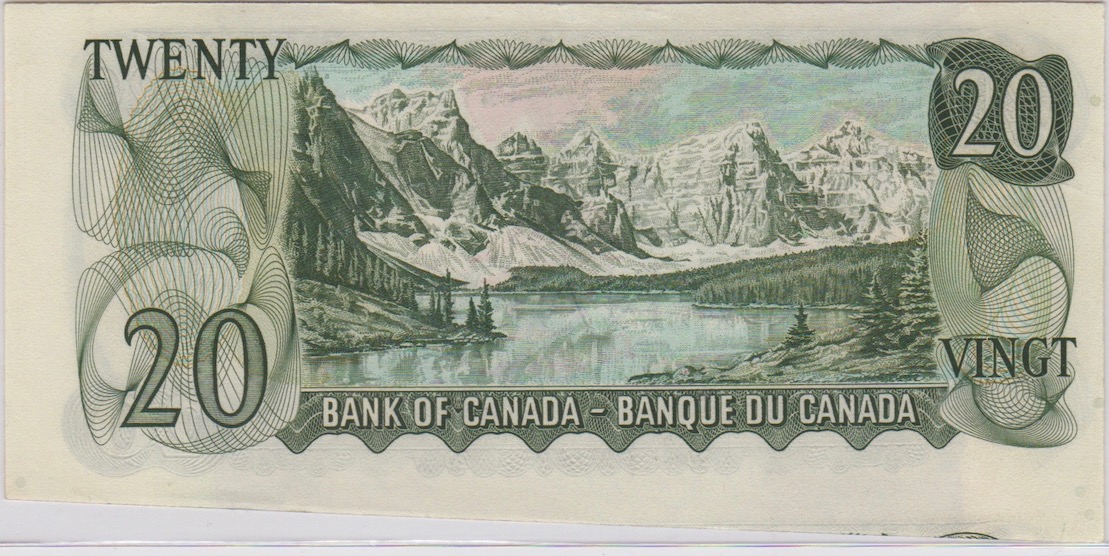
The 1969 Twenty lasted ten years when it was modified with an orange-pink hue added to further distinguish it from the $1. It also had two eleven-digit serial numbers moved to the bottom of the reverse of the note. Canadian collectors were fairly luke-warm towards this 1979 series until they understood that the notes numbered "510" or "516" designated replacement function. Even then, the 1979 series was never as popular as its 1969 predecessor.
https://en.numista.com/catalogue/note201901.html1973 ONE DOLLAR P-85 (BC-46a,b):
Several mass produced replacements (*AA, *AL, *AN, *FA, *FV, etc) had large runs and remain inexpensive. However, there were discoveries of unusually high numbered (above 5M) *AA, *AB, *FB and *FH that remain scarce.
Later, when notes had lithographed backs, interest were turned to these 3 letter change-over (AFF, EAK) prefixes. Asterisk designated replacements were dropped for an X on the third letter. For example, AAX & EAX Lawson-Bouey $1 replacements as well as AAX, BAX & EAX replacements with the Crow-Bouey signature are not that tough to source. In addition to replacements, Test notes were also released with the $1 and these were all 3 letter with the middle letter being an X, such as Lawson Bouey AXA (steel & lithographed versions) as well as Crow-Bouey EXA test notes.
https://en.numista.com/catalogue/note201904.html1974 TWO DOLLARS P-86 (BC-47a,b):
What I have written for the ONES pretty much applies to the TWOS, except for one quarter the number produced translating in reduced examples of scarce replacements (only two high # *BC and super rare *RD) In addition the Bank of Canada used the RS prefix for another batch of $2 Test notes. This denomination also used 3 letter prefixes and an ABX replacement with both signatures.
https://en.numista.com/catalogue/note201905.htmlWorld Collectors:It is important to note that 4 billion ONES & a billion TWOS were issued so having an uncirculated example of each is not going to make you rich. The ONES were the last of that denomination (replaced by our 'Loonie' coin) & as such were hoarded in bundles (X100). However, there were several signature change-overs, tough (but achievable) replacements and test notes to collect making these a fun series to make sets from. Canadian collectors started sorting out radars, repeaters & low numbers from this series so these special serial numbers as well as errors are all affordable in high grades.







 First Page


 Posted 12/20/2021 6:43 pm


 & no apologies necessary!