After watching the videos posted by CCF Press regarding the S.S. Central America and seeing the old passenger steamer trunks on the ocean floor, it reminded me of some additional family history noted below that my mom and I have dug up over the last few years regarding my gggrandfather (FER), provenance if you will for the California fractional gold and coin vest.
Anyway, I thought some of you might find this interesting, that is the backstory that led to a vest full of gold.
——————————
1) FER arrived via the sailing ship brig Hindoo, departing Sweden and arriving in New York on 6/6/1843, and then made his way to Cincinnati, Ohio where he resided until 1849.
2) With gold rush Fever raging, starting in early 1849, he and 23 like minded individuals, took river boat steamers via the Ohio, Mississippi, and Missouri rivers to Independence, MO followed by a mule train trek across the western frontiers arriving in Placerville, CA in August of 1849.
3) FERs venture into gold minding lasted all of six months before realizing there was a better way to make money out of the gold rush craze. Educated in Sweden and with ~10yrs experience clerking in merchantile stores in Sweden and America, he had an idea.
4) In the Spring of 1850, he and a partner built the Buckeye Exchange in Greenwood Valley, CA, the first hotel, restaurant, bar, and stagecoach stop in Greenwood.
5) After taking a wife, married in Sacramento in 1852, and now with a young daughter, the family desired to move to Iowa to be near the wife's family.
6) In December 1853, one advertisement described the property as follows:
FOR SALE. THE Subscriber, designing to return to tho Atlantic States, offers for sale his well known Hotel, situated in Greenwood, the BUCKEYE EXCHANGE. Said Hotel has attached about four acres of TILLABLE LAND, the best Spring of Water, conveyed through pipes, to the convenient use of the house, together with all the NECESSARY FURNITURE for carrying on the business in which he has been successfully engaged for the last four years. ALSO —5 Cows, 2 Calves, 6 Horses 20 Hogs, 150 Chickens, 15 Turkies, 40,000 lbs. of Barley, and a fine lot of Pigeons. The above will be sold on Reasonable Terms (by 1853, FER was the sole owner)
The hotel was also an official California Stagecoach Company stop with an 1855 advertisement stating:
CALIFORNIA STAGE COMPANY NOTICE.
Stages for Sacramento City leave the Nevada House at Georgetown every morning at three o'clock A. M., and the Buckeye Exchange, Greenwood Valley, at four o'clock A. M., arriving in Sacramento in time to connect with the steamboats for San Francisco.
7) The property was finally sold in the fall of 1856. The family stayed in the Bay Area until February 1857, boarding the pacific side steamer S.S. John L Stephens followed by the S.S. Illinois for the Atlantic side trip from Panama to New York City. (We knew they took steamers back, but didn't know which ones until further research a few weeks back, of course wondered if it was the Central America).
8) Upon arrival in Iowa, FER immediately built the first steam powered saw and grist mill in the area followed by the construction of two bridges across the Wapsipinicon River to aid in commerce.
——————————
Regarding the coin vest, maybe not readily apparent, but each coin or short stack of coinage was actually sewn tightly into place.
I count 66 coin impressions. Assuming only one coin was actually sewn into place, the face value of sixty six double eagles was $1,320, current melt about $277K.
It is hard to know what the property actually sold for in 1856, but the asset value, based on prices at the time in California, was around $7,500, or about 375 double eagles, current melt ~$1.5 million. An industry census in 1860 placed a value on the Iowa mills and inventory at $13,000. So whatever the California property sold for, it was a nice chunk of pocket change.
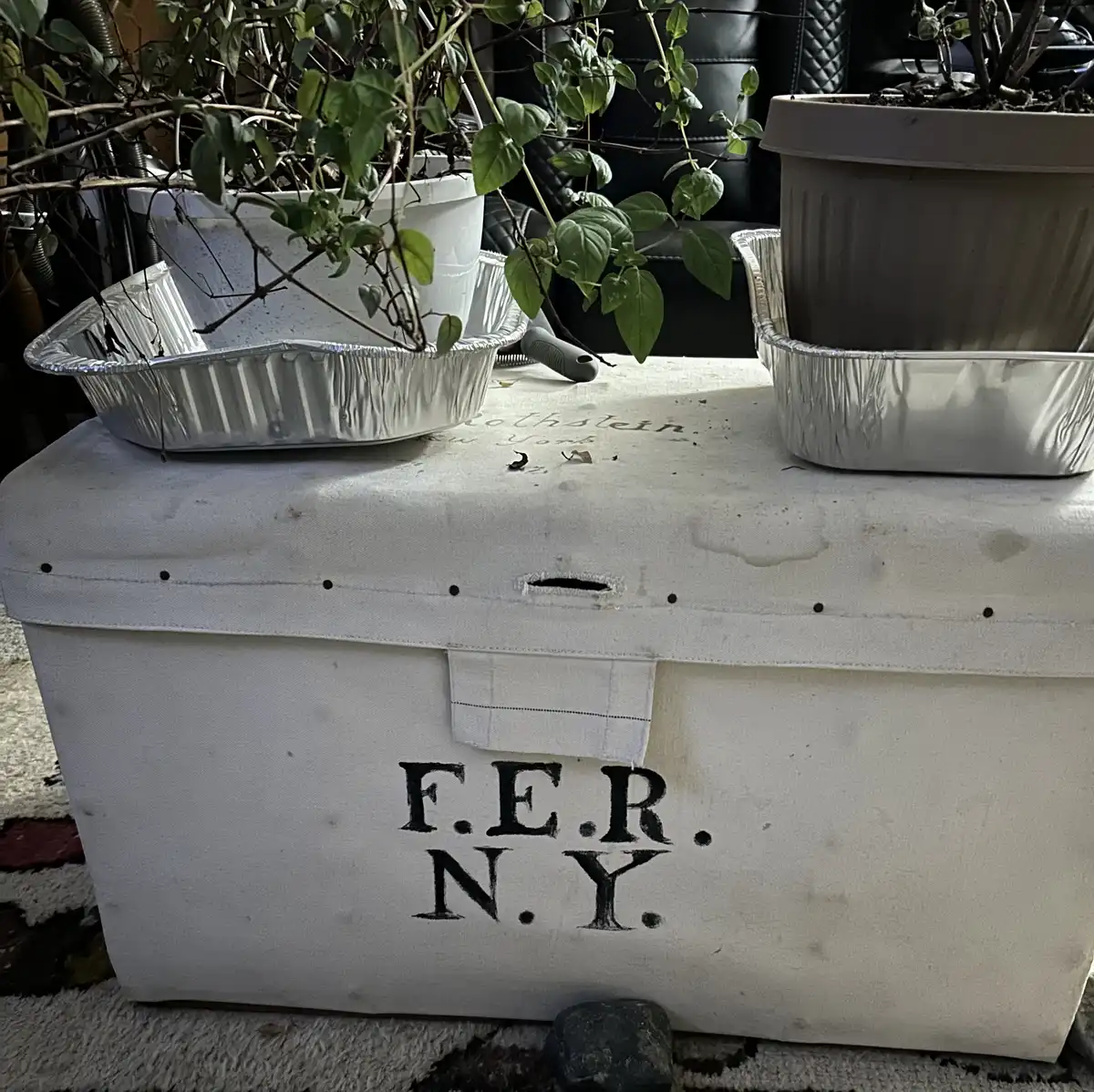
About two years ago we found out that one of FERs descendant's is actually in possession of his steamer trunk (picture at bottom). As he was a poor young man going in, presumably he bought the trunk and coin vest in preparation for the family's return trip first to New York and then Iowa.
I hate seeing this piece of history being used as a plant stand!!





 First Page


 Posted 10/14/2026 6:11 pm


