| Author |
 Replies: 25 / Views: 1,117 Replies: 25 / Views: 1,117 |
Page 2 of 2
|
|
|
|
Valued Member
 New Zealand
234 Posts |
OK, I've had another crack at a photo during prime daylight hours with more adjustments to the camera settings, so hopefully a further improvement. Still learning the camera and the macro lens. Thanks for the feedback on photos and variety possibilities. It's funny: the text in the Breen photo says no normal dates are reported. Yeoman does have a "normal date" as an option. I have pointed out very minor doubling at the top of the one. It's there, but it's faint. The four has a secondary shadow along most of it along the undersides, in addition to whatever is going on with the crosslet on the four. There's also some weirdness in among the nine, and still that little thing poking off the right side of it, which is pretty distinctive if it's not PMD. The cuts of the 8 and 9 are quite different to the one you've shown, makecents. I had to do a double take on the die crack, Altaira. I was wondering how I missed it, but then on the holder I had noted it back when I first put it in there. It is quite distinctive. Mind you, I've had this nearly 20 years. I'll see about submitting it to COC. ETA: The difference between an overdate and a repunched date seemed like semantics to me. What is the difference? 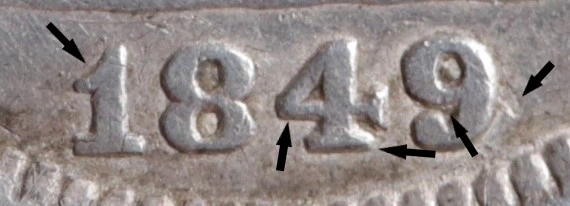 Do not read this sentence.
Edited by Buffalo soldat
07/10/2026 07:42 am
|
|
Pillar of the Community
 United States
8947 Posts |
I don't know that I have anything else to offer, I really don't know much about this series of coin. Good luck and hope someone else can help you.  -makecents-
|
|
Pillar of the Community
United States
8947 Posts |
Quote:
The difference between an overdate and a repunched date seemed like semantics to me. What is the difference? In short, RPD's are re-punched digits of the same numbers, much like an RPM. OVD's (overdates) are from leftover working dies that had old dates punched in them already and a new, different date, was punch over the old, existing date. Here is a link that explains it more in depth. Wexler link. https://doubleddie.com/58327.html-makecents-
|
|
Pillar of the Community
Canada
2527 Posts |
Exactly why I mentioned wanting to see large images of reference coins, to check for other die markers to be able to confirm this. Multiple dies can have very similar date positions. I could use a date position to narrow down, but not precisely pinpoint, unless every other from complete list of all known dies don't match up. Buffalo soldat, are you able to match your coin to a written description (page 55) or plates (page 132) in this book? It may very well be unlisted here as this book was published in 1931. https://nnp.wustl.edu/library/book/562571I believe an overdate would have two different dates visible (like an 2 punched over a 1), while a repunched date would have the same number punched twice (or more) in the same location. The same over/repunched terminology applies to mintmarks. Classic American collectors, please correct me if I'm wrong. EDIT: -makescents- beat me to the punch. I'll leave this final paragraph up for posterity. Edited by Altaira
07/10/2026 10:18 am
|
|
Pillar of the Community
United States
4416 Posts |
|
|
Bedrock of the Community
United States
78077 Posts |
Nice RPD!  Errers and Varietys.
|
|
Valued Member
New Zealand
234 Posts |
Thanks for further thoughts and opinions. All welcomed and much appreciated. Having looked through that book, Altaira, I think it most closely aligns with 8a (obverse) and 6 (reverse) on page 55. The photos were just a little too fuzzy to make much of. It was also weirdly hard to navigate the page. There was a scroll up, but not a scroll down, I could use an arrow up or down for a press or two, but then it started moving the whole page. I could zoom in, but I couldn't maximise the "video". I was able to have a look at it all, but it was peculiar. Good resource, though. Cheers. I also had to go have a look at photograde on PCGS to get a better understanding of what they meant about the fonts on the reverse. I only have a few Seated Liberty half dimes, so I didn't realise the variability in the fonts or the dates, for that matter. Dates really moved around a lot even in a given year, including 1849. And the reverse fonts varied wildly. I'm still wondering what the little dag at the right of the 9 is. Is that PMD? Here's another, better photo of the reverse. 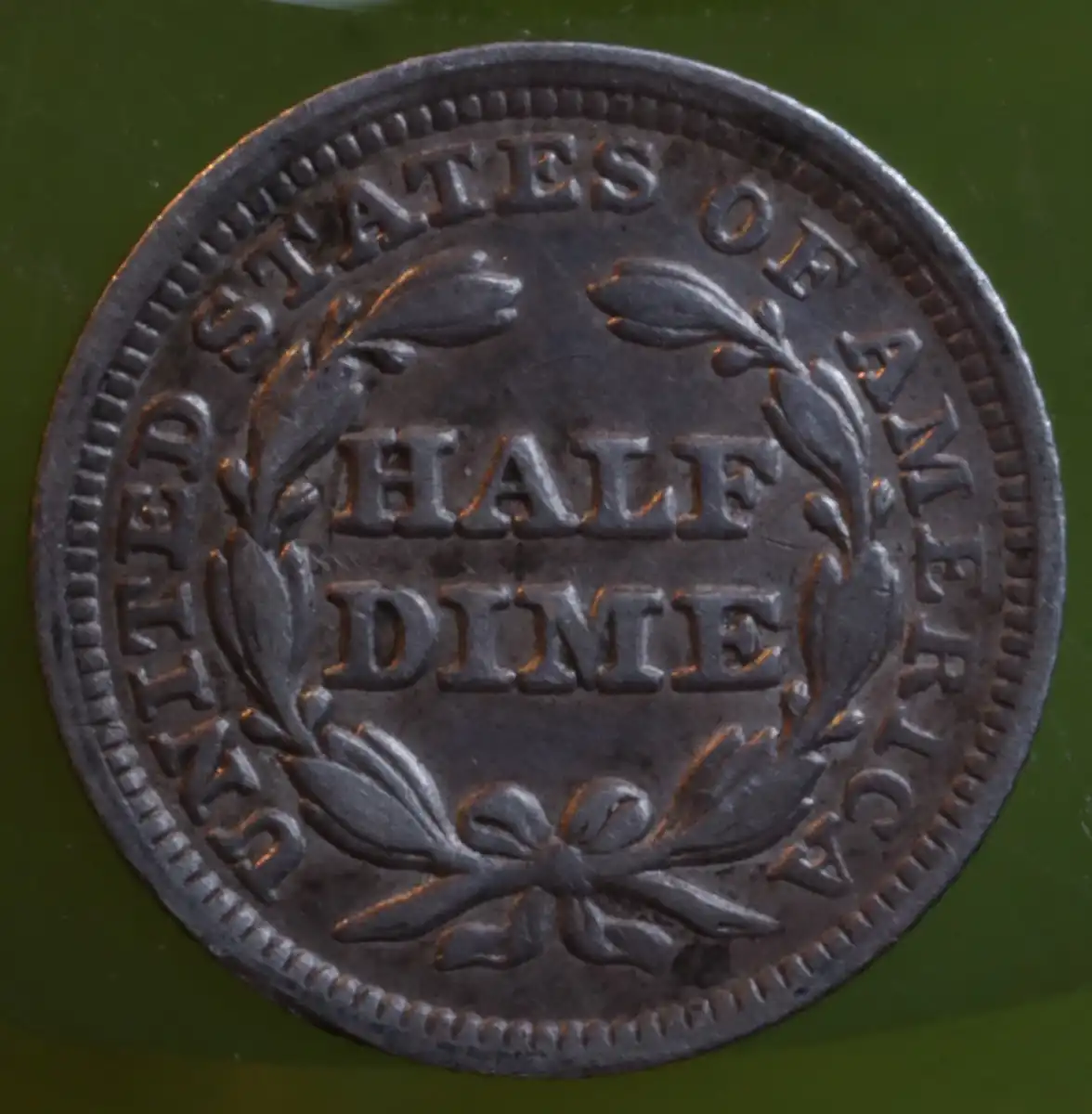 Do not read this sentence.
|
|
Pillar of the Community
United States
8947 Posts |
Tanner, thank you for that link, extremely helpful with a series of coin I know little about. -makecents-
|
|
Pillar of the Community
United States
8947 Posts |
Quote:I'm still wondering what the little dag at the right of the 9 is. Is that PMD? To me, it looks like a possible die gouge. You can see it traveling northwest inside of the 9 too and no damage to the coin that I can tell, which is why I think it is maybe a die gouge. 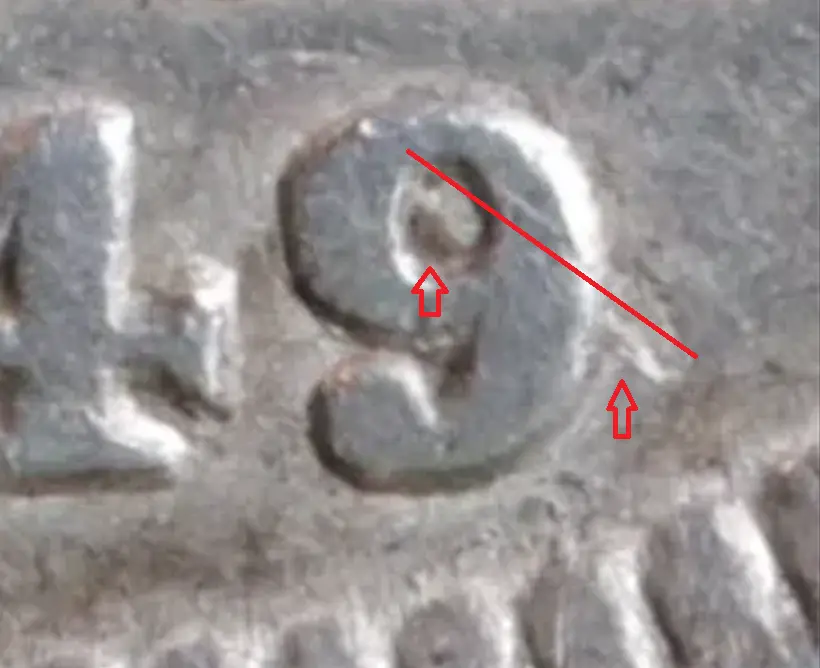 -makecents-
|
|
Valued Member
New Zealand
234 Posts |
Thanks for that analysis of the 9, makecents, and noting the die crack first. And thanks, tanner, for further links. All help much appreciated.
Do not read this sentence.
Edited by Buffalo soldat
07/11/2026 9:17 pm
|
|
Pillar of the Community
United States
8947 Posts |
Quote:
I don't think itis an over date, doesn't seem to match up with the NGC image It's not an overdate and neither is the NGC image. -makecents-
|
|
Pillar of the Community
United States
8947 Posts |
Quote:
Thanks for that analysis of the 9, makecents, and noting the die crack first Actually Altaira mentioned it first and made me look again, I would typically notice such things but was paying too much attention to the date. Quote:
I wish NGC has full photos of the coin to match that die crack Quote:
And thanks, tanner, for further links. All help much appreciated. Just so you know, Buf, Tanner (Tanman2001), is an attributer for the Wexler/doubleddie.com site which is one of the most highly thought of attributing sites and he is a VERY sharp individual, just sayin.... -makecents-
Edited by -makecents-
07/12/2026 12:11 am
|
|
Valued Member
New Zealand
234 Posts |
Thanks, tanner, makecents, altaira and all for feedback. So many helpful folks, it's hard to keep track. Glad to be clear on the difference between an RPD and OD. I'm still kind of staggered by the difference in reverse fonts. I guess that's 19th century coin making for you.
It does look live V9, tanner, although there's still the little element off the right of the nine, a die gouge as makecents suggests. In the Valentine's the closest I could get was V8a obverse/V6 obverse.
Do not read this sentence.
|
|
Moderator
 United States
194256 Posts |
Good to see a happy conclusion. |
|
Pillar of the Community
Canada
2527 Posts |
Tanman2001, I not aware of that website. Thanks for the link, always good to see collectors are still doing the good work. You got yourself an attribution! Cummins' V-9 corresponds to Valentine's obverse V-8a and reverse V-6. Buffalo soldat, if you send an email to the webmaster, maybe he has some more information about the anomaly on the "9" that's still unpublished. Use this link to see the Daniel Valentine book full screen. I don't know how to zoom it in on the NNP website either. https://archive.org/details/uniteds...shalf00vale/An updated reprint of this book was published in 1975, referenced as the "Quarterman reprint", but I can't find it. Something else I came across while searching, Breen supplement to Valentine's Half Dimes book: https://nnp.wustl.edu/library/book/535864The NNP is a truly treasure trove for stuff like this. |
|
Page 2 of 2
|
Replies: 25 / Views: 1,117 |
Page 2 of 2
|







 First Page


 Posted 07/10/2026 12:23 am





