Before I dive into the 1982 proposals for United States ("US") gold bullion coins that were introduced in Congress, I believe it's appropriate to review some events initiated in 1980 that helped shape the coin bills that were to come in 1982.In February 1980, Frank Church (D-ID) introduced a bill in the US Senate that sought "to amend the Bretton Woods Agreements Act to authorize consent to an increase in the United States quota in the International Monetary Fund." ("IMF") The bill also outlined various US policies regarding the IMF.
The Church bill was referred to the Senate Committee on Foreign Relations, and then, after the Foreign Relations Committee reported it, the bill was referred to the Senate Committee on Banking, Housing and Urban Affairs. The bill was again favorably reported by the referred Committee. The Senate considered and passed an amended version of the bill, then sent it to the House of Representatives )"House") for its consideration. It was passed in the House and presented to the President for approval; US President Jimmy Carter signed the bill into Public Law on October 7, 1980.
While being considered in the Senate, in June 1980, Church's IMF-focused bill was amended via a proposal by Senator Jesse Helms (R-NC). Helms' successful amendment added a provision that directed the Secretary of the Treasury (Donald T. Regan) to establish and chair a commission that was "to assess and make recommendations with regard to the policy of the United States Government concerning the role of gold in domestic and international monetary systems."
With the overall bill's approval, a commissioned study of potential US gold bullion coins became a reality!
Per its authorizing legislation, the Commission was to consist of:
1) three members of the Board of Governors of the Federal Reserve System
2) two members of the Council of Economic Advisors
3) one majority and one minority member each from
>>> the Joint Economic Committee of the Congress
>>> the Committee on Banking, Housing, and Urban Affairs of the Senate
>>> the Committee on Banking, Finance and Urban Affairs of the House
of Representatives
4) minority leaders of the House and Senate
5) four distinguished private citizens with business, finance, or academic backgrounds
Gold Commission Roster (from Report)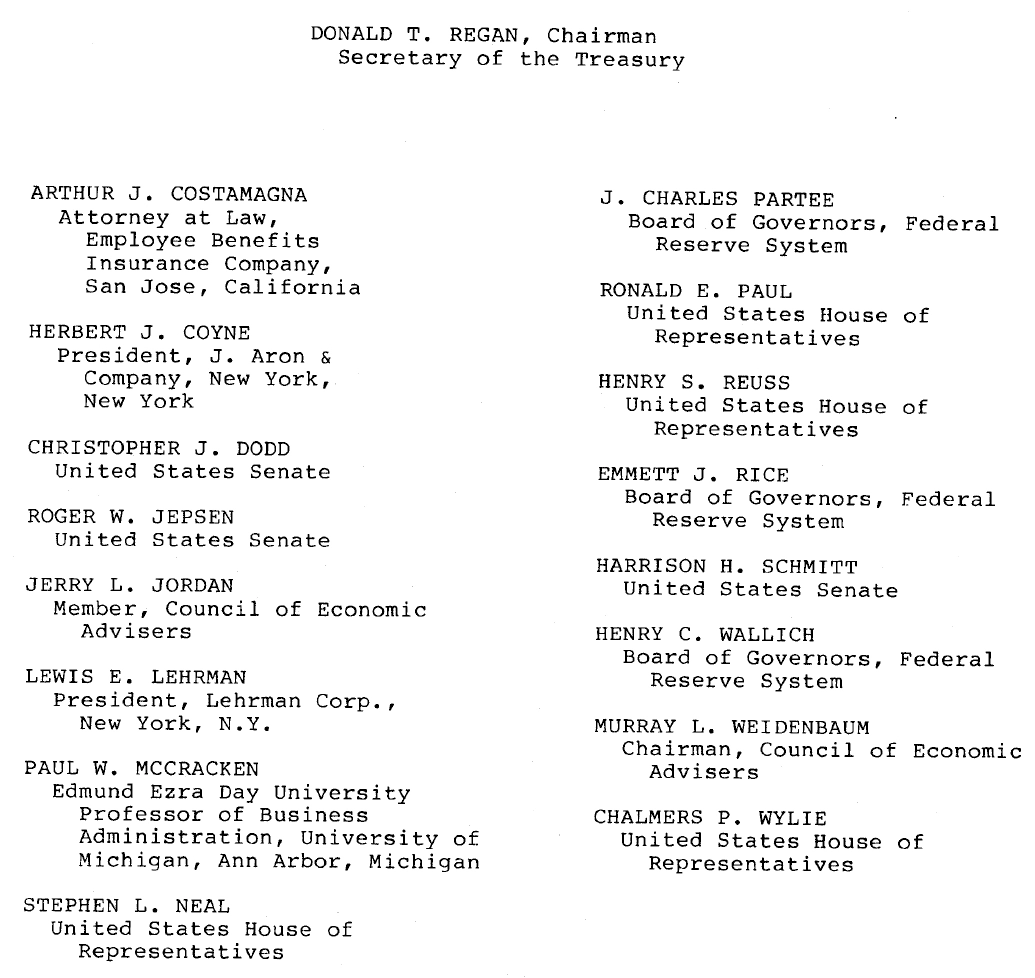 Note: The Commission' s 1982 Report lists 16 members plus the Secretary of the Treasury/Chairman vs. the 17 specified in the legislation. Paul MsCracken filled two spots in the Commission: Private Citizen and Economic Advisor. At the time of the Commission, he was serving on President Ronald Reagan's Economic Policy Advisory Board.
The Commission was certainly set up to be a knowledgeable group that could make reasoned recommendations to Congress!
The Commission's
Report, delivered to Congress in March 1982, outlined several recommendations regarding the handling of US gold bullion:
1) It supported improvements to the program of American Arts Gold Medallion sales along the general lines that the Treasury had outlined. (The Treasury's planned improvement was the establishment of a dealer network for direct public sales vs. through a cumbersome process at US Post Offices. See
1980-84 American Arts Gold Medallions for more about the Post Office based sales process.)
2) The Commission favored the issue of gold bullion coins,
without dollar denomination or legal tender status. (Majority Recommendation) It did not specify recommended coin weights.
Note: The issue of gold bullion coins was not favored by all members of the Commission. A Minority within the Commission opposed the issue of Federal gold bullion coins.3) The Commission recommended that gold bullion coins be exempt from capital gains taxes as well as sales taxes.
It should also be noted that some members of the Commission favored a US return to a gold standard for its money, while others opposed it. (The opposition won out.)
Based on its study of and recommendations for the use of the US gold reserves, the Commission's
Report should be considered a 'foundation' for the future US gold bullion coin program.
I'll take a look at the 1982 bills and Subcommittee Hearing about the House proposal in the next installment.For other of my posts about commemorative coins and medals, including other US modern-era US coin stories , see:
Commems Collection 






 Replies: 4 / Views: 69


 Posted Yesterday 9:58 pm





