As mentioned in
Part I - The Journey, the 1988 Seoul Olympics coin program featured a Gold Half Eagle and a Silver Dollar; each coin was mandated to present a design that was "emblematic of the participation of American athletes in the 1988 Olympic Games." The Secretary of the Treasury was to have final design selection authority.
Gold Half Eagle ($5.00)The coin was struck on a 0.900 fine gold planchet, with a diameter of 21.6 millimeters and a weight of 8.36 grams. It was available in Proof and Uncirculated versions.
The Issue Price of the Proof was $205/$235 (Pre-Issue/Regular); the Uncirculated pricing was $200.00/$225.00. The coin sold a total of 344,378 units (281,465 Proof; 62,913 Uncirculated).
1988 Seoul Olympics Gold Half Eagle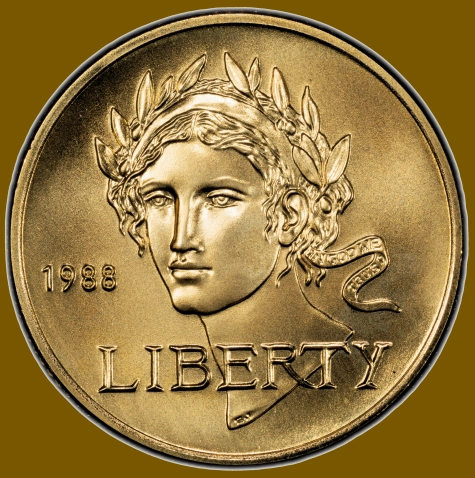
The obverse of the Gold Half Eagle depicts
Nike. the Greek goddess of Victory; she wears an olive branch crown. The design was created by Elizabeth Jones.
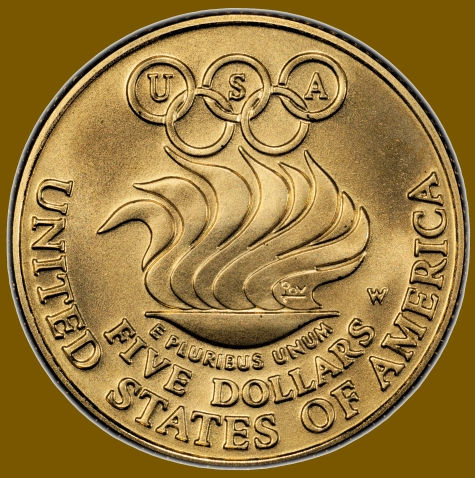
The Half Eagle's reverse presents the Olympic Flame with the Olympic Games ring logo above it. Marcel Jovine was responsible for the design.
I've always liked the juxtaposition of a classical obverse design with a modern reverse design - I think it effectively simultaneously captures the spirit of the Ancient Olympic Games and the Modern Games. As I've mentioned before, it is one of my favorite designs of the Modern US series.
Silver DollarThe Silver Dollar was struck on a 0.900 fine silver planchet, with a diameter of 38.1 millimeters (1.5 inches) and a weight of 26.73 grams. It was available in Proof and Uncirculated versions.
The Issue Price of the Proof was $23.00/$29.00 (Pre-Issue/Regular); the Uncirculated pricing was $22.00/$27.00. The coin sold a total of 1,550,734 units (1,359,366 Proof, including 231,661 in Prestige Sets; 191,368 Uncirculated).
The coin's obverse design presents the Olympic torch (left) merging with
Lady Liberty's The torches are flanked by olive branches. The design was created by Patricia L. Verani.
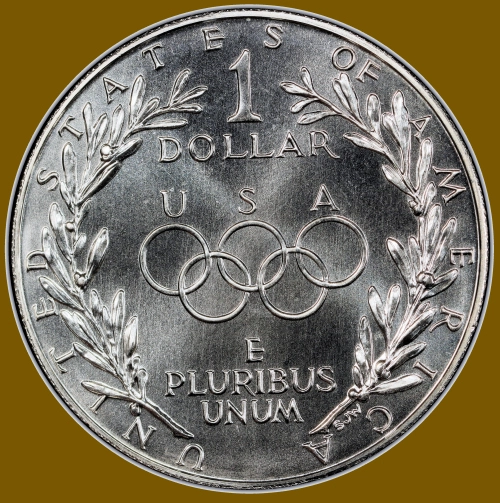
Note: An olive branch wreath was awarded to winners of events at the Ancient Olympic Games - no medals. Then, as now, the olive branch is a symbol for the Games' goal of encouraging peace.The reverse design of the Silver Dollar presents the five-ring logo of the Olympic Games at center, flanked by a pair of olive branches. The design is credited to Sherl J. Winter.
In contrast to my appreciation of the designs of the Gold Half Eagle, I find the designs of the Silver Dollar to be subpar. The symbolism intended by the obverse design is OK, but the reverse design strikes me as simplistic, lazy and uninspired. (That said, the designs are likely better than I could produce - I'm not an artist!)
1988 Seoul Olympics Silver Dollar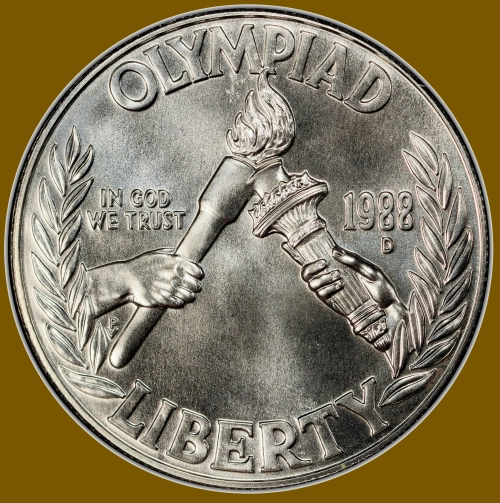
As typical, I went with the Uncirculated version of each coin - I prefer the aesthetics of the Uncirculated coins.
For other of my posts about commemorative coins and medals, including other Modern US Commemorative Coin stories, see:
Commems Collection









 Posted Today 55M ago


