| Author |
 Replies: 28 / Views: 3,295 Replies: 28 / Views: 3,295 |
Page 2 of 2
|
|
|
|
Pillar of the Community
United States
2936 Posts |
If I might, I would recommend for your reading pleasure "Profitable Coin Collecting" by David L. Ganz. He is a past President of the ANA and takes a historical perspective and applies it to modern day collecting. I'm taking his advice, not in my collecting, but in my investing in a certain type of modern coinage.... Paleoguy |
|
Pillar of the Community
United States
1302 Posts |
weighing in here on "investment". You can only make wise investing choices when you can account for most of the variables. In coins you really can't "invest" in that way. The "investment" grade in each coin or each series requires really good knowledge of what is out there. Classic commemoratives are a poor investment in common grades but a fair to good investment in premium grades. The typical grade of each coin depends on the series. Maryland's tend to come pretty nice so that MS-63 is on the lower end of the problem free surviving population. Having something on the low end of the population typically is not a good idea only because people want the best of what is available.
Let's pretend that you have a coin in MS-63 and these are the populations and the values:
MS-63   $150 13,250 approximate pieces
MS-64   $220  8,252 approximate pieces
MS-65   $350  3,252 approximate pieces
MS-66   $500    850 approximate pieces
MS-67 $1,500    103 approximate pieces
MS-68 $8,000      6 approximate pieces
what can you gather out of these values. Does the 63 look like the coin you'd want? Is it worth jumping from 63 to 65? Keep in mind, numismatics has some tradition in play to color people's expectations. MS-63 and MS-65 are traditional steps and 64 is considered an in between grade. I avoid 64 whenever possible because most dealers consider 64 to be a pretty 63. Needless to say, it's not a 65 and collectors like 65 and above.
Your coin could be great. Lots of 63s are. So don't get down on your coin. Just think about what I've just laid out. Think about the variables you can control and how you can read what's out there. Conditions very per coin, per mint, per series, per date... the more you know the better your potential for making money in selling the coin later.
|
|
Moderator
 United States
15940 Posts |
 with CC wise comments relative to the classic silver commemorative series and his detailed description of the values/population for the Maryland example. Well stated CC.  Since we are on the topic ... allow me to add another dimension that is critical if one truly wishes to purse 'investment' grade coins ... that is eye appeal. An ugly coin ... regardless of grade ... will always be ugly. Same for a damaged coin and a common coin ... these will always be viewed as 'less than the best' and hence suffer a tough road for any possible price appreciation. Eye appeal in my definition is a combination of two elements ... strike quality and visual impact of the surfaces. The good news for dedicated collectors is that many (most ?) collectors simply pay attention to the number on the plastic holder and do not consider strike quality or visual impact ... so there exists a great opportunity for the educated collector to select at no additional cost great coins that regardless of grade will always be great coins. The connoisseurs out there know better ... and selecting connoisseur level coins ... regardless of series or grade ... IMHO is where potential price appreciation might happen. Not to steal your thread ... but here is a photo of a connoisseur level Maryland half dollar ... impeccable pedigree at PCGS MS66/CAC approved .... stunning blast white surfaces ... strong strike ... extreme cartwheel luster ... overall exceptional eye appeal. 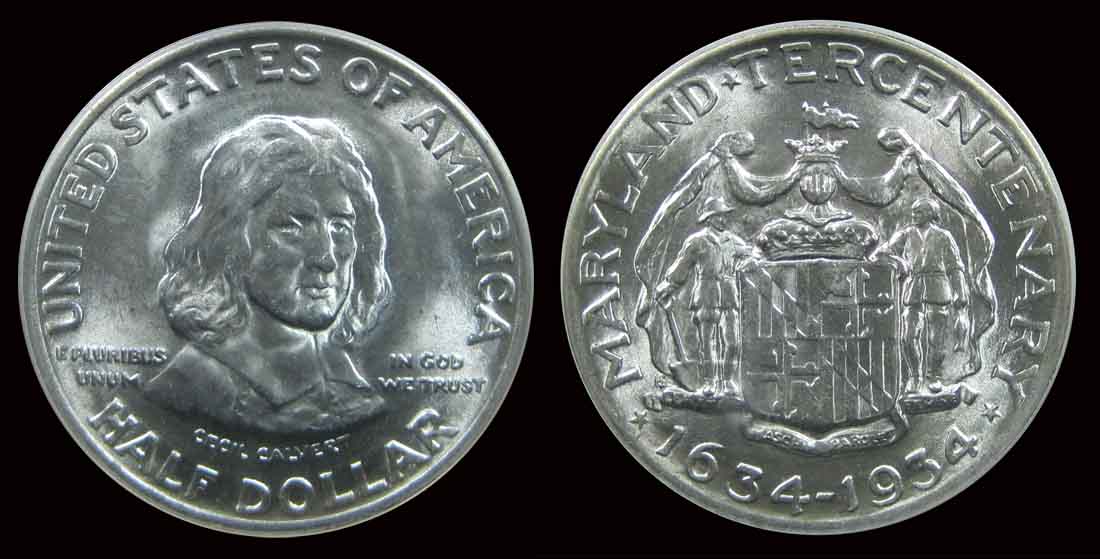 I did not purchase this as an 'investment' ... but coins such as this one have a better than average chance of retaining or even increasing their value over time. David |
|
Rest in Peace
United States
9104 Posts |
making this visibly easier: Quote:
MS-63 $150 13,250 approximate pieces
MS-64 $220 8,252 approximate pieces
MS-65 $350 3,252 approximate pieces
MS-66 $500 850 approximate pieces
MS-67 $1,500 103 approximate pieces
MS-68 $8,000 6 approximate pieces what can you gather out of these values? Does the 63 look like the coin you'd want? Is it worth jumping from 63 to 65? Keep in mind, numismatics has some tradition in play to color people's expectations. MS-63 and MS-65 are traditional steps and 64 is considered an in between grade. I avoid 64 whenever possible because most dealers consider 64 to be a pretty 63. Needless to say, it's not a 65 and collectors like 65 and above. I'd say 66 is the sweet spot in this example, 65 second best. |
|
Pillar of the Community
United States
1302 Posts |
@Dave and @BiggFred - what if you could get a CAC 67 at $1200 money? You do that (assuming you have an interest in "investment quality" coins in this series?
|
|
Valued Member
 United States
214 Posts |
Wow thats a beautiful coin nickelsearcher! I love the luster on it. Also, you mentioned the strike quality of a coin. That is something that I hadn't considered before. Thank you. Also, being from MD, what coin store would you recommend. I like my friendly neighborhood one in Aberdeen, but where would you recommend I'd go for high end stuff?
The breakdown of the different numbers of coins was interesting to look at. Its surprising to see the jump from the number of ms63 coins to the number of ms 68 coins.
Paleolguy: I will pick up that book. Seems like something I'd like to read, and I need new reading material anyway.
Matthew: Your analysis of investment level coins is very insightful. From what I gather, the commemorative coin market is rather niche. So it would make sense to "invest" in coins that a lot of people would want; hence the rare SLQ or the 1909 vdbs.
CC9999: Good point about the series as a whole. Maybe I'll shop around for a higher end Maryland coin to keep it company.
Thanks Biggfredd and CC9999 for the data
Dont get me wrong, I really do like the coin. It was my first slabbed coin, so its kinda special to me. As for pics. I will have to wait til my sister comes home with her nice fancy camera. I dont think my cell could do it justice lol.
|
|
Valued Member
United States
214 Posts |
I also meant to say thank you everybody who responded. There was a lot of information in all the comments!  Thanks again! |
|
Pillar of the Community
United States
1302 Posts |
@jizer, et al... please understand the numbers I gave were made up to illustrate a point. Coinfacts and NGC.'s website have their numbers but they are by no means accurate or complete...
c
|
|
Rest in Peace
United States
9104 Posts |
Quote:
what if you could get a CAC 67 at $1200 money? If you're collecting them, OK, but commems are a manipulated market. |
|
Pillar of the Community
United States
1302 Posts |
@bigg- if you are interested in digging into the numbers- nearly every coin is manipulated in price.
I've done regression models from most major coin series since the 1950s and there's clear evidence of industry "manipulation" of prices throughout this period. Furthermore, when you consider that dealers routinely destroy coins they buy so as to more quickly profit from their purchase through the melting of coins- you can see not only market manipulation on the price side but also on the supply side.
|
|
Moderator
United States
196100 Posts |
Just more reason to only collect and not invest in coins.  |
|
Rest in Peace
United States
9104 Posts |
Quote:
when you consider that dealers routinely destroy coins they buy so as to more quickly profit from their purchase through the melting of coins- you can see not only market manipulation on the price side but also on the supply side. Silver coins getting melted aren't manipulated, but based on what comes in the door. It's not like dealers are telling people to bring in 32d quarters so they can melt them. I agree that all series are manipulated to some extent, but it's a lot harder to manipulate Morgan dollars with some dates with 55,000 in ms65, vs commems where 55,000 would be a large mintage of some issues. |
|
Pillar of the Community
United States
1302 Posts |
@BiggFred- Morgans are manipulated too. Trust me. When prices rise by a buck or so a year for no reason- other than dealers agreeing to raise the prices gradually over time to simulate the appearance of demand- you have manipulation. Even when you take inflation into account- you see manipulation in the market. The only argument I am making is that you cannot look at a price guide and believe that it reflects demand because it is much more complicated than that. There is certainly evidence of price fixing in order to instill the notion of collectibility. The funny thing is, there's also price suppression for certain series as well. Take the Eisenhower dollar series. If you look at the Red Book, you see that they base their prices on MS63. This is a non-collectible grade and very curious considering it is a modern series and gem examples are available. I think in this instance, dealers have so much stock of sub gem/ slider Ikes that they don't want demand to build up for Gem examples because that would make it harder to sell what they have in stock. An MS-66 1971 or 1972 Type 2 ike is worth mas much as a Hawaiian in MS-64... but you wouldn't know that there's a single Ike worth more than $70 if you only read Red Book. |
|
Rest in Peace
United States
9104 Posts |
And the dealers are in cahoots, too.
Back in 1980, there was a teletype dealer paying $47.50 for brown 74 Ikes (not the scarcer 73), but he only advertised occasionally. We were constantly on the machine, so we got a bunch at $40 and had them drop-shipped to him. This went on daily for at least three weeks.
Greysheet never showed them over $18.50, IIRC.
|
|
Pillar of the Community
United States
1302 Posts |
that's a great anecdote Biggfred, thanks for sharing that with me. It's amazing that in 82 the 73 Proof was a $125 coin. Ikes are truly wonderful and confusing series.
|
|
Page 2 of 2
|
Replies: 28 / Views: 3,295 |
Page 2 of 2
|








 First Page


 Posted 02/06/2012 12:26 pm


