| Author |
 Replies: 48 / Views: 8,997 Replies: 48 / Views: 8,997 |
|
|
|
|
Moderator
 United States
196572 Posts |
Good job. It will definitely be interesting to see how other results compare.
|
|
Rest in Peace
 1988 Posts |
Well Conder101 and jbuckHere are the NON scientific analysis of the same coin on 2 different surfaces. I used a 1973 American half dollar for the test. 1 - Dropped the half dollar on a solid maple table. 2 - Dropped the half dollar on a piece of you channel aluminium isolated from the table by a writing pad. Ya, I know, it isn't very scientific, but it is a start..Remember, Alexander Graham Bell didn't have Skype (ha,ha) I noticed that there are certain frequencies that are extremely regular no matter what the material. The frequencies are: 1 - 7000 hz 2 - 12000 hz 3 - 16000 hz 4 - 19000 hz   |
|
Moderator
United States
196572 Posts |
The metal is definitely adding some noise to the readings, but I see the similarities.
This tells me it may be best to use a wood surface and avoid "metal on metal" contact.
|
|
Rest in Peace
1988 Posts |
You are soooooo correct jbuckEveryone can get their hands on a piece of wood....  BUT BUT, this is far from perfect...Lots of work to do. Maybe the wood should be isolated with pieces of rubber..Just a thought. |
|
Bedrock of the Community
United States
17884 Posts |
These results are encouraging. I do believe that it would be possible to make comparisons from one person to another, especially dropping on wood. I think the wood is giving the large mass of low frequencies but it also damps itself and allows the high frequencies of the coin to come through clearly. The metal plate adds to may of it's own high frequencies to the spectrum.
|
|
Rest in Peace
1988 Posts |
ah..... Conder101...Someone is catching on...Good observation. You are correct about wood dampening the frequency response of it's own mass. This (as you said) will allow the frequency of the coin to come trough without secondary frequencies interfering with the results...Yes I can separate them, but hey, why do that when I don't have to. Maple is a hard wood, but low frequencies...The (almost) perfect material...And anyone can get a hold of a piece of maple and say, cut it to 6x6x1 inch (centimetres in Canada..ha,ha) Still trialling it for a while...Wish me luck....  Below is an experiment with the same (two 2009 Canadian dimes)coins. They were both dropped on 1" maple table. first 2009 dime: 1 - Cursor frequency....21950 Hz 2 - Peak frequency......21755 Hz 3 - peak................77 dB Second 2009 dime: 1 - Cursor frequency....21816 Hz 2 - peak frequency......21544 Hz 3 - peak................77 dB That is pretty darn close if you ask me...  Remember, this was done with a built in microphone in a laptop...Not a plugged in mic really close to the coins.   Edited by wert
03/10/2012 7:11 pm
|
|
Moderator
United States
196572 Posts |
Good work.  |
|
Rest in Peace
1988 Posts |
Hi jbuck ...Thanks again for the encouragement. I will have (what I think is) a standard to go by...(within a week) Just trying out my new USB microscope with a goose neck to hover directly over the coin at the same height each and every time. I hope there are people out there that are looking forward to a NEW tool to work with. Below is a picture of the USB microphone I bought at Best Buy for $35.00 (Canadian of course)  |
|
Moderator
United States
196572 Posts |
If I ever get around to giving this an honest test, I will probably use my trusty headset mic at first. I also have one of these at work.  |
|
Bedrock of the Community
United States
17884 Posts |
I am very impressed with the results of these tests. Other tests I could envision would be ring tests rather than drop tests. Tests to see how much variability there is between dates in a series. Differences if any in the same date between mints. What I am wondering is could reference spectrums be produced that could be used as another tool for detecting counterfeits? I don't know if that is feasible, but I'd like to see more results. Since I have the laptop and software I guess I should start running my own tests as well. I don't think my laptop has a built in microphone though so I'll have to pick one up.
|
|
Rest in Peace
1988 Posts |
Conder101...Very cleaver noticing that a ring test would produce another form of frequency testing...I thought of trying that and was wondering with what should I do the ring teat with...Most obvious is making contact with a suspended coin with another piece of metal, but as one of my posts inferred, the metal sounds would have to be manually separated from the frequencies of the coin itself...But worth trying. Also you are catching on to what this tool can be used for: 1 - Frequency differences between same year coins(counterfeits) 2 - Identifying incorrect planchets. 3 - etc. Would like a lot of input from you guys...I am not a coin expert just a thinker... Hope to have a prototype with pictures at the beginning of next week...Then you can tear me and my model apart... 
|
|
Valued Member
United States
292 Posts |
Quote:
Hope to have a prototype with pictures at the beginning of next week...Then you can tear me and my model apart... I love tearing things apart! :D You may want to look at creating a control or multiple controls. Eventually you'll be able to identify how your reaction material shows up on the graph. If you can isolate the frequencies of your reaction material and then remove them leaving only the coin frequencies you'd really be in business. You have many things to account for trying to isolate the reaction material from the coin, though. Material type and all of its properties and then each individual coin's properties will likely react differently with each reaction material. |
|
Rest in Peace
1988 Posts |
ContraJame..You are correct, I have given thought to that very problem and I am trying to isolate ONLY what is needed and am doing an experiment 3 times to get an average....This is still not scientific enough for me...But see below...3 times and then average it out and added bar charts so the average person can see how close it is becoming. 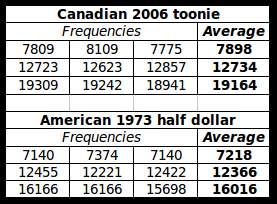 THIS IS THE 2006 TOONIE 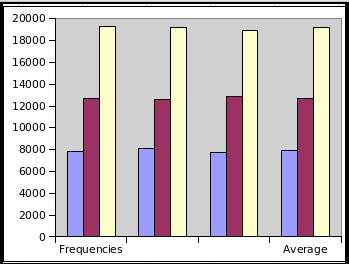 THIS IS THE 1973 AMERICAN HALF DOLLAR 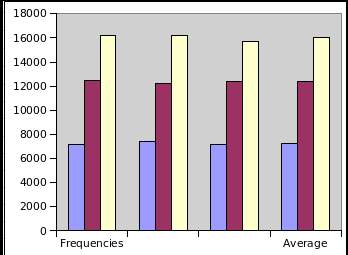
|
|
Rest in Peace
1988 Posts |
Hi guys I have created a PDF file and a WORD file explaining the coin analysis system...If anyone is interested, please e-mail me and I will gladly send it along. If no one is interested, that is OK....I will still be creating a database of coin frequencies on my own....  Thanks WERT |
|
Moderator
United States
196572 Posts |
|
|
|
Replies: 48 / Views: 8,997 |
|








 First Page
 Previous Page


 Posted 03/09/2012 3:00 pm


