| Author |
 Replies: 21 / Views: 12,228 Replies: 21 / Views: 12,228 |
Page 2 of 2
|
|
|
|
Pillar of the Community
United States
1549 Posts |
Quote:
Thank you for your responses! Could you please explain to me what is "the fabric" of a coin?
Do you have any idea since when (approximately) have copies been circulating? 'Style' is the art of the die used to strike coins. 'Fabric' is the sum of technical details that make up everything else about the way our coins were made. These are mostly details of planchet preparation that have left artifacts on the final product. More: http://www.forumancientcoins.com/do.../fabric.htmlIn the earliest years of the 1800's a young German Karl Becker bought a fake gold coin of Commodus from a shady noble collector. When he discovered that he had been cheated, he went to the seller who told him that that was what you get for meddling in something you don't understand. In the day, collecting ancient coins was largely reserved for the aristocracy and a commoner showing interest in the hobby was 'social climbing'. Becker took it as a personal challenge, taught himself die engraving and produced a large variety of very deceptive fake ancients which he sold as genuine to aristocrats and museums that knew less about the subject than he did. His dies were used to strike reproductions for many years after his death and copied by later fakers including Peter Rosa into the 20th century. Original Becker fakes are worth something approaching the cost of the coins they copied (or more). Most fakes don't have the pedigree or the quality of Beckers but they have been in constant production since years before 1800 (remember Becker got started because he was cheated by a fake coin). The modern country (kingdom) called Greece was not founded until after Becker had been making fakes for 25 years. I would love to be able to suggest your coin might have been a Becker used to defraud a Greek noble but his fakes are much better than this one. Unfortunately cheating people who should not be dabbling in something they don't understand is an attitude not restricted to the Baron who cheated Becker. That is why I say that anyone new to ancient coins should buy from a trusted source. I am not terribly proud of my attitude on the matter but I do believe that anyone who buys a $10,000 coin like this dekadrachm without either a trusted dealer or a lot more expertise than I have deserves what he gets. I have to wonder if any fakes have made their way into my collection without my knowledge (I have a few that I bought as fakes so they don't count). |
|
Bedrock of the Community
United States
10045 Posts |
Doug, that story about Karl Becker sure is something--classic revenge story, it could be a movie!  Red_Drop--the genuine Syracuse decadrachms are some of the most valuable ancients ever--and some of the best examples of ancient die work. Here is a real coin for comparison:   Edited by DVCollector
07/06/2012 1:38 pm
|
|
Pillar of the Community
United States
1315 Posts |
Unfortunately this is not a good photo, but there are many similarities between the OP coin and this one. Found at Dr. Ilya Prokopov's Fake Ancient Coin Reports. I would put a link but I can't ever get Forvms links to work....? 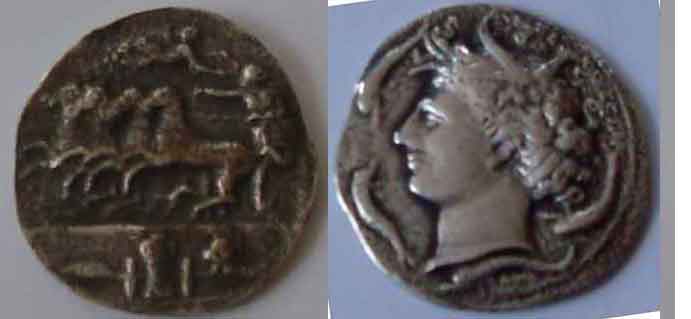 |
|
Moderator
 Australia
17012 Posts |
To get a working link from the FORVM fake database, click on the little "i"-for-information button in the blue toolbar above the picture; that gives you more information about the file, including the permanent URL to use when cutting-and-pasting. In this case, the URL you want is: http://www.forumancientcoins.com/fa...hp?pos=-6810Don't say "infinitely" when you mean "very"; otherwise, you'll have no word left when you want to talk about something really infinite. - C. S. Lewis
|
|
New Member
 Finland
4 Posts |
Wow! I'd like to thank all of you!
Doucet, thank you for the photo! What does OP stand for?
dougsmit, I really enjoyed reading the story, thank you!
Edited by Red_Drop
07/06/2012 10:21 pm
|
|
Pillar of the Community
United States
1315 Posts |
OP = Original Post
Red Drop, your welcome for the pic, sorry there wasn't better news..... welcome to the Ancient Forum.
Sap, thank you for the link tip. I'll try it next time.
|
|
Bedrock of the Community
Australia
21793 Posts |
By the looks of the fabric of the genuine coin, there appears to be a casting sprue on opposite ends of the diameter. This is normally the case with the genuine coins of this famous type.
That being the case, it is very probable as dougsmit has suggested in his notes, that the blanks for the genuine coins have perhaps been cast in horizontal shallow, interconnected stone cup shaped pits, in a horizontal stone slab.
Taking this line a little further, I would speculate that some sort of pre counterweighted balance may have been used, that would easily and accurately gauge the amount of molten silver that would have been poured into each mold. The moulds would have been interconnected across their diameter as the remains of the casting sprues suggest.
The blanks would have been struck hot, immediately after initial solidification.
There does not appear to be any evidence of casting sprues in the pictures that Red_Drop has kindly provided.
|
|
Pillar of the Community
United States
1549 Posts |
I believe that at least some Syracuse coins were struck on globe shaped blanks that were cast in a chain connected by sprues. When these were broken apart, no effort was made to remove the sprues. Sometimes when a blank was placed between the dies, the sprue was up or down so it was erased by striking pressure. Sometimes the sprues were side to side so the final struck coin retained the sprue from the blank. This system is particularly appropriate for very high relief coins like the Syracuse bronze litra and silver with the high relief head of Arathusa. The litra below was weakly struck so the flan is rounder, thicker than many with weakly struck edges clearly showing ridges that once were sprues.  I don't have many silver coins to show but the effect can be seen on this Akragas stater as well. 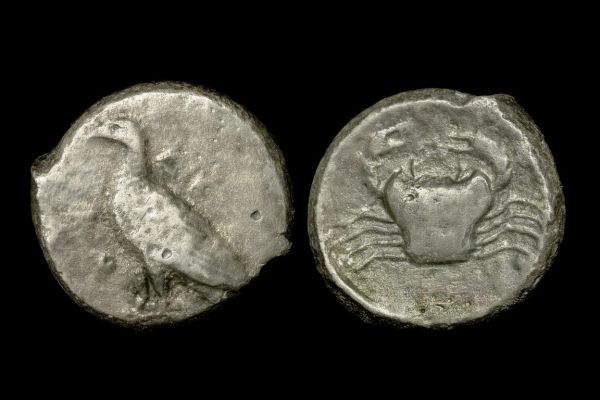 I suspect that other cities may have prepared flans in a similar manner but took the additional step to remove the sprue before striking or, perhaps, hammered the flans to flatten them a bit so the flan became more of a disk than a globe when placed between the dies. We need to remember that every city and every mintmaster could have their own ways of handling these details so the 'fabric' is expected to vary from place to place and time to time. |
|
Bedrock of the Community
Australia
21793 Posts |
Perhaps it might be worth explaining what the word "fabric' has to do with ancient coins, or any other coin, for that matter.
Obviously, it has nothing to do with textiles.
I once had a car, and on the tire was marked:
"Fabrique en Angleterre" - translated means "Made in England".
Often, we are not exactly sure how a particular type of ancient coin was made.
Nevertheless, if a fake of that coin was made from a different method of manufacture (fabrication), that method will betray the coin to be a fake if you know what to look for.
In the case of the subject coin in this discussion, the fake was revealed by the lack of the remains of casting sprues at opposite ends of the diameter.
|
|
Pillar of the Community
United States
1549 Posts |
|
|
New Member
France
2 Posts |
Hey all, I've recently obtained this coin that corresponds to the same coin shown in this forum. Although it is highly rusted, I would like to know if it could be an authentic coin or if it's just a fake copy. Best regards, 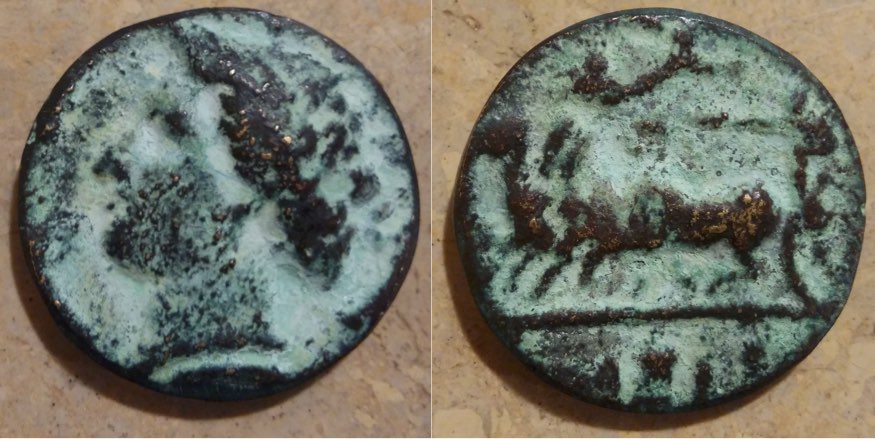 |
|
Pillar of the Community
3772 Posts |
Sorry to inform you, but your coin is certainly not the same type as the one pictured earlier in this thread. Here is a type which is closer to your coin: 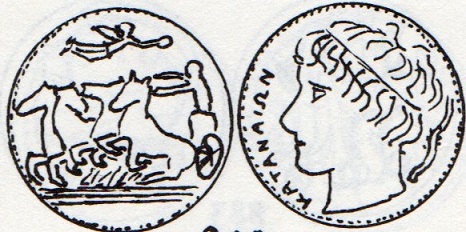 See the difference in the style of the quadriga? And the male head without any dolphins around? Btw, this type is from Katane in Sicily. Your coin looks rather like base metal, what is the weight and the diameter? Somehow the patina looks a little dubious, but based on the picture I cannot make a definite comment. |
|
New Member
France
2 Posts |
Thank you for your answer Medieval.
Yes, it's true that is not the same than in this thread. It makes sense that it is from Sicily since I got it in Cartage, Tunis, which is pretty close to Sicily (and there were lot of trading between Sicily and Cartage).
The coin weights 20.34g and it has a diameter of approximately 3cm.
Does it help? What else would you need to have a better idea of the authenticity?
Cheers,
Nicolas
|
|
Pillar of the Community
3772 Posts |
Please note, that I said the posted sketch is more similar to your coin than the other posted. The sketch is from Plant, a guide for helping to identify ancient coins. Unless one finds a real match one cannot fully attribute the coin.
With the ancient drachm having a weight around the 4.2g mark, your coin doesn't fit into any of the standard categories. From the picture I would suspect anyhow that it is not silver. Is it an authentic ancient coin? Cannot say for sure but I have serious doubt since the patina looks rather painted on to me - but wait to hear what others have to say.
|
|
Moderator
United States
23731 Posts |
to the community Sorry to say but your piece is not a real coin. A genuine Dekadrachm weighs in at little over 43 grams, and is made of silver. It would be well struck in high relief, and well defined, not like this piece. What you have is most likely a tourist piece and not very old at all. |
|
Page 2 of 2
|
Replies: 21 / Views: 12,228 |
Page 2 of 2
|





 First Page

 Posted 07/06/2012 1:37 pm


