Coin Community Family of Web Sites Join Thousands of Coin, Bullion, & Money Collectors
Specializing in Modern Numismatics Royal Canadian Mint products, Canadian, Polish, American, and world coins and banknotes. Vancouvers #1 Coin and Paper Money Dealer 300,000 items to help build your collection! Coin, Banknote and Medal Collectors's Online Mall Royal Estate Auctions - $1 Coin AuctionsJoin Thousands of Coin, Bullion, & Money Collectors


Username:
Password:
Save Password
Forgot your Password?


This page may contain links that result in small commissions to keep this free site up and running.

Welcome Guest! Registering and/or logging in will remove the anchor (bottom) ads. It's Free!

Antimachos I - Heads Or Tails?

To participate in the forum you must log in or register.
First Page  Showing last 15 replies.
Author Previous TopicReplies: 24 / Views: 4,319Next Topic Page 2 of 2
Pillar of the Community
United States
5155 Posts
 Posted 01/02/2013  8:20 pm  Show Profile   Bookmark this reply Add Ancientnoob to your friends list
BH- Thats how it is cateloged online and in Sear but, and normally I would agree with you- but it seems so unlike the Greeks to put any language ahead of Greek.I 'Cuz of that I am inclined to think that the obverse is Nike. You see how I am perplexed?

VK- Got the email, I will check the link thanks. Haven't got a chance yet. Thanks for reminding me.
Pillar of the Community
United States
1549 Posts
 Posted 01/02/2013  8:29 pm  Show Profile   Bookmark this reply Add dougsmit to your friends list
(Greek: Νικηφόρος, "Bringer of Victory")

Can you tell which side was on the anvil and which side was on the punch? I prefer using that as indication of which side is obverse (anvil) when possible. Famous examples are Corinth Pegasi and Syracuse chariots that are both obverses while the Athena heads are reverses.
Pillar of the Community
United States
5155 Posts
 Posted 01/02/2013  8:45 pm  Show Profile   Bookmark this reply Add Ancientnoob to your friends list
@ Doug- Thanks for the translation clarification...

The coin- If I lay Nike down with the king up the coin is very slightly concave.

Would I be correct in assuming that Nike is the "Anvil" side and the King the "Punch" side?

Pillar of the Community
United States
1549 Posts
 Posted 01/02/2013  8:59 pm  Show Profile   Bookmark this reply Add dougsmit to your friends list
Yes
Pillar of the Community
United States
5155 Posts
 Posted 01/02/2013  9:07 pm  Show Profile   Bookmark this reply Add Ancientnoob to your friends list
AH so indeed the Greek Legend is the obverse and the Kharosthi legend the reverse. I guess I was right on my suspicion. Very interesting, thanks for adding "dimension" to my guess work.
Pillar of the Community
United States
4973 Posts
 Posted 01/02/2013  10:54 pm  Show Profile   Bookmark this reply Add chrsmat71 to your friends list
i didn't know which way to guess, usually the greek is on the obverse and the king is on the obverse...here all mixed up.

anyway, another great coin AN!
Pillar of the Community
United States
1316 Posts
 Posted 01/02/2013  11:26 pm  Show Profile   Bookmark this reply Add Eng5858 to your friends list


Anoob, you sure can pick them, Wow, very nice, I would think the horse and rider would be the Ob.but maybe not...sweet coin any side you pick.....
Pillar of the Community
United States
4253 Posts
 Posted 01/02/2013  11:31 pm  Show Profile   Bookmark this reply Add Bing to your friends list
Pillar of the Community
United Kingdom
2624 Posts
 Posted 01/03/2013  02:53 am  Show Profile   Bookmark this reply Add DavidUK to your friends list
My gut says that the left is the obverse and the right is the reverse. Whether that is technically correct or not I really don't know but I know which looks like a heads and which looks like a tail.

Since it is traditional to have portrait on the heads (obverse) and tails on the reverse I still labeled my pegusus Corinth stater as such... but because my pegusus is so beautiful I turned it in the album so reverse is outwards. This punch/anvil criteria is interesting and something I had not given thought to. ^^

Pillar of the Community
United States
5155 Posts
 Posted 01/10/2013  3:40 pm  Show Profile   Bookmark this reply Add Ancientnoob to your friends list
Well I figured I would try to rez this thread...

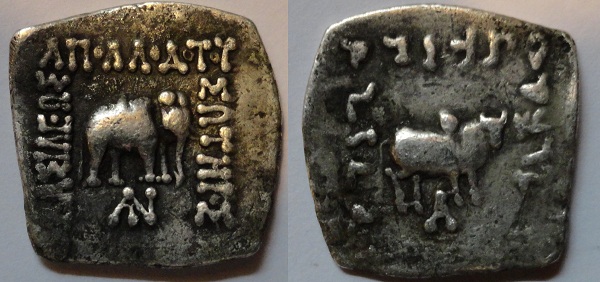
I was trying to do some reading on this ruler Antimachos I. Every time I come upon this coin type it is attributed to Antimachos II a contemporary of Apollodotus I. Both of whom did not strike tetradrachms in the Greek fashion but rather struck Indian standard drachms of approx 2.4g fine silver. So now I am wondering whats the deal with this coin and who is it really attributed to? Any people care to comment. Maybe those with more knowledge and time in the game then myself? Both kings were as far as I know suceeded by the great Menander I.
From what I have read this attribution of Antimachos II is due to the reuse of the certain monograms on the drachms of Menander, and the similar weight of the square Apollodotus I drachms.
coin #1
Bactria (Indo Greek) Indian Standard Weight..
Apollodotos I (174-165 BC)
AR Drachm 17.4mm x 17.0mm @ 2.29g
Obverse: Elephant Standing Right- BASILEWS APOLLODOTOY SWTHROS around AN monogram below
Reverse: Kharoshti Legend- Zebu bull standing monogram A
Antimachos-I---Heads-Or-Tails?

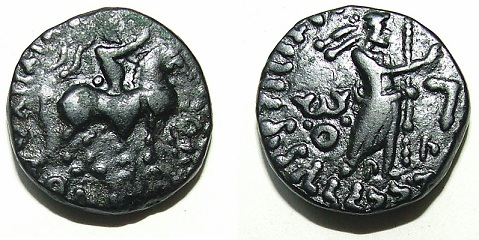
coin#2

The Original Post coin...
Edited by Ancientnoob
01/10/2013 3:43 pm
Pillar of the Community
United Kingdom
946 Posts
 Posted 01/10/2013  4:21 pm  Show Profile   Bookmark this reply Add Masis to your friends list

Quote:
Sellers Note: These bilingual drachms were struck during Antimachos' occupation of Gandhara and Taxila (Pakistan and North Western India)-Ancientnoob


It is interesting to learn this, as we know of the AE Tetradrachms issued by king Gondophares Sases in 55 AD were also in Greek and Karoshti.
They were issued at Taxila.


Quote:
My gut says that the left is the obverse and the right is the reverse. Whether that is technically correct or not I really don't know but I know which looks like a heads and which looks like a tail-DavidUK


It seems that in the lowland floodplains in which Taxila lay, Karoshti was the official language, and perhaps the side of the coin with Karoshti on it is the "heads" side?

Antimachos-I---Heads-Or-Tails?
Pillar of the Community
United States
5155 Posts
 Posted 01/10/2013  9:24 pm  Show Profile   Bookmark this reply Add Ancientnoob to your friends list
Very interesting thanks Masis. I think since we were able to determine what is front and back based on the way it was struck. The coin you posted is considerably later in date and I could consider it Kushan after the clan Yuezhi toppled the remnants of the Indo-Greek Kingdom. Weather the importance or the tradition of what was the obverse or reverse changed I don't know...but its interesting. Kudos.
Pillar of the Community
United Kingdom
946 Posts
 Posted 01/12/2013  12:31 pm  Show Profile   Bookmark this reply Add Masis to your friends list

Quote:
I could consider it Kushan after the clan Yuezhi toppled the remnants of the Indo-Greek Kingdom-Ancientnoob


It is interesting how Greek script continued to be a desired feature on the coinage of these nomadic kings.
I recall seeing a depiction of a coin of a king of Transoxiana (khwarazm) that had tried to use Greek, but the legend was all a blunder.

Gondophares IV "Sases" (circa 55 AD) is always confused with his predecessor and namesake, Gondophares I (circa 20 BC) and so is known more by the name of Sases.
http://en.wikipedia.org/wiki/Sases

Heraios seems to have been the first king of the Kushans, reigning from about 1 - 30 AD.
http://en.wikipedia.org/wiki/Heraios
Yet the Indo-Parthians remained free from the Kushan armies by the mountains of the Hindu-Kush.

It seems that after the death of Gondophares IV in 55 AD, whatever was left of his kingdom was overthrown by the Kushan armies led by Kujula Kadphises, second king of the Kushans (reigned circa 30 - 80 AD)

On Kujula...
"He invaded Anxi (Indo-Parthia), and took the Gaofu (Kabul) region." - Book of the Later Han (written in the 5th century AD).

On the Parthians, they were really Dahae tribes, inhabiting the region of modern Turkmenistan, since at least 500 BC.
http://en.wikipedia.org/wiki/Dahae
It was when Arsaces I led members of this tribe to invade Parthia, then under Seleucid control, in around 250 BC, the Parthian kingdom came about.

The "Yuezhi" (Da Yuezhi in Han Chinese) seem to have inhabited the Tarim Basin of modern western China probably since at least 500 BC as well.

Both the Parthians and the Kushans tribes used a "Tamga" to represent their individual clans.
http://en.wikipedia.org/wiki/Tamga
Yet the Kushan male nobility follwed a Turkic practice of artificial skull deformation.
http://en.wikipedia.org/wiki/Artifi..._deformation

That is a practise not officially recorded as being done by the Parthian male nobility.

Certainly the Scythian male nobility seem to have practised this, as seen on the "Pazyryk rug" showing a mounted nobleman, note the norrowness of the head and slant of the forehead.
Antimachos-I---Heads-Or-Tails?
Looking at this Tetradrachm of Arsaces I, the first king of the Parthians, it is not beyond possibility that he, and all the male nobility of the Parthians underwent artificial skull deformation as well.
The "conical" shape to his head, seems to be due to that.
Antimachos-I---Heads-Or-Tails?

Yet judging by coins of king Phraates II (circa 128 BC) any possible practise of artificial skull deformation does not seem to have been continued.
If it had been, perhaps it was due to wishing to appeal to both the Persians and the Greeks by not looking so "barbaric".
Yet the long "conical" hat of the Parthian kings continued to be worn as a crown by king after king, even the early coins of king Ardashir I of the Sassanid Persian dynasty depict him wearing that crown.

Antimachos-I---Heads-Or-Tails?

So perhaps the Dahae and the Da Yuezhi had a common origin and the replacement of rule by the Indo-Parthians by the Kushans seemed to the local Indians as barely a change.

Edited by Masis
01/12/2013 12:41 pm
Pillar of the Community
United Kingdom
2838 Posts
 Posted 01/12/2013  12:46 pm  Show Profile   Bookmark this reply Add bobbyhelmet to your friends list
Great post

Maybe you two could help out in this tread with a Scythian ID and a rather nice coin?

https://goccf.com/t/138596
Pillar of the Community
United Kingdom
946 Posts
 Posted 01/12/2013  1:39 pm  Show Profile   Bookmark this reply Add Masis to your friends list
Hi bobby!
I think you ID'd that right, a tetradrachm of a king that was thought to be Azes II (but now it is thought there was only 1 Azes!).
I have one of these, and hopefully will be able totake a photo tomorrow, if need be.
They are really nice coins, the silver content alone is great!

That example looks genuine.

Checking Azes I out on wikipedia, again note the artificial skull deformation, and he was a Scythian.
Antimachos-I---Heads-Or-Tails?
Edited by Masis
01/12/2013 1:40 pm
Page 2 of 2   Previous TopicReplies: 24 / Views: 4,319Next Topic Page 2 of 2
First Page  Showing last 15 replies.
To participate in the forum you must log in or register.


Disclaimer: While a tremendous amount of effort goes into ensuring the accuracy of the information contained in this site, Coin Community assumes no liability for errors. Copyright 2005 - 2026 Coin Community Family- all rights reserved worldwide. Use of any images or content on this website without prior written permission of Coin Community or the original lender is strictly prohibited.
Contact Us  |  Advertise Here  |  Privacy Policy / Terms of Use

Coin Community Forum © 2005 - 2026 Coin Community Forums
It took 0.38 seconds to rattle this change. Forums