|
This page may contain links that result in small commissions to keep this free site up and running.

Welcome Guest! Registering and/or logging in will remove the anchor (bottom) ads and the security checks. It's Free!
To participate in the forum you must log in or register.| Author |
 Replies: 156 / Views: 23,445 Replies: 156 / Views: 23,445 |
|
|
|
|
Pillar of the Community
 United States
6130 Posts |
QuietusUsurper v. Gallienus, 260 - 261  BI (gilt?) Antoninianus IMP C FVL QVIETVS PF AVG, Radiate draped bust right APOLINI CONSERVA, Apollo standing left, holding branch and resting hand on lyre on ground, star to left *This antoninianus has a distinctive gold coloration, and may have been gilt at one time to attempt to pass as a double-aureus or binio. Quietus was the brother of Macrianus, and was left to secure the East while his father and brother sought to destroy Gallienus. Quietus attempted to fortify himself in Emesa, but was defeated by Odaenathus, the king of Palmyra.
|
|
Pillar of the Community
United States
6130 Posts |
The Gallic EmpirePostumus, 260 - 269  BI Antoninianus IMP C POSTVMVS PF AVG, Radiate, draped, and cuirassed bust right P M TR P COS II P P, Postumus, helmeted and in military garb, standing left, holding globe and spear As was common with the military emperors, virtually nothing is known about the early life of the first Gallic emperor. He rose through the ranks of the army, and in 259 was entrusted with the command of the armies guarding the Rhine frontier against the marauding Goths. Serving for a time under the young Saloninus, the army mutinied in 260, when, demoralized by the capture of emperor Valerian on the Sassanian front, they were further denied the collection of their war booty from a routed Germanic raiding party in Gaul. Saloninus was assassinated, and Postumus was declared emperor by his troops in competition to Gallienus. He was able to consolidate his hold on the region, and by 261, Gaul, Germania, Hispania, and Britannia had all declared Postumus their emperor. Gallienus was too preoccupied with the invasions on the Danbue to deal with this usurper immediately, and so Postumus was able to establish a capital (Probably at Cologne) where he seems to have put together a senate. He was successful in repelling multiple incursions from the Germans, and was able to stabilize the areas almost to the point that life seemed to be returning to normal. In an unprecedented move, Postumus increased the silver purity of his antoninianii, and reintroduced bronze denominations, including the coveted Double Sestertius which had previously been introduced by Trajan Decius. In 265, Gallienus was finally able to stabilize the rest of the empire enough to attempt to retake the lost provinces by storm, but he was grievously wounded and forced to retreat and cease hostilities. Historians often take this as de facto recognition of the "Gallic Empire" as a separate and independent political entity. The years 265 - 268 were unusually peaceful for the Gallic empire; however discontent seemed to grow toward the end of 268, possibly due to his subjects' increasing wishes for Postumus to march on Rome to reunite the empire under his rule, which Postumus did not seem keen to attempt. After dealing with a number of ephemeral usurpers (attested only through coinage), Postumus found his first real challenge in the usurper Laelianus, an army commander who had been elevated as a usurper by his troops in Mainz. Postumus marched to meet this challenger in early 269 and was victorious; however, when Mainz fell to the siege, Postumus' troops demanded to be allowed to loot the city as a bonus payment for their loyalty. Postumus refused, and was murdered on the spot by his disaffected troops.
|
|
Pillar of the Community
United States
6130 Posts |
Aureolus (Rebel loyal to Postumus, 268) BI Antoninianus, Milan Mint Struck in the name of Postumus IMP POSTVMVS AVG, Radiate, draped and cuirassed bust of Postumus right CONCORD AEQVIT, Concordia standing left on prow, holding patera and rudder, S in exergue Born of obscure origins in the later Severan period, Aureolus was apparently employed as a horse groomer for the elite cavalry when Gallienus noticed his natural talent for military strategy. Aureolus quickly became one of Gallienus' most trusted companions, and was instrumental in suppressing the revolts of Ingenuus and Macrianus. His fall from grace is not well understood, but it is believed that Gallienus blamed him for the failure of the campaign against Postumus. Aureolus was demoted and seemingly resolved to strike back against his emperor; he declared his loyalty to Postumus, abandoned his post and took Milan by force. From this station, he minted coins for Postumus and entreated his new emperor to march on and take Rome, but Postumus declined. Gallienus marched and laid siege on Milan, but was murdered by his own troops during the siege. Aureolus surrendered to the new emperor, Claudius II, but was murdered by his own troops while in custody.
|
|
Pillar of the Community
United States
6130 Posts |
Marius, 269 AE Antoninianus IMP MARIVS P F AVG, Radiate, draped and cuirassed bust right SAEC FELICITAS, Felicitas standing left, holding caduceus and cornucopia The story of Marius is one of my favorite from the Crisis era. Only the Historia Augusta paints a picture of this ephemeral emperor, who would otherwise have been dismissed as a usurper. According to the histories that survive, the untimely death of Postumus at the hands of his own troops was both unexpected and a challenge the Gallic Empire was unprepared for. In the absence of a clear legal successor, the now leaderless troops seem to have simply drawn lots from among their own ranks. From the chaos emerged Marcus Aurelius Marius, an army blacksmith of reportedly huge stature and build. It did not take long before Victorinus, a skilled politician and general under Postumus, rose to challenge Marius, who was summarily executed with a sword of his own manufacture. According to the Historia Augusta, Marius ruled just three days; however numismatics tell us that his reign produced at least a dozen reverse types from two mints - which simply would not have been possible in three day's time. It is likely that he reigned between one and three months.
|
|
Pillar of the Community
United States
6130 Posts |
Victorinus, 269 - 271Lifetime AE Antoninianus (with features of Marius) IMP C PI VICTORINVS AVG, Radiate bust right AEQVITAS AVG, Aequitas standing left, holding scales and cornucopiae *The earliest antoninianii of Victorinus use recycled busts of Marius, further casting doubt on the official story that Marius ruled for only three days*  AE Antoninianus IMP C VICTORINVS P F AVG, Radiate, draped, and cuirassed bust right PAX AVG, Pax standing left, holding branch and scepter, V left, Star right Posthumous AE Antoninianus, Interregnum issue(?) DIVO VICTORINO PIO, Radiate bust right CONSECRATIO, Eagle standing right on globe, head left, wreath in its beak Hailing from wealthy local origins, Victorinus was a trusted companion of Gallic emperor Postumus, and shared the consulship with his emperor in 268. Upon learning of the death of his predecessor and the election of Marius, Victorinus' troops declared him emperor, and Marius was effortlessly deposed. What he inherited however, was a fracturing empire, as news had just arrived of the glory and prowess of the new Roman emperor, Claudius II. Hispania deserted back to the central Roman Empire, and the rest of Victorinus' domain hung by a thread. Augustodunum Haeduorum (modern-day Autun) defected, and was besieged and sacked for its transgression. Claudius II then seems to have withdrawn his efforts, perhaps due to the more pressing issues with the Goths. Victorinus had a reputation for being a womanizer, and this caught up with him in early 271, when he was murdered by an officer in his army whose wife he had seduced. Following the death of Victorinus, it appears that his mother Victoria held power until a successor could be procured. Victorinus was the only Gallic emperor deified and honored on posthumous coinage.
|
|
Pillar of the Community
 Spain
2752 Posts |
A lovely collection your displaying Steve!.... This is not an era I'm that up on so have learnt a great deal from your write ups.... Looking around the obverse wear on the Macrianus and Quietus portraits seems to be quite common place so yours are nice examples of the types...But these can get expensive yes?... Love the detail on the Aureolus!...I'm assuming the reverse legend AEQVIT is what distinguishes these from Postumus? Great Marius too!...Another tough to find Emperor.. Quote:
Victorinus was the only Gallic emperor deified and honored on posthumous coinage. Didn't know this so thanks. One I see is missing Laelianus VERY expensive!..Do you have plans to add him in the future? |
|
Pillar of the Community
United States
7067 Posts |
Quote:
have learnt a great deal from your write ups Me too! Thanks, Steve. |
|
Pillar of the Community
United States
6130 Posts |
Thanks guys!
@Paul - lots of questions!
- The Quietus and Macrianus were the two best examples I was able to snag, the Macrianus from a large lot from Leu, and the Quietus was a relatively inexpensive purchase from Savoca - they of course come much worse than mine, and much nicer - but nicer examples rapidly go from ~$100 to approaching $500-1,000.
- Coins are attributable to Aureolus on the basis of coming from Milan, which was not part of the Gallic Empire and had no business minting for Postumus otherwise. Stylistically, these are well-struck on tight flans, and the portrait is more squat and angular than from any of the Gallic mints - these also utilize officina marks in the exergue, which Cologne, Trier, and Lyon did not.
- And yeah, Laelianus is on the horizon, but I haven't been able to snag one yet, and probably won't until the current market frenzy dies down.
|
|
Pillar of the Community
Spain
2752 Posts |
Quote:
@Paul - lots of questions! Apologies! As I said not an area I knew a great deal about....Thought I'd ask the man who has the answers! Thanks for the replies.....Interesting on the Aureolus as I didn't know it was down to the exergue mint mark....But I'm also sure the reverse legend AEQVIT is only attributed to him aswell? |
|
Pillar of the Community
Sweden
2124 Posts |
@Finn235, that is an awesome collection of Gallic Emperors you have there!  I find the double sestertii of Postumus especially interesting, I haven't really seen a good explanation to why he chose to revive those. Finding them in good condition is not easy (they were often overstrikes of old coins), but I would like to share this one, recently acquired, and in decent condition: 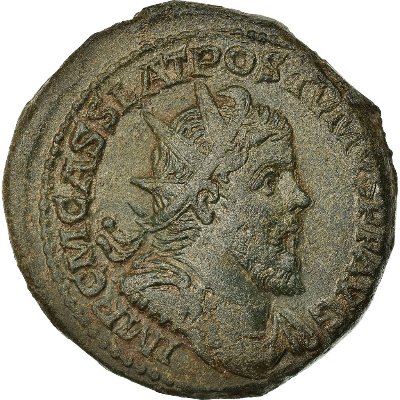  Double sestertius, 261, Postumus, Trier. RIC V 123. Obv: IMP C M CASS LAT POSTVMVS P F AVG. Rev: FIDES MILITVM. It is a sturdy piece of copper, especially compared to the slim antoninianii - 22.6 g, 34 mm, 4.5 mm thick at the high reliefs. Radiated to indicate the double value, like the antoninianus. |
|
Pillar of the Community
United States
6130 Posts |
No worries Paul! Always happy to explain anything that may not be clear!
I wasn't sure, but I do believe the --- EQVIT types are exclusive to Aureolus in the name of Postumus, so he was probably trying to suck up at least a bit.
@erafjel, beautiful double sestertius! I have been trying for one for years; never seen to be the top bidder. His bronzes come in laureate, radiate, and helmeted - while the large radiate bronzes of Decius are definitely double sestertii, the distinction is less clear with Postumus, as they aren't even consistently heavier than the laureate bronzes. I wonder if they could perhaps be medallions instead?
|
|
Pillar of the Community
United States
6130 Posts |
Tetricus I, 271 - 274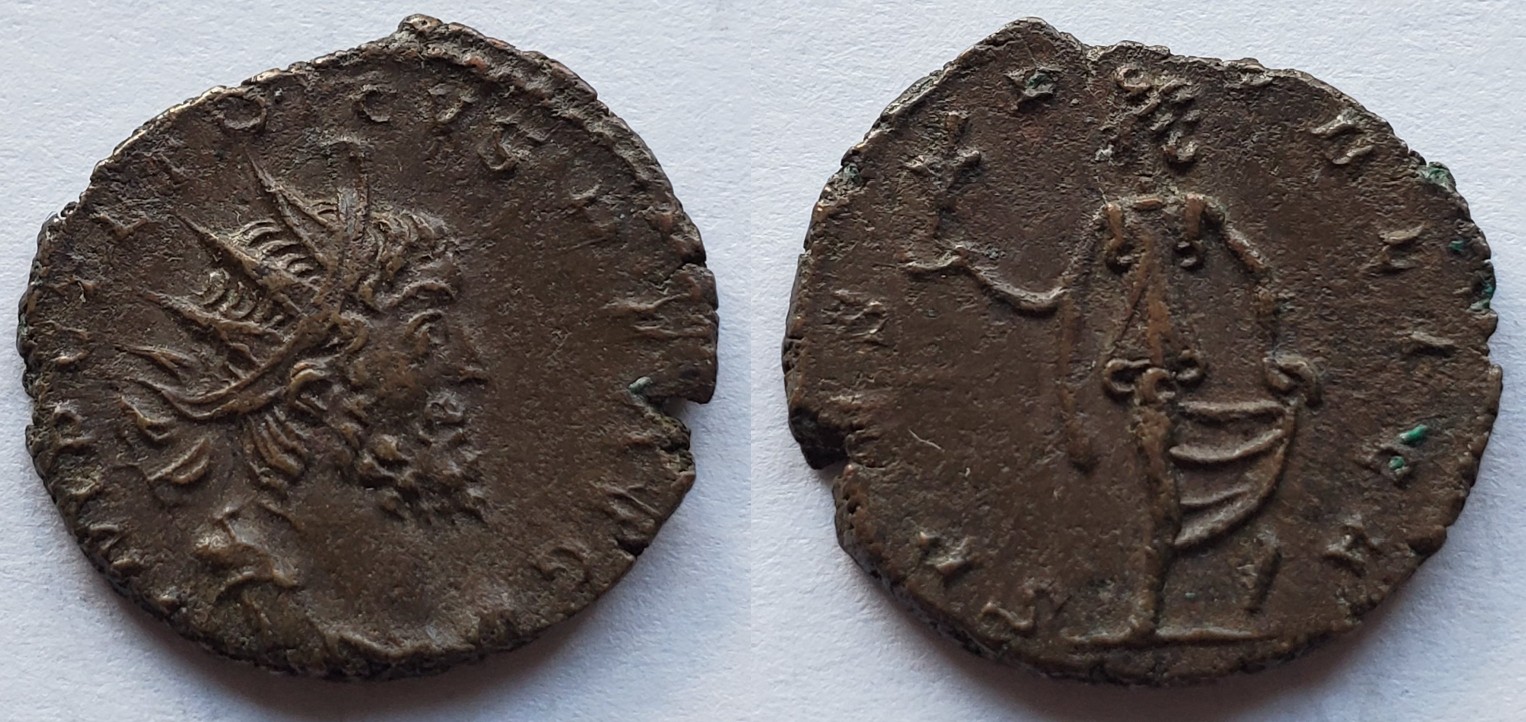 AE Antoninianus IMP C TETRICVS P F AVG, Radiate draped bust right SPES PVBLICA, Spes walking left, holding flower and raising hem of robe 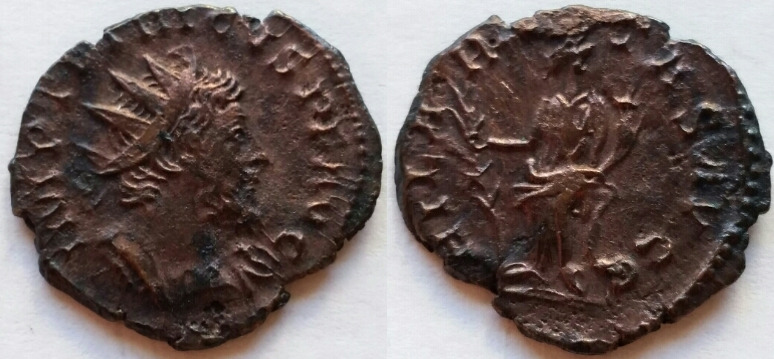 AE Antoninianus IMP TETRICVS P F AVG, Radiate, cuirassed bust right HILARITAS AVGG, Hilaritas standing left, holding palm and cornucopia 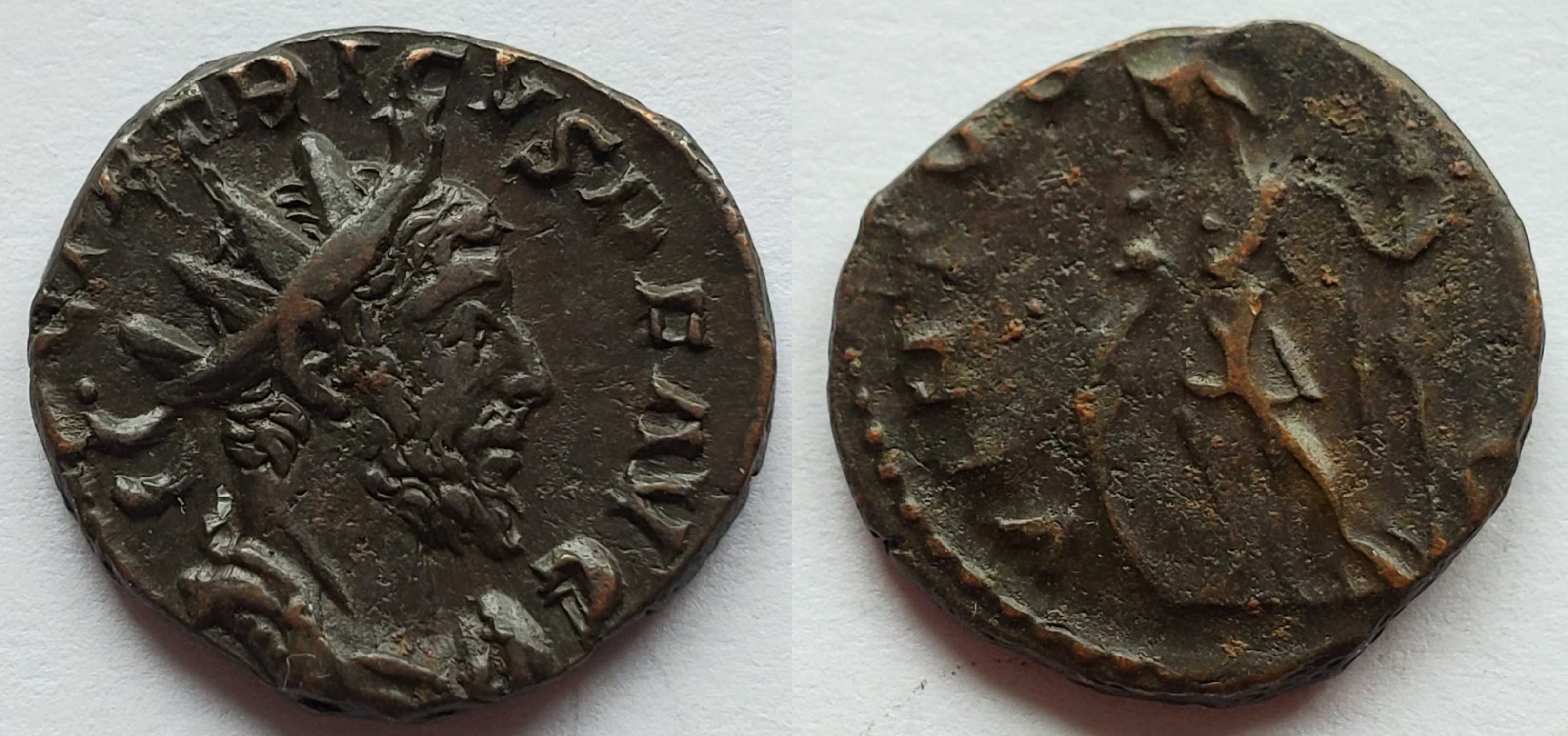 IMP C TETRICVS P F AVG, Radiate, draped and cuirassed bust right VIRTVS AVGG, Virtus standing left, holding spear and shield  AE Barbarous Radiate, uncertain reverse type  AE barbarous radiate, reverse possibly Apollo holding lyre? After the sudden death of Victorinus in 271, Victoria seems to have enlisted Tetricus, who at the time was serving as the governor of Gallia Aquitania. His reign was deeply troubled, as the raids from the Germanic peoples had increased in frequency and ferocity, and Tetricus struggled to keep his troops paid--officially minted antoninianii dipped down to 1% silver or even less, and were supplemented by a massive wave of unofficial token coinage, today called barbarous radiates, which are about as common as official coins. In 273 to bring some measure of political stability, Tetricus elevated his young son Tetricus II to the position of Caesar. The new Roman emperor, Aurelian, however, had just succeeded in bringing the Palmyrene empire back under imperial control, and was now poised to reclaim Gaul and Britannia. Their forces met at the Battle of Chalons, and surrendered without much fight. Some historians claim that the battle was just a show by Tetricus - he knew he would not win, and negotiated a surrender with Aurelian prior to the battle--if he surrendered, his troops would have surely murdered him and set up another in his place. Tetricus and his son were paraded through Rome in Aurelian's triumph, but afterward pardoned and allowed to retire to obscurity. For reasons unknown, the provincial citizens selected Tetricus' antoninianii as their small change of choice, and the overwhelmingly vast majority of unofficial "barbarous radiates" are modeled after Tetricus and his son. Archaeological studies have revealed that the later crude barbarous radiates were being produced as late as the 280s and likely circulated until Constantine was able to provide a suitable small coin of official minting.
Edited by Finn235
05/25/2021 11:22 pm
|
|
Pillar of the Community
United States
7067 Posts |
Enjoyed the new post, Steve. Well done.
|
|
Pillar of the Community
United States
6130 Posts |
Tetricus IIAs Caesar 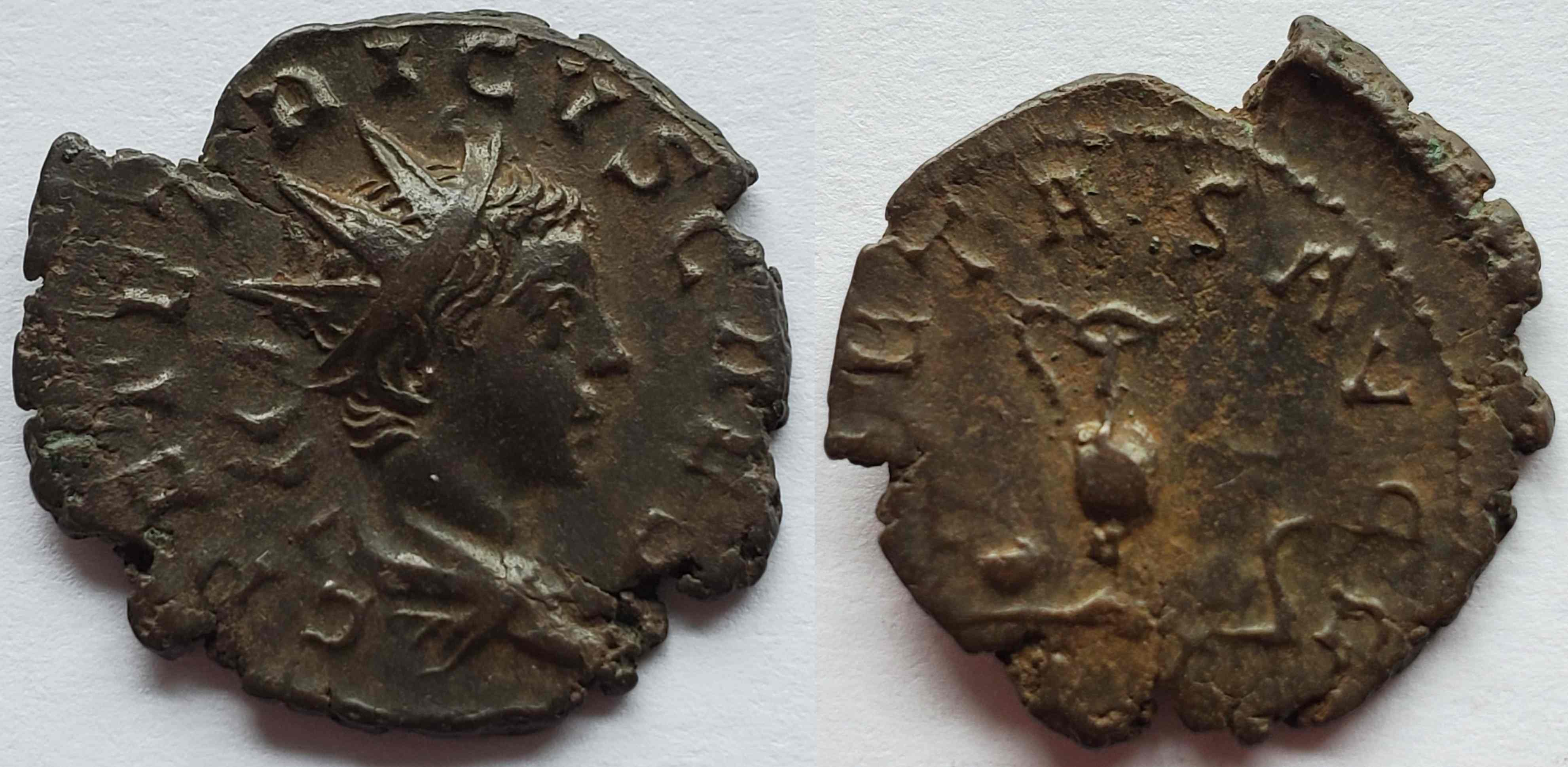 AE Antoninianus C P E TETRICVS CAES, Radiate draped bust right PIETAS AVGG, Priestly implements 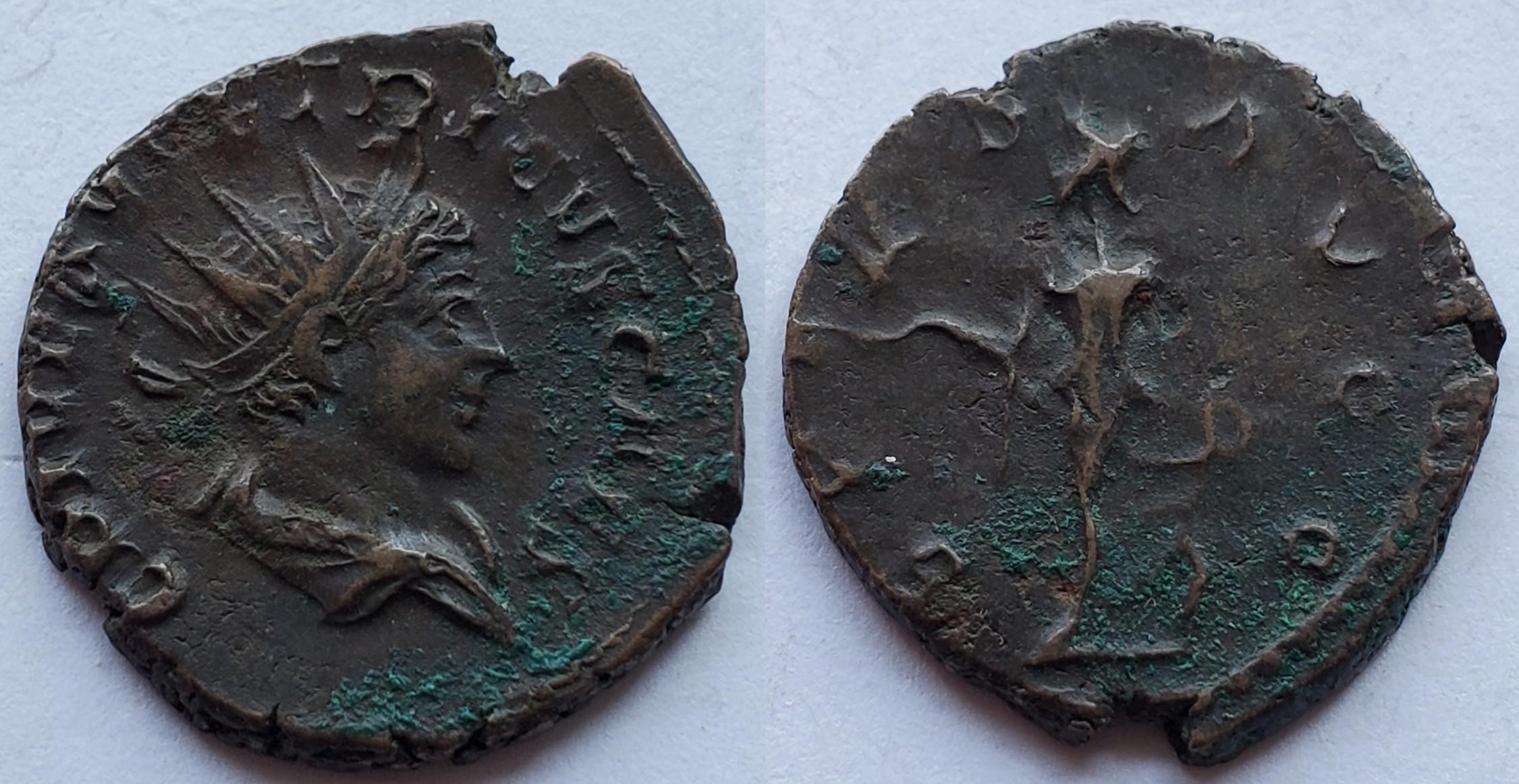 AE Antoninianus C PIV ESV TETRICVS CAES, Radiate draped bust right SPES AVGG, Spes walking left, holding flower and raising hem of robe  AE Antoninianus, probably barbarous (...) TETRICVS CAES, Radiate bust right SALVS (AVGG?) Salus standing left, holding patera to snake rising from altar *This coin is of convincing style, but is too small and Tetricus II did not produce unambiguously official coins depicting Salus* 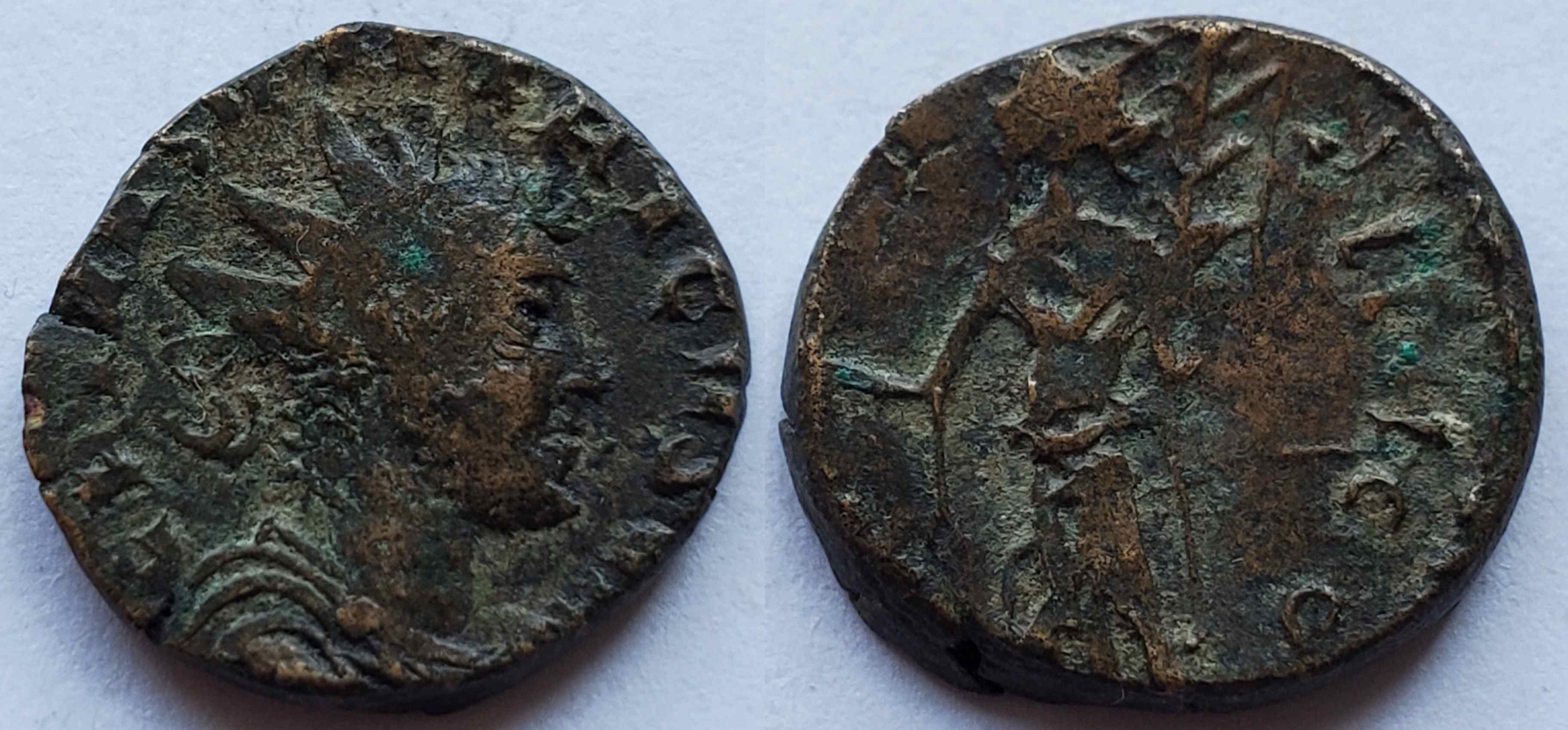 AE Antoninianus, Barbarous made with stolen official die? CA (PIV?) ESV TETRICVS (?), Radiate draped bust right Illegible, Hilaritas-type figure standing with palm This fascinating piece is either the most skilled barbarous obverse ever made, or else it was made from a presumably official obverse that was looted from the mint and paired with a homemade reverse. It is notable that the obverse legend does not seem to match any known official examples, and the final letters are indistinct, leaving the title unknown but presumably still CAES. "As Augustus"  AE Barbarous Radiate (...)ETRICVS PF AVG, Radiate head right PAX AVG, Pax standing left holding scepter and branch Tetricus II was the young son of Tetricus I, elevated to the office of Caesar in 273. He is scarcely mentioned in contemporary histories, and based on the portrait on his coinage, he was probably about 8-14 years old. He shared a consulship with his father in 274, may have briefly been raised to Augustus in that year. Numismatic evidence for this elevation is at best dubious, as unofficial emissions are just as plentiful as the official, and can sometimes be of convincing style. Following their defeat, Tetricus was paraded with his father in Aurelian's triumph, and was allowed to return to life as a private citizen. The Historia Augusta claims that he went on to become a senator in his later years.
Edited by Finn235
05/26/2021 10:22 am
|
|
Pillar of the Community
Spain
2752 Posts |
As always Steve really interesting write ups with some great looking portraits.....I do like the look of the wacky Barbarous types....
|
|
|
Replies: 156 / Views: 23,445 |
|
To participate in the forum you must log in or register.
Disclaimer: While a tremendous amount of effort goes into ensuring the accuracy of the information contained in this site, Coin Community assumes no liability for errors. Copyright 2005 - 2026 Coin Community Family- all rights reserved worldwide. Use of any images or content on this website without prior written permission of Coin Community or the original lender is strictly prohibited.
Contact Us | Advertise Here | Privacy Policy / Terms of Use
|
| Coin Community Forum |
© 2005 - 2026 Coin Community Forums |
| It took 0.48 seconds to rattle this change. |
 |
|
| |
| |







 First Page
 Previous Page

 Posted 04/21/2021 12:15 am


