| Author |
 Replies: 17 / Views: 4,017 Replies: 17 / Views: 4,017 |
Page 2 of 2
|
|
|
|
Pillar of the Community
United States
1291 Posts |
That's it! I'm getting out of this hobby right now! Eee-yechhh!
|
|
Pillar of the Community
United States
7842 Posts |
Feel free to send your germ-ridden coins and paper my way, I had my shots!  "what doesn't kill you, makes you stronger" Nietzsche (I believe) success, Edited by oih82w8
03/30/2009 11:11 pm
|
|
Moderator
 Australia
17005 Posts |
Coins are typically made of metals like copper, silver, nickel, zinc, manganese, etc. These are all technically classified as "heavy metals" and all are toxic to most Earth life-forms, often in remarkably small quantities. Thus, coins are "self-sterilizing" and are probably amongst the biologically cleanest things you could find in your house. Washing your hands after handling coins is still recommended, not to "remove the germs", but to remove the toxic heavy metals you might otherwise ingest.
As for the rapid formation of deposits, I've heard lots of people talk about carrying around "pocket pieces" and never heard of anyone else reporting this problem. Nor have I seen it to any great extent on any normal, everyday circulation coins. I can only conclude that there's some strange chemistry going on in your pocket, perhaps involving your sweat or other moisture, and/or residual detergent or bleach from the laundry.
Don't say "infinitely" when you mean "very"; otherwise, you'll have no word left when you want to talk about something really infinite. - C. S. Lewis
Edited by Sap
03/30/2009 11:03 pm
|
|
Bedrock of the Community
United States
20753 Posts |
Quote:
Coins are typically made of metals like copper, silver, nickel, zinc, manganese, etc. These are all technically classified as "heavy metals" and all are toxic to most Earth life-forms, often in remarkably small quantities. Thus, coins are "self-sterilizing" and are probably amongst the biologically cleanest things you could find in your house. Washing your hands after handling coins is still recommended, not to "remove the germs", but to remove the toxic heavy metals you might otherwise ingest.
Interesting. Many people think that nothing can survive on just a plastic toilet either. My suggestion is take any coin from change and place under a microscope. Swab the average coin, place on a collecting dish and insert into an incubator. Gee, I wonder where all that life came from? |
|
Pillar of the Community
United States
2443 Posts |
Best way to clean a coin is the pop it in your mouth and swoosh it around a bit. True coins are dirty, but what isn't?
|
|
Valued Member
United States
114 Posts |
Now this is the kind of in depth analysis that brought me to this site and keeps me coming back  |
|
Pillar of the Community
 United States
3363 Posts |
I don't know about the toxicity of silver, but copper could be a problem, so I'll wash my hands before eating.
After wiping 2 hours accumulation of grime spots off of a mixture of early US, Russian and French copper this AM, I'm starting to wonder whether it's the mixture of different metal alloys and hardnesses that causes them to soil up. It's worst on the high points - central figures or rims. And it's random. Where the coins don't grime up they polish each other to bright metal.
"Two minutes ago I would have sold my chances for a tired dime." Fred Astaire
|
|
Pillar of the Community
United States
3363 Posts |
This scan (darn the lack of color, but whatever) shows what is going on: 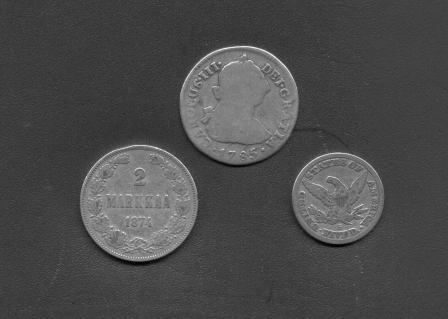 Both the half eagle and the 2 Markkaa were clean metal this morning. After an hour in my pocket, the half eagle is spotted with deposits on the wings, beak and letter E of FIVE. The 2 Markkaa is spotted on the wreath and on the 2. These coins were in contact with a 1785 Lima 2R, which I strongly suspect is the origin of the deposits. "Two minutes ago I would have sold my chances for a tired dime." Fred Astaire
|
|
Bedrock of the Community
United States
20753 Posts |
Quote:
Both the half eagle and the 2 Markkaa were clean metal this morning. After an hour in my pocket, the half eagle is spotted with deposits on the wings, beak and letter E of FIVE. The 2 Markkaa is spotted on the wreath and on the 2. These coins were in contact with a 1785 Lima 2R, which I strongly suspect is the origin of the deposits.
Not meaning anything personal but how often do you wash your clothing with the pockets. Ever turn your pockets inside out when cleaning those? If you have something in your pocket that effects coins in one hour, please stay away from me. If you place your pants on a chair and they sit there by themselves and/or get up and start walking, don't worry about your coins.  |
|
Valued Member
United States
259 Posts |
a little off the topic perhaps, but newspapers are even dirtier. Ever look at your fingers after you've read the newspaper? After reading the paper I just do the same thing I do after handling a bunch of pennies: go wash my hands.
|
|
Pillar of the Community
United States
3363 Posts |
Carl, the strange thing is that this will happen in a pair of pants fresh out of the clothes dryer. I only have to walk for 20-30 minutes with coins in pocket to see it happen. Not only do the coins blacken each other, the deposits rub off and blacken the pocket linings too. I think it's a metallurgical/friction effect.
I've also worked in newsprint mills, around pressrooms, and in news recycling. The old letterpress inks were carbon black mixed with heavy non-drying petroleum oil and never really dried on the paper. This is why they rubbed off so easily. The newer inks use resin binders (mostly based on soy), but are still prone to smear. I think the worst is in magazines and news inserts, where the ink doesn't absorb very well into the clay coating
"Two minutes ago I would have sold my chances for a tired dime." Fred Astaire
Edited by thq
04/06/2009 11:22 am
|
|
Bedrock of the Community
United States
20753 Posts |
Quote:
I've also worked in newsprint mills, around pressrooms, and in news recycling. The old letterpress inks were carbon black mixed with heavy non-drying petroleum oil and never really dried on the paper. This is why they rubbed off so easily. The newer inks use resin binders (mostly based on soy), but are still prone to smear. I think the worst is in magazines and news inserts, where the ink doesn't absorb very well into the clay coating
And guess what? I found things like that out the hard way. Being a train commuter and by the time I got on no seats so sat on the stairs. Used a newspaper so I wouldn't get dirty from the stairs. Yeah, right you are about that ink. Any light colored cloths are now readable with the latest news. Quote:
Best way to clean a coin is the pop it in your mouth and swoosh it around a bit. True coins are dirty, but what isn't? On a kids show on TV not long ago they had kids compare germs on many items. Our mouths sure lost out there even compared to a dogs mouth. I don't think a coin in our mouths would help that coin at all. |
|
Pillar of the Community
United States
8904 Posts |
Best way to clean a coin is the pop it in your mouth and swoosh it around a bit. True coins are dirty, but what isn't?
Wow... I don't feel so good. (Particularly after reading some of the first posts on this topic...)
|
|
Valued Member
United States
198 Posts |
Quote:
I used to hear this when I was a kid. If you handled money you were supposed to wash your hands before you ate anything because of the germs.
Interestingly, the token coinage used at Palo Seco Leper Colony, Panama Canal Zone, was done away with in 1952 and replaced with U.S. Silver coinage which at the time was thought to be "self sterilizing". ~ Jim |
|
Pillar of the Community
United States
3363 Posts |
Quote:
...with U.S. Silver coinage which at the time was thought to be "self sterilizing". So the silver abraded off on my hands and pocket lining might be good for me because of a biocidal effect? Googling around, I found a lot of references to the benefits of colloidal silver as biocide. It was used in the past for treating eyes of newborn babies, for instance. There are also a few references to the self-sterilizing properties of silverware.... Which leads to another topic which currently interests me. Coin silver was used to make early American spoons, bowls, coffee pots, etc. Because so much of it was made, it sells for about the price of bullion. A handmade teaspoon ca 1800-1810 containing more silver than a draped bust half sells for $15-30. If made before 1800 the price goes way up, and the sky's the limit if the silversmith was someone like Richardson, Syng or Revere. "Two minutes ago I would have sold my chances for a tired dime." Fred Astaire
|
|
Page 2 of 2
|
Replies: 17 / Views: 4,017 |
Page 2 of 2
|








 First Page


 Posted 03/30/2009 9:49 pm


