| Author |
 Replies: 17 / Views: 15,954 Replies: 17 / Views: 15,954 |
Page 2 of 2
|
|
|
|
Moderator
 United States
23731 Posts |
All Swiss 1 Franc coins after 1967 were made from copper-nickel KM# 24a.1.
|
|
Valued Member
 Bulgaria
474 Posts |
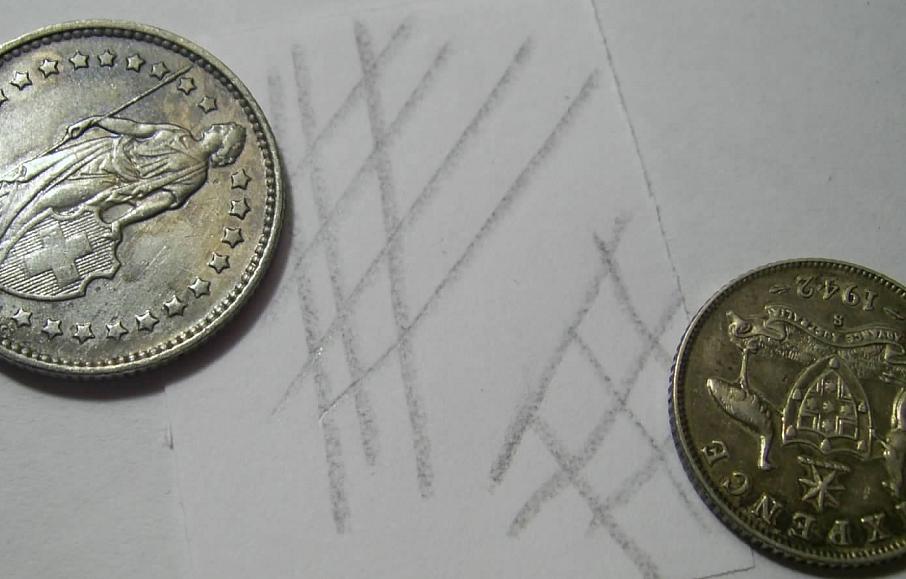
Image:  1968silver2.jpg 1968silver2.jpg62.57 KB Friends, I know that all after 1967 is copper-nickel. But please see to the black traces the coin on white paper, and the track of Australian silver 6 pence. coin is exactly the same size as 1 franc coins after 1967, but certainly is not copper nickel. Some site with Swiss coins to know?
|
|
Pillar of the Community
United States
3098 Posts |
|
|
Pillar of the Community
Poland
3201 Posts |
Interesting. I dug out a 1968 Franc and 1968 1/2 Franc and they leave a very faint trace on paper, nothing like that pictured. I don't know if it's a good method of detecting silver, but the composition of the coin might be indeed different.
Edited by DL20K
04/01/2009 11:48 am
|
|
Bedrock of the Community
United States
10045 Posts |
Not to dispute you, but the weight of 3.9g is nearly impossible for a silver 1 Fr.
Secondly, the amount of raised lines around 1 Fr. is very unusual. If one thing can be said about Swiss coins during this period, they are very consistent and high quality. Since other metals (such as base-metal) leave gray streaks on paper that's not conclusive I'm afraid...the weight is far more important here.
|
|
Valued Member
Bulgaria
474 Posts |
Really I have over 500-600 silver coins and all leave gray-black streaks incl. 0.220 silver 19 c. german coins! I am sure - this is not copper-nickel, probably error but tomorrow will check with jeweler whether is silver or other.
|
|
Bedrock of the Community
United States
10045 Posts |
Sorry--I did not mean to suggest you don't know the silver coins in your collection.
I've only observed that pewter and other base-metal alloys leave a streak too. I agree--CuNi does not leave such marks.
Another option--since 1 Fr was worth something in 1968, this could be a contemporary forgery meant to be spent.
|
|
Valued Member
Bulgaria
474 Posts |
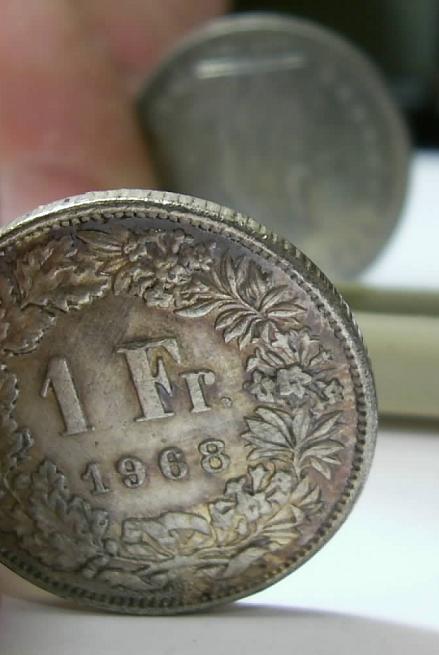
Another interesting fact - the coin has turned 180" avers, like coins before 1968, but is thick as coins after 1967 from copper-nickel alloy (not thin as silver before 1968)... please see picture. Image: 1968silver3.jpg39.87 KB |
|
Moderator
United States
23731 Posts |
It could be that the mint made a few coins in silver for that year prior to the change over to copper-nickel.
|
|
Valued Member
Bulgaria
474 Posts |
|
|
Valued Member
United States
365 Posts |
Very interesting-- pretty compelling idea, a silver '68! I hope it is so!
How does one account for the weight differential, though?
|
|
Pillar of the Community
United Kingdom
1077 Posts |
1968 and pre 1968 Swiss coins are aligned alike. They didn't switch to medal alignment until 1982.
|
|
Pillar of the Community
United Kingdom
1077 Posts |
I really don't think this coin is silver. If it is thicker than a silver 1 Franc, but weighs less than a copper-nickel one it just can't be possible. Unless it's hollow.
|
|
Valued Member
Bulgaria
474 Posts |
I agree the coin is not silver. But the metal is soft, unfortunately I can not find similar coins in the internet ...  |
|
Pillar of the Community
United States
3098 Posts |
Could it be tin? Or lead, even?  |
|
Page 2 of 2
|
Replies: 17 / Views: 15,954 |
Page 2 of 2
|







 First Page

 Posted 04/01/2009 11:29 am


 1968silver2.jpg


 1968silver3.jpg


