| Author |
 Replies: 24 / Views: 8,621 Replies: 24 / Views: 8,621 |
Page 2 of 2
|
|
|
|
Valued Member
 United States
106 Posts |
Thanks 'svslav'. No, actually I'm of English and Irish heritage. Eastern European coins are of a particular interest (the Balkans in particular) because of all the changes that have gone on in the past 20 years. Some of the events of the medieval Balkans have molded what is currently happening.
~Daniel
|
|
Valued Member
United States
106 Posts |
This next section deals with the BANATE OF SLAVONIA (also called the 'Banovina of Slavonia'). Slavonia was formed in the 13th century as a province of Hungary and lasted until 1476 AD, when it joined with the Banate of Croatia. Slavonia is now part of modern Croatia and Bosnia-Hercegovina. The first specimen is a silver Denar issued under Ban: Heinrich von Gussing, dating from 1269 to 1270 AD. The second is silver Groschen issued under Ban: Stjepan Babonic, dating from 1280 to 1282 AD (?) *.  SLAVONIA (BANATE)~AR Denar 1269-1270 AD SLAVONIA (BANATE)~AR Denar 1269-1270 AD SLAVONIA (BANATE)~AR Groschen 1280-1282 AD (?) SLAVONIA (BANATE)~AR Groschen 1280-1282 AD (?)*- Although there are no records of the Groschen listed, references lead to it being issued by ruler listed above. Changes will be made in the future if necessary. |
|
Valued Member
United States
106 Posts |
This next specimen is a silver Grosso from the REPUBLIC OF RAGUSA (now Dubrovnik, Croatia) 1372-1383 AD. The city of Ragusa was established in 614 AD, and became a republic in 1358 after it gained independence from Venice. For the next hundred years Ragusa remained for the most part a independent entity with loose ties to the Kingdom of Hungary. In 1458, Ragusa was being threatened by the approaching military of the Ottoman Empire. To avoid a complete takeover, Ragusa signed a treaty with Ottoman Empire on which a diplomat would be sent to Constantinople (now Istanbul) each year on November 1, to make the tribute. By 1481, Ragusa became a Turkish vassal, but maintained a good deal of autonomy. However, Portuguese exploration that opened new ocean trade routes, thus the ships no longer went through the Mediterranean Sea. Also, the discovery of America, caused Mediterranean shipping to suffer. The two combining factors caused both Venice and Ragusa to go into decline. The republic came under a month long siege by the Russian fleet. The siege ended when Ragusa surrendered to France when Napoleon and his troops entered the city in 1806. The republic was officially abolished in 1808, and made part of the French Illyrian Provinces.  RAGUSA (REPUBLIC)~AR Grosso 1372-1383 AD RAGUSA (REPUBLIC)~AR Grosso 1372-1383 AD |
|
Valued Member
United States
106 Posts |
Another formidable power in the Balkans was the BULGARIAN EMPIRE. Bulgaria stood as an empire twice in their history. The first empire lasted from 632-1018 AD when it was overrun by the Byzantine Empire. The Bulgarian Empire was restored in 1186 AD (sometimes referred to as the Second Bulgarian Empire) and would reign, next to Serbia, as a major power in Southeastern Europe until 1396 AD, when they were conquered by the Ottoman Empire. The following specimen is a silver Groschen issued during the reign of Tsar: Ivan Asen I 1189-1196 AD.  BULGARIAN EMPIRE (SECOND)~AR Groschen 1189-1196 AD BULGARIAN EMPIRE (SECOND)~AR Groschen 1189-1196 AD |
|
Valued Member
United States
106 Posts |
|
|
Valued Member
United States
106 Posts |
The next coin is a billon Trachy from the KINGDOM OF THESSALONICA 1200-1224 AD. Thessalonica was a short lived crusader state that was a vassal of the Latin Empire. In 1210 AD, the Despotate of Epirus lead an attack against Thessalonica until the territory was conquered and annexed by Epirus in 1224 AD. The ruler for which this coin was issued under is yet unknown.  THESSALONICA (KINGDOM)~Billon Trachy 1200-1224 AD THESSALONICA (KINGDOM)~Billon Trachy 1200-1224 AD |
|
Valued Member
United States
106 Posts |
This next specimen is a billon Denier from the DESPOTATE OF EPIRUS 1294-1313 AD. It was issued during the rule of Despot: Philip de Taranto. These were Frankish coins that were circulated in the region that is now part of northwestern Greece and Albania.  EPIRUS (DESPOTATE)~Billon Denier 1294-1313 AD EPIRUS (DESPOTATE)~Billon Denier 1294-1313 AD |
|
Valued Member
United States
106 Posts |
The Venetians also had a strong influence in Balkan region, especially on the Dalmatian coast and the Aegean islands. This first specimen is a gold Zecchino from CHIOS which was issued under Doge/Duke: Philip Maria Visconti 1415-1436 AD. The Zecchino had a similar pattern to the Venetian Ducat. The second specimen is a copper Fallaro from CATTARO/KOTOR 1569-1571. Cattaro was a walled city on the southern Adriatic coast, and is now known as 'Kotor' in Montenegro.  CHIOS~AV Zecchino 1415-1436 AD CHIOS~AV Zecchino 1415-1436 AD CATTARO/KOTOR (MUNICIPAL)~AE Fallaro 1569-1571 CATTARO/KOTOR (MUNICIPAL)~AE Fallaro 1569-1571 |
|
Valued Member
United States
106 Posts |
Here are two coins from the islands of RHODES under the Order of the Knights of St. John. The first is a silver Gigliato issued under Grandmaster: Juan Fernandez de Heredia 1376-1396 AD. This was overstruck on a coin issued by the previous grandmaster Robert d'Anjou. The second is silver Gigliato issued under Grandmaster: Philabert de Naillac 1396-1421 AD. The Knights of St. John were assigned to protect Rhodes, during the crusades, from the Ottoman Empire which had threatened Southeastern Europe. It's operation in Rhodes ran from 1310-1523. Later they were stationed in Malta from 1530-1798.  RHODES~AR Gigliato 1376-1396 AD RHODES~AR Gigliato 1376-1396 AD RHODES~AR Gigliato 1396-1421 AD RHODES~AR Gigliato 1396-1421 AD |
|
Moderator
 United States
23731 Posts |
Really nice collection. Thanks for posting them.
|
|
Pillar of the Community
United States
2605 Posts |
Those "BANATE OF SLAVONIA" coins made me think of modern Croatian kunas: 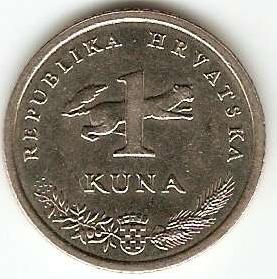 Do you think I'm right? |
|
Valued Member
United States
106 Posts |
Your absolutely right 'svslav'. The animal is called a Marten which was a major source of trade in the region. As you can see, they are still using it on the coins of modern Croatia. Good modern example you used. Thanks for your reference.
~Daniel
|
|
Bedrock of the Community
United States
10045 Posts |
Wow, this is a fascinating and informative thread--thanks for posting these coins and their histories!  |
|
Pillar of the Community
United States
3499 Posts |
Awesome coins and thread overall! Thanks!
|
|
Valued Member
United States
106 Posts |
Thanks 'DVCollector' and 'Archraz'. This is very interesting area to collect. And some of them have very interesting stories behind them. I'll post more images as I aquire them.
~Daniel
|
|
Page 2 of 2
|
Replies: 24 / Views: 8,621 |
Page 2 of 2
|







 First Page
 Posted 12/23/2009 10:38 pm


