| Author |
 Replies: 16 / Views: 34,551 Replies: 16 / Views: 34,551 |
Page 2 of 2
|
|
|
|
New Member
 United States
37 Posts |
These are three versions of the reverse die used on the original round ingots. The die at top was carved by Howard Eichen, and did not long survive the pressures of the stamping press. The two dies at the bottom were used for production. Bottom right die was used first, bottom left die came next. 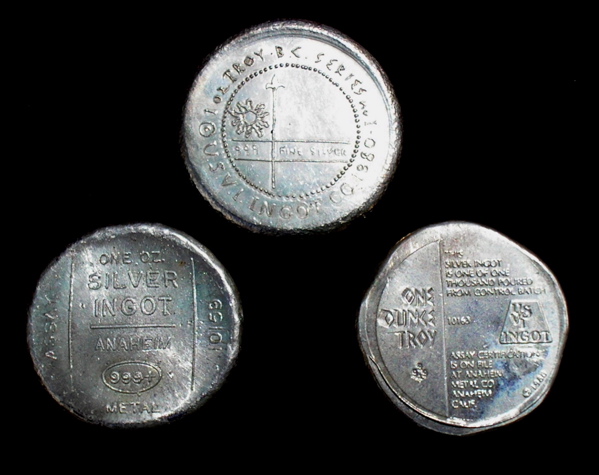 The original round ingot packaging. I remember that some customers (stores) prefered to remove the packaging. 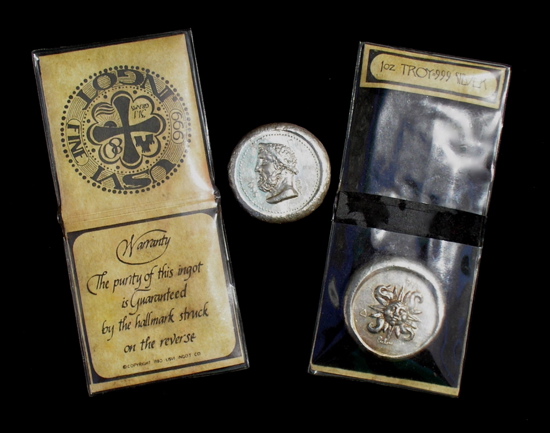 |
|
New Member
United States
37 Posts |
Loaf Bars (check here later for more story) Amark, second obverse design. 'loaf' bar ingot 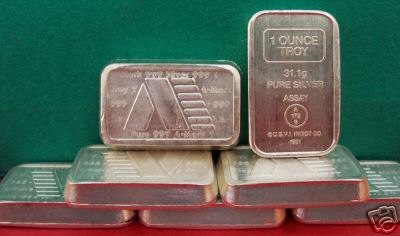 Early loaf bar, reverse dies. The ingot on left shows the first style of reverse die. This might have been the only batch to bear the name of Anaheim Metal Co. The top most graphic changed to say 1 OZ. Troy with the next assay number. Both of these ingots say AMARK inside of an oval on the obverse. The ingot on the right shows some of the difficulty we sometimes had in obtaining a complete corner fill during the strike. 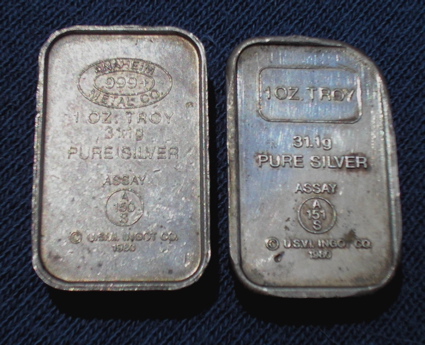 An example of an extrustion press: 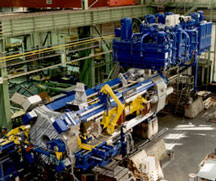 A basic description of the extrustion process: http://www.energymanagertraining.co...Products.htm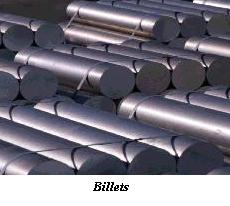 Edited by USVI Ingot
06/17/2006 3:41 pm
|
|
Forum Kid
Kuwait
1523 Posts |
All I can say is WOW!!!
Awesome story and awesome Silver!!!!!
TKC!
|
|
Pillar of the Community
United States
954 Posts |
Very interesting, thanks for sharing!!  |
|
New Member
United States
37 Posts |
Experimental ingots. Very few of these were produced, and they were not popular. The idea was to see what sort of edge formed using wide, shallowly engraved dies. 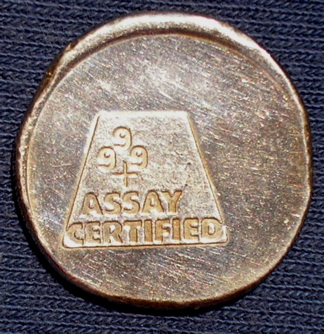 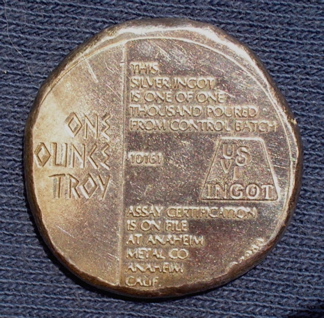 Edited by USVI Ingot
06/17/2006 3:19 pm
|
|
New Member
United States
37 Posts |
Square Cornered Bars 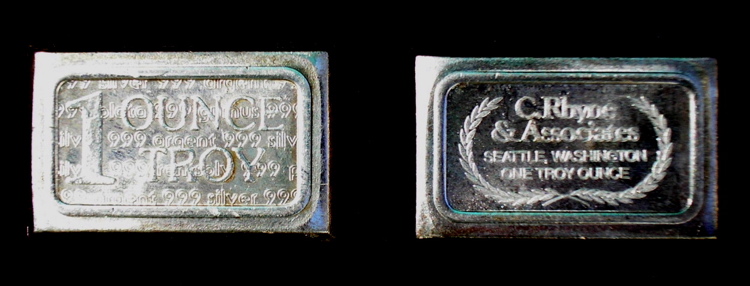 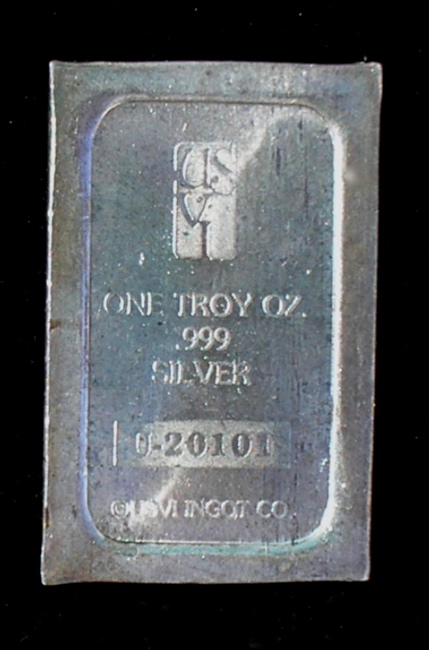 Edited by USVI Ingot
06/16/2006 6:22 pm
|
|
New Member
United States
37 Posts |
10 ounce ingots 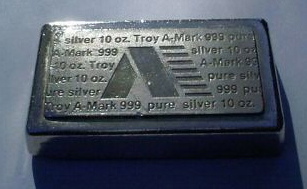 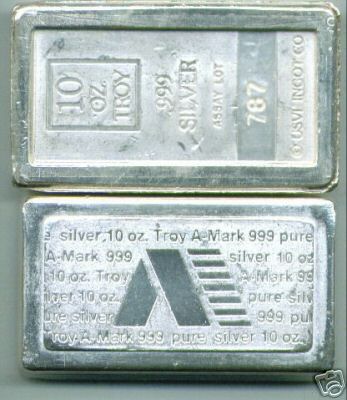 Edited by USVI Ingot
06/17/2006 10:10 am
|
|
New Member
United States
37 Posts |
Enclosed edge die stampings made in the hydraulic press. Large, flat USVI Ingot round with edge, obverse 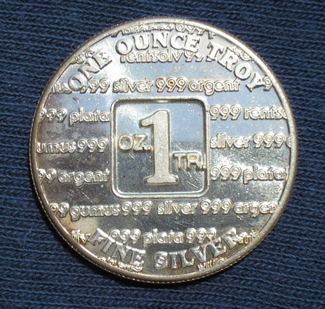 reverse 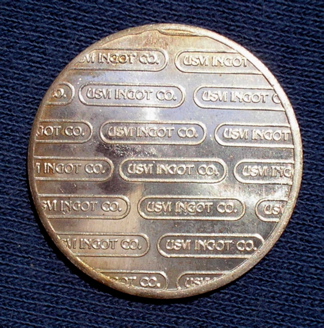 Monex Silver Eagle 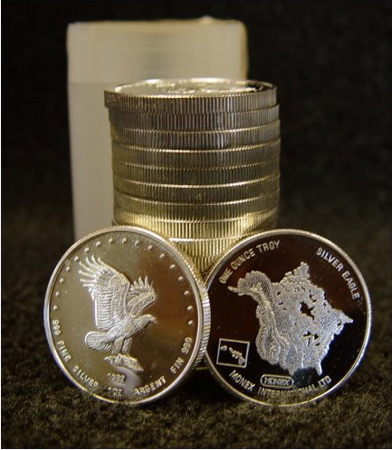 Monex Trade Eagle, obverse 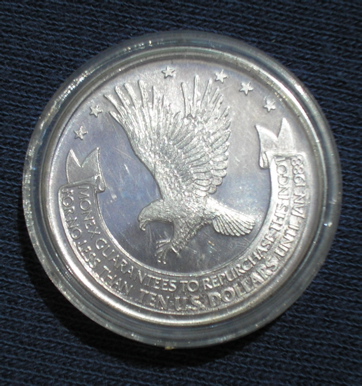 reverse 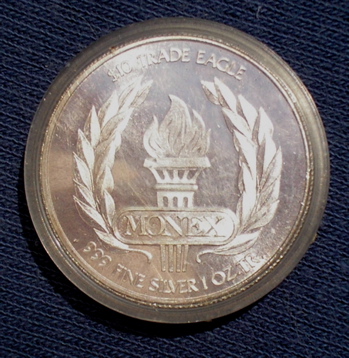 Edited by USVI Ingot
06/17/2006 1:50 pm
|
|
New Member
United States
37 Posts |
This large flat bar was produced after my departure. (Photo courtesy falconridr) 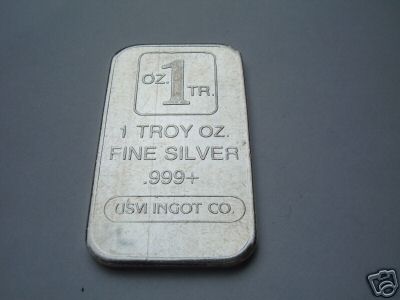 Edited by USVI Ingot
09/22/2006 03:26 am
|
|
Pillar of the Community
United States
2150 Posts |
|
|
Pillar of the Community
United States
2150 Posts |
I would like to speak with you more about this topic if possible please email me. Thanks
|
|
Valued Member
New Zealand
227 Posts |
That is one of the best looking collections of silver I have ever seen!!!  Thank you for sharing your knowledge of this with us  |
|
New Member
United States
1 Posts |
quote:
Originally posted by USVI Ingot
10 ounce ingots
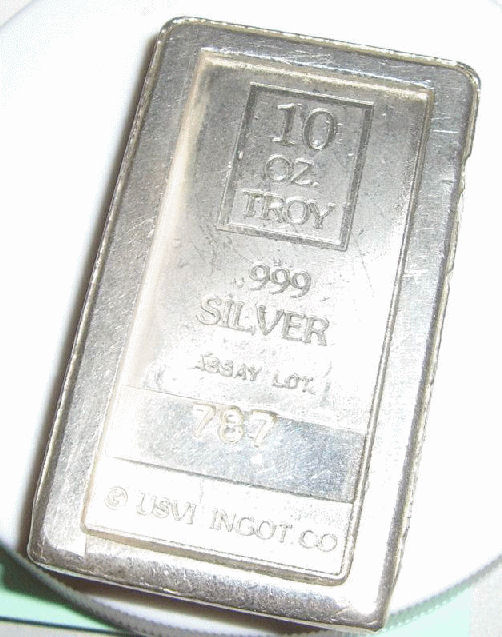
I'm new to this forum and honestly only joined it to get an answer to a question. I recently purchased a USVI Ingot of 10 oz. troy for the purpose of melting down and alloying to make into jewelry. My question though is concerning the number stamped into the ingot. It's 787, just the one one pictured in this thread. I'm curious as to why both ingots would have the same number. The stamping is in a little different location on mine than on the one pictured above(?). Image:  USVIa.jpg USVIa.jpg66.59 KB |
|
Pillar of the Community
United States
1454 Posts |
Only grasping and throwing out ideas but, it could have come from the same assay lot. They may have melted it down from a much larger ingot and put them into these 10oz. bars and stamped them with the same number if lets say 5 of them came from the same larger ingot. Just an idea, I do not know for sure.
|
|
New Member
United States
37 Posts |
quote:
Originally posted by Irishraider
Only grasping and throwing out ideas but, it could have come from the same assay lot. They may have melted it down from a much larger ingot and put them into these 10oz. bars and stamped them with the same number if lets say 5 of them came from the same larger ingot. Just an idea, I do not know for sure.
Yes, exactly. The silver arrived at our factory in large ingots that weighed approx. 1000 oz. Many were stamped Engelhard or Johnson-Matthey. They were melted in batches and poured into billet molds. The billets were then extruded, and the long bars were cut to length/weight, polished, and stamped in a punch press. The lot numbers were stamped by hand as I recall, hence slightly different locations on the bar. There would be approximately 100ea. 10-oz ingots in each assay batch. The weights of the large ingots varied by a couple of hundred ounces, so it's a rough estimate re. the number of ingots per batch. |
|
Page 2 of 2
|
Replies: 16 / Views: 34,551 |
Page 2 of 2
|





 First Page

 Posted 06/16/2006 1:31 pm


 USVIa.jpg


