| Author |
 Replies: 20 / Views: 3,377 Replies: 20 / Views: 3,377 |
Page 2 of 2
|
|
|
|
Valued Member
 Serbia (Srbija)
58 Posts |
Thank you for the answers and compliments on the coins.
Unfortunately, I cannot make a better quality image of the coins. My camera is obviously not so good.
As for the coin [5] it is neither Macrianus Minor, nor Severus Alexander nor Elagabalus. I managet to read "IMP ANTONINVS AVG" so it is probably Antoninus Pius. The face looks young and it has does not have a crown but the other thing I do not know the name in English for.
As for the coin [6] I managed to read "_______AVNIOCCER". Does that confirm it is Severus Alexander?
|
|
Pillar of the Community
United Kingdom
2838 Posts |
Quote:
I managed to read "IMP ANTONINVS AVG" so it is probably Antoninus Pius. The face looks young and it has does not have a crown but the other thing I do not know the name in English for. Remember 'ANTONINVS' was on the coins of many people and not just Antoninus Pius. Commodus, Marcus Aurelius, Uranius, Caracalla, Elagabalus and Macrinus all had it on some or all of their coins too. I think I agree with SAP that its the Egalabalus he posted a link too with him wearing a 'radiate' crown. If it is its worth about £30GPB. It certainly cant be a Macrianus with 'ANTONINVS' on it even though the styles are very similar. As for #6 I cant find anything with 'AVNIOCCER' on it? |
|
Valued Member
Serbia (Srbija)
58 Posts |
I did not know that several emperors used the same name written on their coins. Anyway, he does not have any kind of crown. He has the same thing Diocletian on his head on the coin  . Having had a detailed look, I too now agree with Sap. I believe this is the coin: http://www.wildwinds.com/coins/sear...tml#RIC_0019As for the [6] is is certainly Severus Alexander? Also, what Philip is on coin [2]? First or second? I still do not know who is on coin [4]. |
|
Pillar of the Community
United Kingdom
2838 Posts |
The item on the head is called a 'laureate' or laurel wreath in English - not sure where the word originates from though. 'Laureate' looks like a French word that has been adopted into the English language. Its originally from the Greek word 'Laurus'.
I'll have a look at the other coins a bit later when I get some time.
|
|
Pillar of the Community
United States
2269 Posts |
Very nice coins. I especially like the portrait on Claudius.
|
|
Moderator
 Australia
17007 Posts |
#2: since they ruled and issued coins at the same time and had similar titles, Philip I and Philip II are distinguished by portrait: beardless coins are for Philip II. #4: I think I can read "LVSIAN" above the emperor's head; the only ruler with these letters as part of his name is Volusian. See here for a similar coin; reverse legend is IMP CAE C VIB VOLVSIANO AVG. #6: It's a tetradrachm from Alexandria, Egypt. These coins have late Greek script on them, not Latin. the final letter in your "AVNIOCCER" is a B, not an R; CEB is Greek shorthand for Sebastos, the equivalent of Augustus (and therefore is the "Greek equivalent of AVG"). I think it's much later than Severus Alexander, but I'm not getting any match for "AVNIOC". Don't say "infinitely" when you mean "very"; otherwise, you'll have no word left when you want to talk about something really infinite. - C. S. Lewis
|
|
Pillar of the Community
United Kingdom
2838 Posts |
Again I think SAP is correct about #4  As far as #6 goes I've been trying slight variations on the 'AVNIOCCEB' and found the following: Aurelian: http://www.wildwinds.com/coins/bigp...elian/i.htmlThe reverse is very close with the 'L' and the 'B' but the bust is perhaps not 100%? This would be based on the coin reading 'AIANOCCEB' rather than 'AVNIOCCEB' this is possible as on a few coins I've looked at the 'N' has been poorly stamped looking more like 'II'. This could lead to the 1st 'I' in the 'N' being read along with the proceeding 'A' as an 'N' leaving the 2nd 'I' in the 'N' to be read as an 'I' giving 'NIOCCEB'. Hope that makes sense! - here is a picture of a poorly stamped Alexandria Aurelian that might make it clearer: http://www.wildwinds.com/coins/bigp...elian/i.htmlSee how the 'AIANOCCEB' could be read quite easily as 'AI/V NIOCCEB' Edited by bobbyhelmet
05/19/2010 1:07 pm
|
|
Valued Member
Serbia (Srbija)
58 Posts |
Well, the portrait of Aurelian does look similar to the portrait on the coin #6.
It seems it is the same ruler.
|
|
Valued Member
Serbia (Srbija)
58 Posts |
I finally got a better camera so here is a more detailed picture of coin [6]. 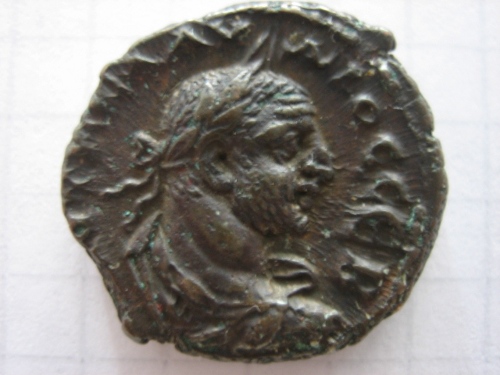 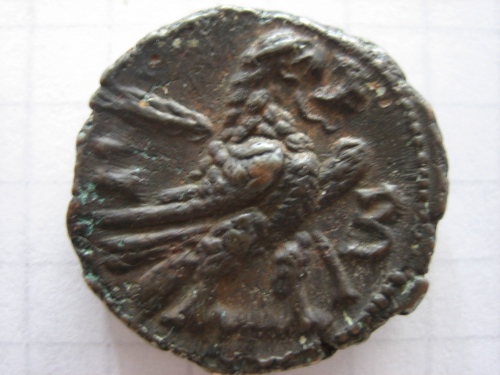 |
|
Moderator
Australia
17007 Posts |
I read it as "...LAVDIOC CEB" with the "D" a triangle-shaped Greek letter delta, and the "L" the inverted-V-shaped letter lambda. That would be Claudius II. Reverse inscription L-B, which means "Year 2" or 269 AD. This Wildwinds example dates from Year 3. Don't say "infinitely" when you mean "very"; otherwise, you'll have no word left when you want to talk about something really infinite. - C. S. Lewis
|
|
Valued Member
Serbia (Srbija)
58 Posts |
Thanks a lot Sap! You really know a lot about roman coins.
I am very glad it is Claudius II. Interestingly, he was born not so far from where I live.
|
|
Valued Member
Canada
54 Posts |
Ya,the denari is Elagabalus right?Niice Claudius
|
|
New Member
Romania
1 Posts |
*** Edited by Staff - Please Review the rules that you agreed to when you registered. ***
|
|
Rest in Peace
United States
9104 Posts |
 , flopenet! Your email won't work until you have 50 posts. |
|
Pillar of the Community
United States
1549 Posts |
Coin #2 is a particularly nice example of a Provincia Dacia coin and is not the same as a Viminacium in either legend or the animals shown. Viminacium would have a bull and no eagle. The Elagabalus (#5) is sometimes mistaken for Caracalla but Antoninus Pius was a much older man (52) when he came to power so the portrait alone should allow you to rule him out. I did a page to help separate Caracalla and Elagabalus since there are a few tricks that make them easier to separate. http://www.forumancientcoins.com/do...ar-elag.html |
|
Page 2 of 2
|
Replies: 20 / Views: 3,377 |
Page 2 of 2
|






 First Page

 Posted 05/18/2010 1:16 pm


