| Author |
 Replies: 24 / Views: 9,794 Replies: 24 / Views: 9,794 |
Page 2 of 2
|
|
|
|
New Member
 Canada
6 Posts |
OK, I took another photo under natural light on a white background. Much more accurate. Also added a regular penny for comparison. 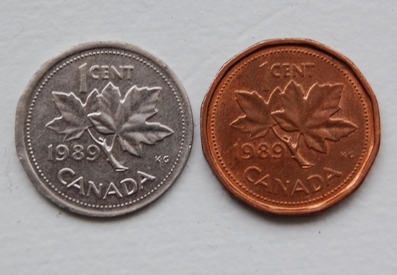 |
|
Valued Member
Canada
248 Posts |
First -Juicy Fruit- IMO, means In My Opinion.
---Ugly - True! Lighting plays a big role in how a subject looks in the end! I know a picture can lie! Intentional or not?
---Have you never been baited or fooled by one? It's real easy to due!
---I'm not saying that -Juicy fruit is playing us but the jury is still out! I'm just stepping carefully he is new, and was his first post!
---Note that I did welcome him!
---He has not gained a reputation yet in all fairness, so maybe I'm a bit sceptical at times but is justified when you see a coin like this, if not he then someone at the mint or somewhere messed with this coin, a coin of unknown composition and is our question? What happened to make this coin?
---Before -Juicy Fruit's- last post with new pictures it was questionable in all fairness!
---I was just being honest! No offence meant, IMO just a question?
---That having been said -Juicy Fruit- I can see the difference now! Thank you!
---I'm looking at the new pictures and they look the same in size! I still stand on my first assessment.
---If it were on a dime planchet the beads would be nearly wiped out on one side so the size plays in this.
---It still looks like a penny just different colour and that it still may have been dipped and that has been done before by experimenters.
---Or maybe -Ugly- is right? In his thinking, it as a foreign coin planchet, is a possible answer and has a different composition making it magnetic, as you say.
---I also had a passing thought that maybe it is a test coin that went kinda wrong?
---In 1989 that was a transition year were changes were in the making for 1990, changing it's effigy, maybe they were trying a composition change and went undisclosed, unsaid? and that sometimes is true!
---So I looked back for examples and in 1943 they did a test penny of copper plated steel that weighed 3.0g maybe this was reversed or just steel? Could that be? The weight is close?
---Then in 1966 they did a test penny out of nickel but weighed 3.50g so to much for nickel unless your weight was wrong, somehow?
---So I come back to (Steel)? I would be curious to explore that as a possibility?
---How about, if you could take a picture with a dime next to your penny and the normal one, side to each other in that order, just for kikes.
Thanks!
|
|
Pillar of the Community
Canada
1733 Posts |
The simplest explanation is very usually the correct one.
|
|
Pillar of the Community
Canada
695 Posts |
|
|
Bedrock of the Community
United States
10045 Posts |
 A 10c blank makes a lot of sense. Clearly the die had less metal to strike up the edge. |
|
Pillar of the Community
Canada
1166 Posts |
Nice! A fairly valuable one at that!
|
|
Valued Member
Canada
248 Posts |
-- -Ugly- I cant believe that you would minimize other possible or not hypothesis without a why that! ---I took the time how about you. How could you be so sure with a simple picture? ---It doesn't really mater to me it's not my coin! I'm just trying to help with open discusion, not shut it down. ---I'm willing to learn! If I'm wrong I will have learnt something! ---This to me, is not about being right! Note! I opened other Idea's, from mine! ---Sorry! But with all due respect, I,m not going to say yes without thought or proof! ---I may be wrong but I will explore with an open mind, isn't that how we learn! ---So to give a blanket statement like; Quote:
The simplest explanation is very usually the correct one. That kinda discourages open thought after yours!---To simplify that quote even more! Ya at times maybe true, so you may be right -Ugly-! -Scissle- But I learnt from your post, with Occam's razor. Quote:Overview The principle is often inaccurately summarized as "the simplest explanation is most likely the correct one". This summary is misleading, however, since the principle is actually focused on shifting the burden of proof in discussions.  That is, the razor is a principle that suggests we should tend towards simpler theories (see justifications section below) until we can trade some simplicity for increased explanatory power. Contrary to the popular summary, the simplest available theory is sometimes a less accurate explanation. Philosophers also add that the exact meaning of "simplest" can be nuanced in the first place.[4] Thank You! Edited by commoncents13
04/07/2011 04:39 am
|
|
Pillar of the Community
Canada
1733 Posts |
My statement that you requoted was a rephrasing of Occam's razor, one that Scissle recognized obviously. It's the basis of processing anything in science, you start with the most likely hypothesis and work your way down the list. Feel free to think all you like, I didn't suggest you stop for a moment, however most often if Bob is caught kissing a blonde girl in a downtown hotel by his wife, it's usually not his cousin no matter how much you theorize about it. Sometimes a rock is just a rock and not a cherished artifact from a sunken Atlantean civilization.
I'm 99 per cent sure this is a penny on a dime planchet. Why? I've seen several previously and it looks pretty much the same. The weight works within the degrees of accuracy of a non lab scale. The strike looks correct, the rim looks correct, it's magnetic and so on.
This is called "A working hypothesis". Now instead of a spinning a tall tale about what else it might be , you place your energy into disproving a working hypothesis. Yes, not proving it, DISPROVING it. If you find evidence that only supports the working hypothesis then you needn't move on. If you find non supporting evidence, you add that new evidence to your existing list of evidence and THEN you synthesize a new working hypothesis.
If the evidence doesn't support this being a dime planchet then you move on to examining matching foreign planchets as I already alluded. I believe the next step for this is having it certified as an error by an expert. The most easily accessible experts are those employed by coin grading services.
SO, CC, diagnosing coins is a relatively simple process, lay your feathers back down and get on with the task at hand.
To the original poster, send the coin in and have it graded would be my honest advice, based on what we've gathered up here in this thread it's worth the risk in terms of the outlay of cash required (less than 20 bucks all in) compared to the potential benefit.
Regards,
Ugly
|
|
Pillar of the Community
Canada
695 Posts |
I find with online forums it's often hard to tell experts from greenhorns. As with any specialty field, someone who has seen hundreds of error coins will get a feel for what is genuine and the cause of an error. A simple comment might seem like a terse off-the-cuff opinion though. Then again, a collector without a lot of experience with error coins is more likely to have wild, creative & entertaining postulations.
|
|
Valued Member
Canada
248 Posts |
--- Ugly- Thanks for your kind words, analogies and advice but no need! I have my own tasks to accomplish! ---Who am I to try like you say and DISPROVE what you say, nor have intention to try! ---I am humbly saying that I cant compete with your knowledge and will add I was not! The floor is yours. ---That being said I don't have feathers, I have fur! There is no response from the owner so seems done and so am I with this topic.  Regards, Regards,
CommoncentsEdited by commoncents13
04/09/2011 04:09 am
|
|
New Member
Canada
6 Posts |
No I'm still here. Just waiting for the dust to settle. Thank you everyone for your comments.
Ugly recommends that I have the coin graded. Does this mean 'someone' tells you what condition the coin is in, or does it also indicate value? Obviously, I haven't a clue as to what this coin is worth. ikandiggit suggests it valuable while Ugly says he/she has seen them before.
Does anyone have any idea (ballpark) what this coin is worth? I suppose I'm really wondering if it's worthwhile sending this coin insured mail from Yukon to Ont/Quebec and back plus the cost to get it graded (in other words.. is it worth more than that mailing/grading cost?)
Thanks all.
JuicyFruit
|
|
Pillar of the Community
Canada
1733 Posts |
If authenticated, I'd put a value on it between 200-300 based on other similar items for sale past and present. The problem with wrong planchet errors are that they have a more narrow audience than a normal coin and you may take some time to sell if that is your goal.
If you were selling this online, authentication increases the marketability, to exactly what extent I cannot define.
|
|
Moderator
 Canada
10477 Posts |
If your intent is to sell the coin online or via consignment to an auction, then certification is a viable option. However, good photos of the coin next to a normal 1989 strike and a photo of the coin on a scale (where you can see the weight readout in the photo) is probably good enough to fetch a decent price on ebay. "Discovery follows discovery, each both raising and answering questions, each ending a long search, and each providing the new instruments for a new search." -- J. Robert OppenheimerContent of this post is licensed under a Creative Commons Attribution-NonCommercial 3.0 Unported License. See: http://creativecommons.org/licenses...0/deed.en_USMy eBay store
|
|
Pillar of the Community
United States
4007 Posts |
If you plan on selling it, then I agree that this one calls for a slab. If you send it in for grading, they will also authenticate it.
Deeper pockets will come out if it is authenticated and graded by a reputable company.
|
|
Pillar of the Community
Canada
1610 Posts |
Yeah, similar enough we just discovered a 25 cents struck on a 1 cent planchet (copper it is awesome!
|
|
Page 2 of 2
|
Replies: 24 / Views: 9,794 |
Page 2 of 2
|








 First Page

 Posted 04/06/2011 06:10 am


