It was interesting to watch the spirited live-auction bidding inspired by this common one-penny Irish merchant's token at The Canadian Numismatics Company's "Criterion V" sale last night. The grocer (per Davis) in question, one Edward Bewley of Dublin, issued his pennies in 1816 and used them not only as advertising for his business but to celebrate, or perhaps capitalize on, the widespread respect for and adulation of the Dublin-born Wellington and his many military victories, including his defeat of Napoleon's forces at Waterloo in 1815. The use of the 1814 date below Wellington's effigy is taken as a commemoration of Field Marshall Arthur Wellesley's elevation to the Dukedom, which was newly created especially for him that year.
The designation as "Bowman 12" identifies this piece as a "Borderline token," so it's believed to have circulated in Canada, like a couple of dozen other Irish tokens and Wellington types, either contemporaneous with or a bit later than its 1816 issue date. That conjecture seems well-supported by the interest shown in it last night, in the middle of this week's five-session auction of 1,548 lots of Canadian and world coins, tokens, and paper money.
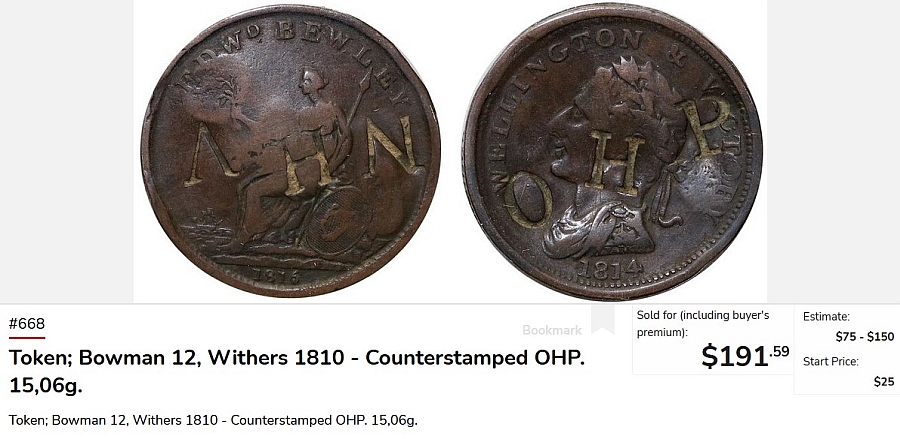
In any event, last night's bidding opened at CDN $25 and the token worked its way slowly through the small bid increments as mail, online, phone, and live bidders ran it up to the final hammer price of CAD $161. While I'm not a c/m collector, it seemed pretty obvious that all the value in this token resides in its countermarks -- OHP and NHV, to all appearances -- as without them its underlying condition puts it closer to a $5 filler. My own example (below) is a solid gVF in my estimation, and I acquired it for about £15 perhaps ten years ago.
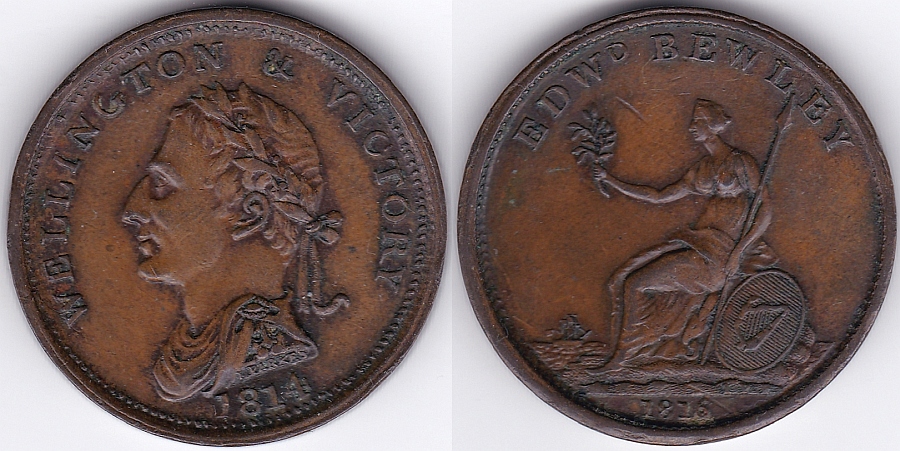
The countermarks hold the key to this mystery, I think. Does anyone here know what they mean? Why would the auction house make note of the OHP c/m but not the NHV? Could this be some sort of mob mentality in action -- auction fever -- or are the c/m's truly collectibly for some content-related significance?
Just to cast a wider net, I'll cross-
post to the Canadian tokens forum to see if anyone there recognizes these c/m's and why they're such a value multiplier for this otherwise ho-hum Hiberno-Canadian token.

Best to all!
Tom




 First Page
 Previous Page


 Posted 08/09/2021 11:13 am