| Author |
 Replies: 17 / Views: 2,274 Replies: 17 / Views: 2,274 |
|
Valued Member
Poland
263 Posts |
Hello. Please tell me what do you think about this cent? This is an error coin or result of chemical bath? 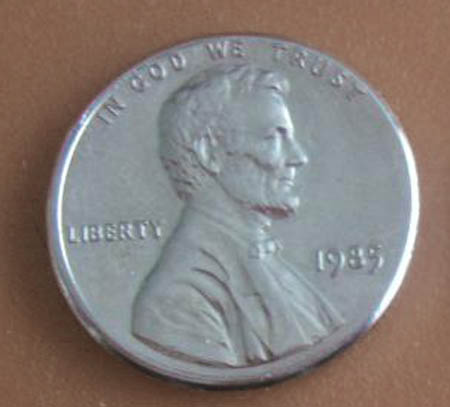 |
|
|
|
Pillar of the Community
Australia
7096 Posts |
 It could be an un plated (copper) Zinc planchet  have you weighed it ? |
|
Valued Member
 Poland
263 Posts |
Unfortunately I have no possibility of weighing coins on weight with 0,00g. There is some other way to check whether the coin was "bathed" in chemicals?
|
|
Pillar of the Community
Australia
7096 Posts |
I have no idea mate, In Aus we have not had to resort to using Zinc in our coins yet  |
|
Bedrock of the Community
United States
17884 Posts |
The inage seems to show the coin lacking luster which would make me suspect a plated coin.
|
|
Valued Member
United States
318 Posts |
Is it possible to un-plate a coin, removing the copper and leaving the zinc?
|
|
Valued Member
Poland
263 Posts |
Edited by thusdayclub
03/26/2013 12:16 pm
|
|
Valued Member
United States
108 Posts |
My guess is PMD. People like to do funny things to cents. -Jay |
|
Pillar of the Community
United States
4992 Posts |
Appears to be Zinc plated. Occasionally pennies are struck on a 10c planchet but this does not appear to be one of them - not the right color. If the copper was stripped away by acid, the coin would not have that much detail.
|
|
Bedrock of the Community
United States
17884 Posts |
Quote:
s it possible to un-plate a coin, removing the copper and leaving the zinc? Yes you can, but the Zinc normally comes out rough. |
|
Pillar of the Community
Canada
2805 Posts |
I've done an experiment like this for an open house - my job was to sit in the lab with a jar of pennies and do this trick all night.
First, dissolve some zinc sponge in some sodium hydroxide and boil the solution.
Drop in your shiny pennies. The mixture will react and a layer of zinc will form on the surface - so you are NOT removing the copper layer but rather re-plating the coin with more zinc. This is probably what caused yours.
Then hold it in a Bunsen burner for a few seconds. The thin layer of zinc will melt and dissolve some of the copper, forming low brass. At the end you get brass-looking pennies.
|
|
Valued Member
United States
318 Posts |
Can I do this with clad pennies?
|
|
Valued Member
Poland
263 Posts |
Thanks nalaberong, your post told me everything:) Too bad,i was hoping that this penny is rare mint error:) Thank you all for answers.
|
|
Pillar of the Community
Canada
2805 Posts |
Quote:
Can I do this with clad pennies? Yes, you can use any coins as long as they have any copper surface at all (even a really thin layer). I found a Union shield cent (the first one I'd seen in Canada) and brassed it that night, although it wasn't too shiny to begin with so it didn't turn out nice. Quote:
Thanks nalaberong, your post told me everything:) Too bad,i was hoping that this penny is rare mint error:) Thank you all for answers. You're welcome! I think this is why most valuable off-composition coins have to be distinguishable with a magnet (like the brass Canadian 1944 nickel) - otherwise they could have been plated and there's no way to tell without destroying them... |
|
Valued Member
United States
337 Posts |
That looks exactly like the coin I spray painted silver as a kid! Maybe you found it?
|
|
Valued Member
Poland
263 Posts |
It is possible it is your coin, but what your cent is doing in Poland?:) Do you want it back?:)
|
| |
Replies: 17 / Views: 2,274 |






 Posted 03/26/2013 07:33 am





