Richmond is the capital of the Commonwealth of Virginia; Kentucky, Massachusetts, Pennsylvania and Virginia refer to themselves as a "Commonwealth" vs. a "State" - there is no practical difference.
The roots of present-day Richmond can be traced back to 1737 when Major William Mayo was commissioned to create the town's grid/map/layout. Mayo was a British-born engineer who conducted multiple land surveys in Virginia in the 1720s and 1730s. He served in the position of Virginia's Chief Civil Engineer until his death in 1744 at the age (estimated) of 59; he died in Richmond.
Richmond, VA is named after Richmond, England (originally located south-west of London, but now a part of the English capital). The initial settlement grew rapidly and was incorporated in 1742. It was named as Virginia's capital in 1779 with the State government moving there in 1780 (from Williamsburg for safety reasons in response to the ongoing American Revolution); Richmond has been an independent city (i.e., not part of a county) since 1871.
A few historical notes: St. John's Church in Richmond was the site of Patrick Henry's famous "Give me Liberty, or give me death" speech in 1775, the Virginia General Assembly began meeting in Richmond in 1780 and Virginia ratified the US Constitution during a Convention held in Richmond in June 1788 (Virginia was the 10th State to ratify the Constitution on June 25). During the US Civil War, Richmond served as the second capital of the Confederate States (following Montgomery, Alabama and preceding Danville, VA).
The coin bill was introduced by Senator Harry Flood Byrd (D-VA) in June 1937. The proposed 50-cent pieces were to be struck "in commemoration of the founding of the town of Richmond, Virginia, in 1737."
The bill called for up to 50,000 half dollars to be struck at a single US Mint facility. The coins were to bear the date "1937" regardless of when struck, with coining authority set to expire one year after enactment of the bill. The coins were to be struck on behalf of the Virginia Capital Bicentennial Commission, Incorporated of Richmond, Virginia ("Commission").
The bill was referred to the Senate Committee on Banking and Currency. As with most commemorative coin bills of the time, it was never reported out of Committee and died for lack of action.
There might not have been a commemorative half dollar struck, but commemorative wooden nickels were produced by the Commission for the city's 1937 celebrations. The front of each "wood" features the Virginia State Capitol.
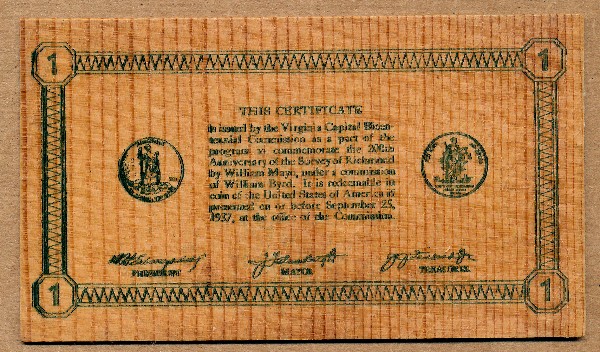
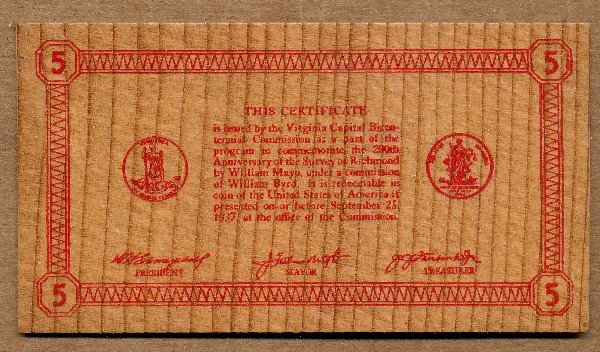
Here are the One and Five nickel pieces in my collection:
Richmond Bicentennial - One Wooden Nickel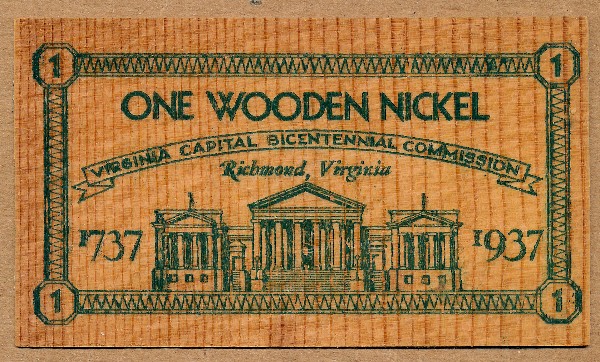
 Richmond Bicentennial - Five Wooden Nickels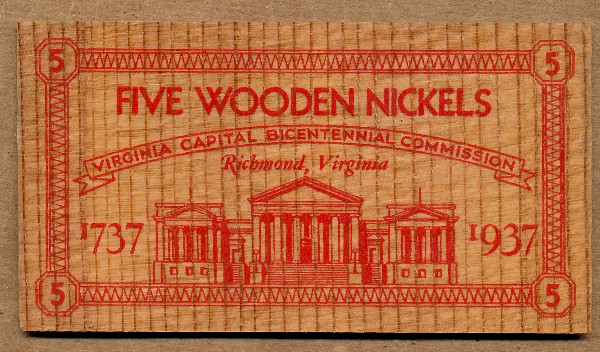
For other of my posts about commemorative coins and medals, including more What If? stories, check out:
Commems Collection.




 Posted 05/03/2022 10:25 pm





