In May 1937, during the 75th Congress, companion bills were introduced in the Senate and House of Representatives that called for half dollars "in commemoration of William Holmes McGuffey and the one-hundredth anniversary of the McGuffey Readers." The Senate bill was introduced by Joel Bennett Clark (D-MO); the House bill by Harold Gerard Mosier (D-OH).
William Holmes McGuffey (1800-1873) was born in Pennsylvania but moved to Ohio with his family as a young boy of just two. He graduated from college in 1826 (Washington College of Pennsylvania) and embarked on a life-long career of teaching and education-focused projects. One such project was a series of books that provided standardized lessons in spelling, phonics, reading and reading comprehension. William was the editor responsible for the content of the first four books; his brother, Alexander Hamilton McGuffey, co-edited the series' fifth and sixth volumes with William.
William Holmes McGuffey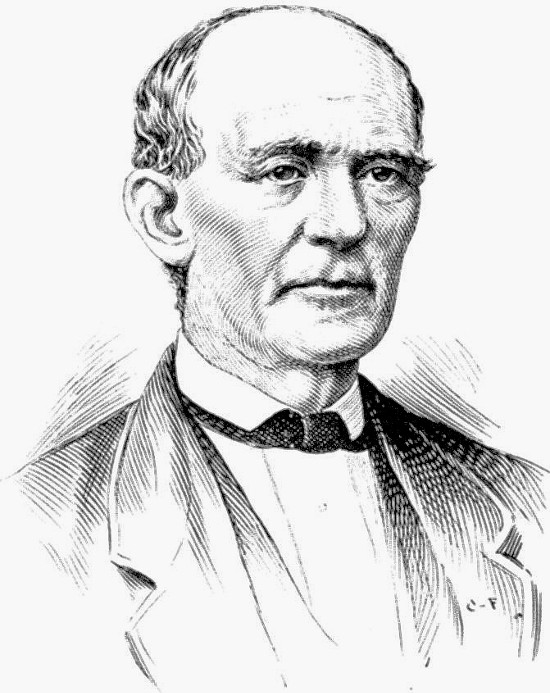 (Image Credit: Vail, Henry H. A History of the McGuffey Readers, Project Gutenberg. Public Domain.)
The books were/are referred to "McGuffey Readers" and were a widely-used textbook in US schools from the 1840s into the early 20th century; the books are still in print today and sell tens of thousands of copies each year (mostly for home school use). Millions of 19th century American schoolchildren used the McGuffey textbooks as part of their grade school education. The first two books of the series were published in 1836, the second two in 1837.
In the beginning, the "Readers" had a strong religious and morality component, but this was lessened over time. In general, the content of the "Readers" was updated and refined in many successive editions though they were never comprehensive in their coverage of all subjects (e.g., they "featured" many omissions in their coverage of US history).
The Clark and Mosier bills called for a fairly limited mintage of just 10,000 coins to be struck at a single US Mint facility. All coins struck were to bear the date "1937" regardless of when struck and coining authority was set to expire one year after the bill was enacted into Law. The coins were to be struck on behalf of the Federation of McGuffey Societies.
The Federation was based in Oxford, Ohio and had a mission of furthering and promoting the principles advanced by William Holmes McGuffey - education, literacy and morality chief among them; local Societies from across the country were members.
The Clark bill was referred to the Senate Committee on Banking and Currency; the Mosier bill to the House Committee on Coinage, Weights, and Measures. Neither bill gained much traction, however, and neither was reported out of Committee. When the 75th Congress adjourned, both bills died.
For more of my topics on commemorative coins and medals, including many more What If? stories, see:
Commems Collection.




 Posted 12/30/2022 2:32 pm





