The 75th anniversary of the start of the US Civil War was looming (1936) and so, in 1934, thoughts were turning toward remembrances for key players and battles of the War. One such prominent figure of the War was General Thomas Jonathan "Stonewall" Jackson. (Jackson is depicted, along with General Robert E. Lee, on the 1925 Stone Mountain Memorial commemorative half dollar.)
General Stonewall Jackson Portrait - Circa 1939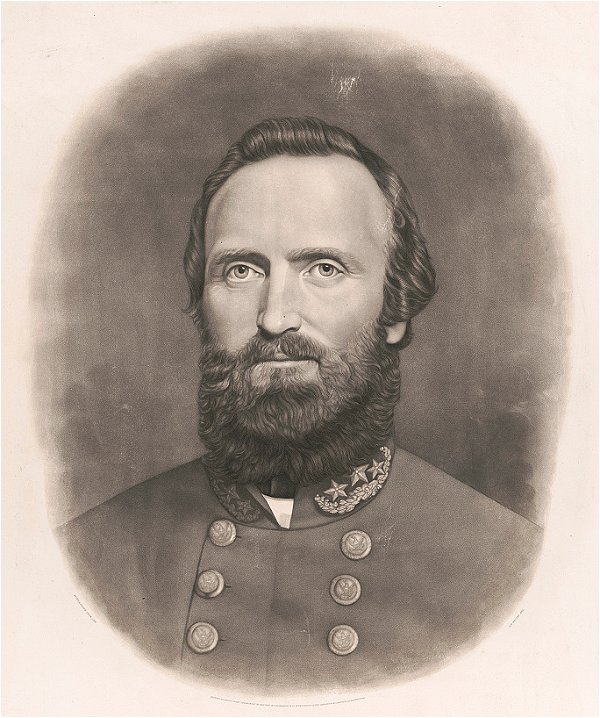 (Image Credit: Library of Congress, Prints and Photographs Division. Public Domain.)
In 1934, Jackson's birthplace was the focus of a coin bill introduced by Representative Andrew Edmiston (D-WV). The bill sought half dollars "in commemoration of the birthplace and boyhood home of General Thomas J. (Stonewall) Jackson" for the benefit of the West Virginia State 4-H Camp. Jackson was born in Clarksburg, Virginia (located within West Virginia beginning in 1863 when WV separated from Virginia and became the 35th State of the Union.) Jackson's birth date was January 21, 1824; he lived in Clarksburg until the age of six and then was sent to live with relatives after the death of his parents.
General Stonewall Jackson Birthplace - Circa 1885 - Encroached by More Modern City Development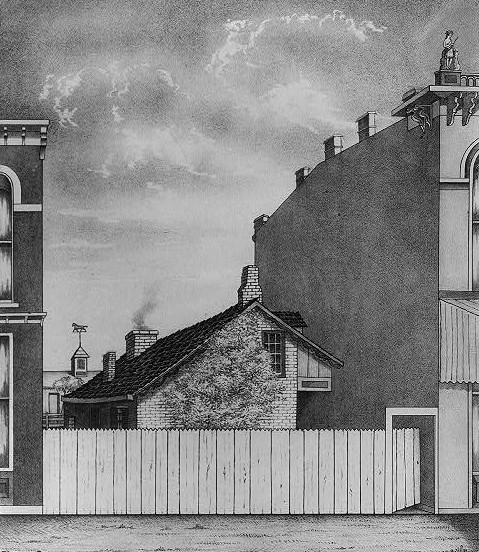 (Image Credit: Library of Congress, Prints and Photographs Division. Public Domain.)
Though he never received a formal education, Jackson did receive an appointment to West Point Military Academy and graduated 17th in his class. He served for a time in the US Army, exceling in the Mexican-American War and achieving the rank of First Lieutenant. Jackson met Robert E. Lee, then a Brevet Major, during the M-A War.
After the M-A War, he resigned his commission and taught for several years at the Virginia Military Institute (VMI). When the Civil War began, Jackson joined the Confederate effort and initially served as a Colonel in Virginia. He led troops in the First Battle of Bull Run (the Battle of Manassas to many in the South), It was there that he earned his nickname of "Stonewall" courtesy of the defiant stand he and his troops made against Union forces that had nearly overrun the troops of General Barnard Elliott Bee Jr. The General remarked that Jackson and his troops stood like a "stone wall." The description stuck and "Stonewall" Jackson was born!
Jackson's leadership skills enabled his rise through the ranks of the Confederate Army, achieving the rank of General. and becoming General Robert E. Lee's "right hand man."
Jackson was killed as a result of "firendly fire" wounds received at the Battle of Chancelorville on May 2, 1863. After successfully leading Confederate troops against Union soldiers during the day, Jackson was returning to his camp with his men when they were mistaken for a Union force and shot upon. Jackson was hit three times in his left arm and hand. His shattered arm was injured so severely that it was amputated. Jackson then developed pneumonia and died from associated complications eight days later.
Side Note: Jackson's body was/is buried in a cemetary in Lexington, VA while his arm was buried in Locust Grove, Virginia where a grave marker remains to the present. It's unclear, however, if Jackson's arm is still buried there as multiple reports exist of it being dug up and moved over the years. The coin bill called for up to 50,000 half dollars of standard specifications, but did not include limiting language regarding the date to appear on the coins, or an expiration date for coining authority. This combination would have allowed the coins to be struck and sold over the course of multiple years. During consideration of the bill, Representative Edmiston, referring to the boys and girls of the State 4-H Camp stated: "They will not sell them for just a year, but they will keep right at it until they dispose of the number authorized."
Upon its introduction, the bill was referred to the House Committee on Coinage, Weights, and Measures. It was reported out favorably, with several amendments, after about two months. The Committee decided against including the "boyhood home" reference, preferring to keep the bill focused on Jackson's birthplac and switched the bill's named sponsor/beneficiary from the State Four-H Camp at Jacksons Mill, West Virginia to a Commission appointed by the West Virginia Governor.
The bill was contested in the House, facing objections each of the two times it was brought up for consideration. The second time it was considered, only one objection was heard. As three were necessary to prevent the bill's consideration, it proceeded to be read, amended, engrossed, read for a thrid time and passed. Next stop, the Senate.
Once received in the Senate, the bill was immediately referred to its Committee on Banking and Currency. The Committee reported the bill without further amendment. When considered in the Senate, it was passed without objection or debate of any kind.
The bill was then examined and signed in each chamber before being presented to the President (Franklin Delano Roosevelt - FDR) on June 16, 1934. Congress adjourned just two days later - June 18, 1934.
Once a bill has been passed by Congress and sent to the President, he/she has ten days (not including Sundays) in which to either approve it or veto it. If no action is taken by the end of the tenth day, the bill is considered approved and becomes law. One exception to this is when Congress has adjourned and is not available to receive a bill from the President. This was the scenario when FDR was presented with the Jackson coin bill. As he could not return it to Congress with his veto, he sent out a Press Release on June 26th with a long list of bills that he was not approving (i.e., for which he was exercising a pocket veto). For each, he included brief comments regarding what led to his disapproval.
(From Senate.gov - Vetoes: The president has ten days (excluding Sundays) to sign a bill passed by Congress...A pocket veto occurs when Congress adjourns during the ten-day period. The president cannot return the bill to Congress. The president's decision not to sign the legislation is a pocket veto and Congress does not have the opportunity to override.)For the Jackson bill, FDR stated:
"Although I have approved several bills to authorize issuing 50-cent pieces to commemorate anniversaries of the founding of States, I have announced that hereafter such coinage should be greatly limited.
"While the boyhood home of General Jackson is of great interest to all Americans, I do not believe that a special coinage of 50-cent pieces is justified."
And so, there was almost a second US coin designed to honor the Confederacy (following the Stone Mountain Memorial Half Dollar). Had I been around at the time, I would not have been a supporter - I'm thankful FDR intervened as he did..
Jackson's birthplace home no longer exists, a historical marker has been placed near to the original site.
For other of my topics on commemorative coins and medals, including more on the Stone Mountain half dollar and many more What If? stories, see:
Commems Collection.










 Posted 02/02/2023 10:17 am


