In my post discussing the proposed 40-million piece mintage of commemorative half dollars in honor of Charles Lindbergh (see it here:
What If? 1928 Charles Lindbergh), I briefly mentioned a parallel medal proposal. I've been thinking, however, that a call for 10 million commemorative medals to be struck by the US Mint deserves its own discussion. So...
Two days after the Lindbergh half dollar bill was introduced in the House of Representatives by Miles Clayton Allgood (D-AL), Ole Juulson Kvale (Farmer-Labor-MN) - he of Norse-American Centennial Medal fame - introduced a commemorative bill calling for medals "in commemoration of the achievements of Colonel Charles A. Lindbergh." He introduced the bill on February 16, 1928; it was immediately referred to the House Committee on Coinage, Weights, and Measures.
The bill called for the striking of up to 10 million medals for the benefit of the Lindbergh Commission (the bill also created the Lindbergh Commission). Its language did not restrict production to a particular Mint or Mints, though it is likely that the Philadelphia Mint would have produced the medals as it was the main branch of the US Mint and had the most extensive production setup for medals. The bill was also non-specific regarding the metallic composition of the medals - medals struck in bronze, silver and/or gold were all possibilities. (see Hearing discussion below for more.)
Representative Kvale included specific instructions in the bill on how the net proceeds from medal sales were to be used:
"SEC. 3. The commission is authorized to sell such medals at such price or prices as it may determine. The commission shall, in cooperation with Colonel Charles A. Lindbergh expend out of the proceeds of such sale a sum not to exceed $500,000, as follows:
(1) For the purchase and equipment of the Lindbergh homestead at Little Falls, Minnesota (such equipment to be in cooperation with the Richard Howard Farrell Post Numbered 46, American Legion, and in such manner as they may determine to be in the interest of the public welfare), a sum not to exceed $250,000.
(2) For the purpose of constructing and equipping a Lindbergh Museum at Saint Louis, Missouri, a sum not to exceed $250,000.
The balance of such proceeds shall, under the direction of Colonel Charles A. Lindbergh, the Postmaster General, and the Secretary of Commerce, be expended for the scientific research of aerodynamics, plane design, and aviation motors, and for the further development of commercial aviation."
Note: Considering the designated use of the balance of the proceeds, the inclusion of the Postmaster General in the decision-making process is a surprise to me.A Hearing for the medal bill was held within days of its introduction/referral. Key takeaways from the Hearing:
1. Part of the "equipment" plan for Lindbergh's Little Falls, MN home site was potentially "a hospital or similar institution to be operated in the public welfare." (The site today is the Charles Lindbergh House and Museum, a site administered by the Minnesota Historical Society - there is no on-site hospital.)
2. Representative (Committee Member) Lloyd Thurston (R-IA) didn't believe the Committee should report the bill before it had feedback from Lindbergh. (He was outvoted.)
3. Kvale indicated that it was likely that gold and silver medals would be requested if the bill passed.
4. Representative Kvale emphasized to the Committee that his bill did not compete with the John Quillin Tilson (R-CT) bill which sought a larger-format Congressional Gold Medal; he recommended that both bills pass.
After the Hearing, the Committee voted to report the Kvale bill favorably, and recommended that it pass with a few minor amendments to the composition of the five-member Lindbergh Commission (increase House members from one to two and decrease Senate members from two to one).
When the bill was brought up on the Consent Calendar, Representative Fiorello Henry La Guardia (R-NY) motioned for it to be "stricken from the calendar." When questioned, La Guardia simply responded with "I think for the present it ought to be stricken from the calendar. That action will meet the approval of every one concerned." And with that nebulous response, the bill's consideration was ended - no commemorative medals for Charles Lindbergh were struck by the US Mint for the never-formed Lindbergh Commission.
Representative Tilson's Congressional Medal bill fared better, and was ultimately struck, with with bronze duplicates made available for purchase by the public.
Charles Lindbergh Congressional Gold Medal - Bronze Duplicate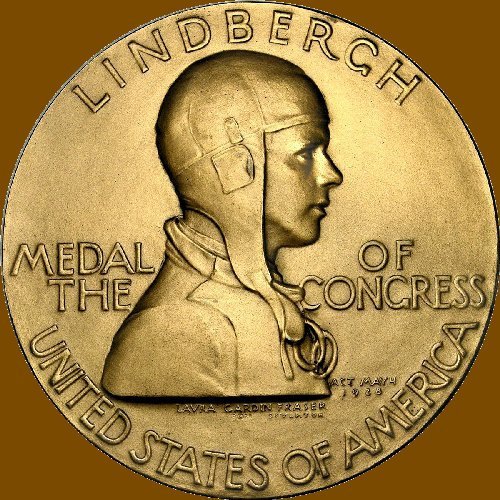
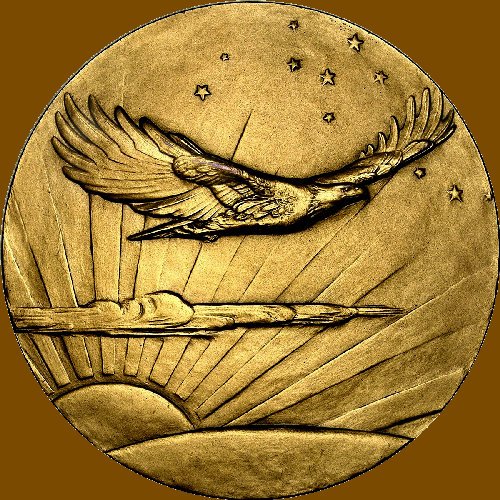
The medal was designed/sculpted by
Laura Gardin Fraser. It was originally available from the Mint in 1928 (List Medal Number 645), and has been re-struck multiple times over the years. Unfortunately, the medal has not been available from the Mint for ~40 years (early 1980s). Examples of the medal can generally be found in the secondary market (that's where I got mine!).
For more on the proposed Charles Lindbergh half dollar, check out:
-
1928 Charles LindberghFor other of my topics on commemorative coins and medals, including many more What If? stories, see:
Commems Collection.






 Posted 04/19/2023 1:51 pm





