In March 1900, John Franklin Rixey (D-VA) introduced a bill that called for "the coinage of certain memorial half dollars for the benefit of the Washington Monument Association of Alexandria, Virginia." Upon its introduction, the bill was referred to the House Committee on Coinage, Weights, and Measures.
The half dollars were intended to aid "in defraying the cost of a pedestal, and completing in a suitable manner the work of erecting a monument, designed by the Washington Monument Association of Alexandria, Virginia, to commemorate the memory of General George Washington in his home town, the city of Alexandria, Virginia, as a farmer, a mason, a fireman, a surveyor, and a citizen, on the centenary of his death, as a feature of the appreciation of the Congress of the United States for Washington as a citizen, and its desire to see his memory properly commemorated in his home town."
The Washington Monument Association of Alexandria, VA was established on November 1, 1899, with William B. Smoot as President, for the purpose of fulfilling the objectives outlined in the previous paragraph. In response, it settled on a standing depiction of Washington with each side of the statue's pedestal devoted to a different aspect of Washington's life as a citizen: Farmer, Surveyor, Fireman and Mason.
Proposed Washington Monument/Statue in Alexandria, VA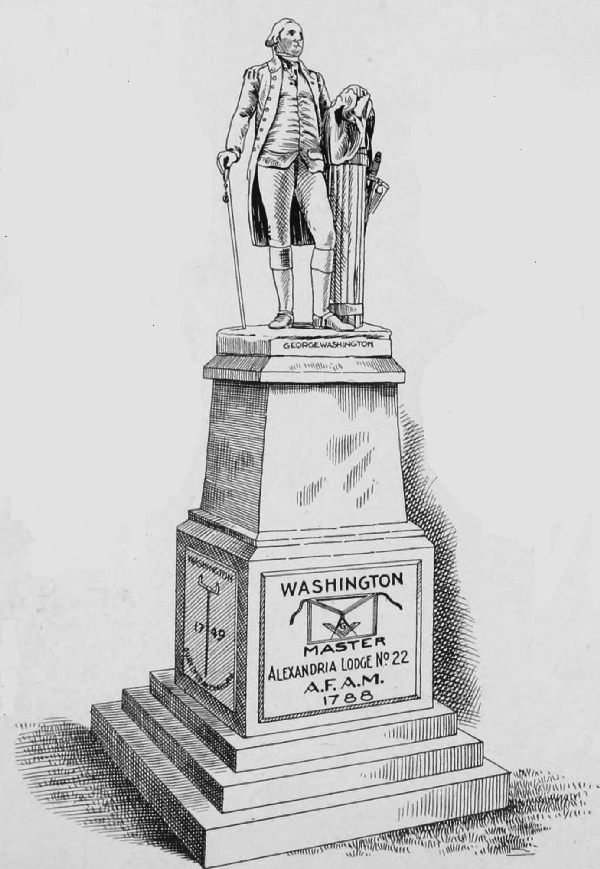
The coin bill authorized the striking of 200,000 silver half dollars of standard specifications to be known as Washington Memorial Half Dollars.
The coin bill was sent to the Treasury by the Committee Chair for the Treasury's review and opinion. In a foreshadowng of the future, the Treasury's review came back with a negative opinion and an expression of how such coinage could set an unwanted precedent for similar organizations in the future. The Secretary also let it be known that the objections expressed would not be had for aa bill requesting commemorative medals. As a result, the Committee reported the bill back with an amendment that changed the coin bill into a medal bill.
The Monument Association did not "jump" on the opportunity to have souvenir medals struck on its behalf vs. its requested half dollars. As a result, no action was taken on the amended bill during the remainder of the 56th Congress.
There would, ultimately, be US Mint-struck medals in the Monument Association's future (a topic for an upcoming post), but in an interesting twist...
A decade later, the Monument Association was still in need of funds for its project, and was driven to try the commemorative coin route again. Charles Creighton Carlin (D-VA) was engaged to introduce bills in 1909 and 1911 that were essentially duplicates of Rixey's 1900 coin bill and once again called for silver half dollars. A notable change in Carlin's version of the coin bill, however, was a request for 300,000 coins vs. Rixey's original request for 200,000. Each of the bills was referred to Committee, but never reported out.
The Monument Association was never able to raise the funds it needed to complete its planned monument to George Washington, and eventually disbanded without completing its mission. Decades later, a simple Washington Monument was erected in Alexandria in a park along the Potomac River - essentially a miniature version of the Washington Monument across the river in Washington, DC. The Association had nothing to do with the miniature replica.
For more about the Washington Monument Association medals that were ultimately approved, see:
-
1902 Washington Monument Association - Medals / Origin StoryFor other of my topics on commemorative coins and medals, including many more What If? stories, see:
Commems Collection.







 Posted 04/20/2023 8:33 pm





