Note: Under construction.I've previously discussed the origins of the Washington Monument Association's medals (first as a coin proposal -
What If? 1900-1901-1910-1911 Washington Monument Association - then as a medal proposal -
1902 Washington Monument Association Medals / Origin Story), this time out, I'm focusing on the designs of the medals and the Association's promotional efforts to sell them.
DesignsThe Monument Association envisioned a statue of Washington placed on a pedestal upon which each of its sides celebrated a different aspect of Washington's life as a citizen of Alexandria, VA. To help raise money to fund the statue and pedestal, the Monument Association desired a set of souvenir medals that would mirror its design goals for the Monument. As such, the US Mint was authorized to prepare four sets of dies for the medals. There would be a common obverse design and four distinct reverse designs; each reverse design coincided with the theme of one of the sides of the statue's pedestal: Mason, Farmer, Firefighter and Surveyor. (My previous post:
1902 Washington Monument Association Medals / Origin Story includes an illustration of the proposed monument.)
George Washington Monument Association Medal - Common Obverse[Image coming Soon.]
The obverse die depicts a right-facing George Washington (based on the Houdon bust). In a nod to the medals' authorizing legislation, an ENCIRCLING inscription reads: "STRUCK BY ORDER OF CONGRESS TO COMMEMORATE THE CENTENARY OF WASHINGTON'S DEATH". In front of Washington's bust is presented: "WASHINGTON / MONUMENT / ASSOCIA / - TION" and ALEXAN / - DRIA VA" is seen below the bust. (Odd use of hyphenation IMO!)
George Washington Monument Association Medal - Mason Reverse[Image coming Soon.]
The Mason medal design features the Mason square and compasses logo at its center (on an apron), flanked (top and bottom) with "WASHINGTON" and "MASTER" to indicate Washington's level within the Masons organization, and "ALEXANDRIA LODGE No. 22 A. F. & A. M. 1788" which represents the year the Alexandria Lodge was chartered and when Washington was asked to be its Charter Master. (Washington had joined the Masons on November 4, 1752 at the Fredericksburg, VA Lodge.)
Note: AF&AM = Ancient Free And Accepted Masons.George Washington Monument Association Medal - Firefighter Reverse[Image coming Soon.]
George Washington was rumored to be a member of the Friendship Fire Company in Alexandria, VA. (The rumors were started long-after Washington's death (mid-1800s) and have never been verified. Most historians consider his active membership in the fire company to be more legend vs. fact. ) The medal design depicts a piece of horse-drawn firefighting equipment from Washington's time.
George Washington Monument Association Medal - Surveyor Reverse[Image coming Soon.]
On the reverse of the "Surveyor" medal is seen a surveyor's transit circa 1740s (when Washington's was a surveyor in Virginia). The transit's pole bisects the inscriptions "WASHINGTON" "1788" and SURVEYOR ALEXANDRIA". Washington performed his survey of Alexandria in 1748, and prepared maps of the area in 1748 and 1749.
George Washington Monument Association Medal - Foremost Farmer Reverse[Image coming Soon.]
The "Foremost Farmer" design is the most complex of the group. It features a left-facing, winged, female, allegorical figure carrying a radiating torch above symbols of farming/agriculture. Depicted at left is a bee hive with buzzing bees. More to the center is found a pair of bales of grain products along with a rake, a scythe and a plow. To the right of the plow, below the flying figure's feet, is seen a fruit-bearing vine (pumpkins?).
Each medal is 40 mm in diameter (US Silver Dollar = 38.1 mm) and, in bronze, has a weight of xx grams. The medals are thicker than a typical US coin and were struck in higher relief. Overall, I find them to be well-executed and attractive. In my collection, I have one of each design in bronze and one of the silver medals.
Per US Mint records, 2,006 of each design, in bronze, were struck in 1904. In addition, a total of 506 medals were struck in silver (Mint records do not provide a split by design for the silver versions). The delay between the medal's approval in July 1902 and its striking in 1904 might have been tied to production schedule issues at the Mint, or (more likely IMO) funding issues at the Monument Association. The Mint was not authorized to provide the medals to the Association without being paid for them, and the Monument Association had ongoing issues with fundraising.
Sales PromotionThe Monument Association primarily marketed its souvenir medals locally, making them available at local stores, gift shops and Mason's lodges; they encouraged a wider audience, however, and offered the medals via mail order as well. Individual bronze medals cost $0.50, with a five-piece group available for $2.00. The five-piece set featured one of each reverse design, plus an extra medal to enable simultaneous display of the common obverse.
I've not yet encountered pricing for the silver medals. VIP presentation pieces vs. public sale?
Sales of the medals did not come close to meeting Association expectations and thus failed to produce the revenue needed by the Association to erect its planned monument/statue. When the Association later dissolved, it left behind only a vision to honor Alexandria's most prominent citizen vs. a lasting, tangible tribute.
If you've ever been on I-95 south of Washington, DC, you have no doubt observed a distinct and imposing tower rising in the west. The tower is the George Washington Masonic National Memorial. It is a grand memorial to George Washington and is open to the public for tours - the Monument Association was not involved with its construction. (To learn more about it, see:
The George Washington Masonic National Memorial.)
George Washington Masonic National Memorial - Alexandria, VA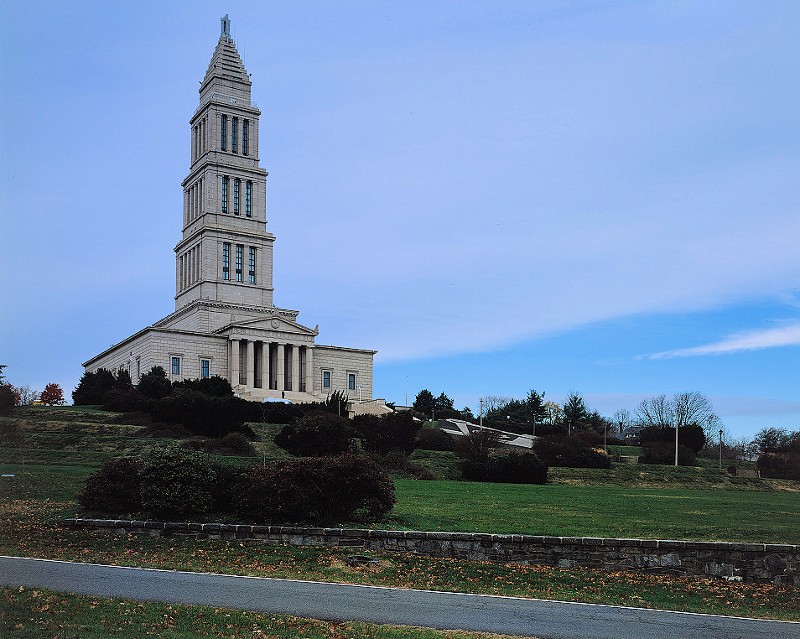 (Image Credit: Library of Congress, Prints and Photographs Division. Public Domain.)
For more about the origin of the Washington Monument Association medals, see:
-
1902 Washington Monument Association Medals / Origin StoryFor other of my topics on commemorative coins and medals, including many more What If? stories, see:
Commems Collection.







 Posted 04/22/2023 11:54 pm





