I have written previously about my views on the commemorative nature of the 1932 Washington Quarter (
1932 Washington Quarter,) today I turn my attention to the 1921 Peace Dollar.
At the 1920 American Numismatic Association (
ANA) Convention held in Chicago, Illinois (August 23-26) a paper was read during the Convention's Third Session (Wednesday, August 25) that called for a circulating commemorative coin "to formally acknowledge we are at peace with all against which we battled in the great war." The paper was written by Farran Zerbe and received at the Convention by Special Delivery - it was read to attendees by Moritz Wormser.
If being coined again, Zerbe proposed use of the one dollar coin as its larger size would enable the best artistic expression. (At the time of the Convention, the silver dollar was not being struck, but it would be shortly thereafter- using the standard "Morgan" design.)
The issue was raised at the session that formal, comprehensive peace treaties were not yet fully in place, and therefore a "peace" commemorative coin proposal was premature. The Treaty of Versailles (which formally ended World War I and outlined the terms of peace between Germany and the Allies) was signed June 28, 1919; additional peace treaties were signed in January 1920. The formal treaty between the US and Germany to restore "friendly relations" was signed on August 25, 1921 and ratified on October 21, 1921.
The signed treaty issue was considered something that would resolve with time, and not a reason to dismiss the proposal. A successful motion was made at the Convention to refer the proposal to the
ANA Committee on Resolutions for further action. A Special Committee was authorized and appointed; it consisted of A.Judson Brenner (former
ANA President), Dr. John M Henderson (former
ANA President), Howland Wood (former
ANA General Secretary, Board Member and Associate Editor of
The Numismatists, Farran Zerbe (former
ANA President) and US Representative William Albert Ashbrook (D-OH). Brenner, Chairman of the
ANA Committee, Dr. Henderson and Representative Ashbrook went before the House Committee on Coinage, Weights, and Measures in December 1920 and urged the passage of a circulating "peace" dollar commemorative coin proposal. House Committee members voiced their support for the proposal.
A Peace Dollar commemorative coin was proposed via House Joint Resolution 111 in May 1921; it was introduced by Albert Henry Vestal (R-IN). The bill specified that new silver dollars struck in accordance with the Pittman Act of April 23, 1918, "shall be of an appropriate design commemorative of the termination of the war between the Imperial German Government and the Government and people of the United States." The resolution went on to specify that "such design shall be known as the 'peace dollar.'"
The resolution was referred to the House Committee on Coinage, Weights and Measures, from which it was reported out with a recommendation for passage. When the resolution was brought up for Unanimous Consent in the House, it was objected to by James Robert Mann (R-IL); this was enough to have the resolution stricken from the Calendar and further consideration; Mann was serving his 13th consecutive term at the time he objected to the Peace Dollar Resolution.
As no proposal (bill or resolution) for a "peace dollar" commemorative coin was introduced in the Senate, the Peace Dollar was not considered in the chamber and was basically defeated by a single objection in the House.
Note: When a bill/resolution is on the Calendar for Unanimous Consent, it can either streamline the approval process or fall to the objection of a single Senator or Representative.However, the Treasury Department/Mint was in favor of a new design for the silver dollar and, since the current design by George T. Morgan had been in use for more than 25 years it did not need Congress' authorization to make a design change.
(Note: The dollar was the only circulation coin to meet the 25-year design threshold in 1921.) The Treasury Department was in favor of producing the proposed Peace Dollar. So, it announced that it would soon be making a design change to the silver dollar, and would be striking a dollar coin that commemorated the War's end and subsequent international peace.
Per the 1922
Annual Report of the Director of the US Mint, the "coin commemorates the declaration of peace between the United States, Germany, and Austria, exchanges of peace treaty ratifications having been made in Berlin on November 11, 1921, and in Vienna on November 8, 1921. and peace having been proclaimed by the President of the United States on November 14 and 17, 1921, respectively." IMO, a clear indication of its commemorative nature/intentions.
The fact that the Treasury made the move as a design change on its own vs. being directed to by Congress - plus the fact that it became a somewhat annual circulation issue - places the coin in the "not a commemorative coin" category for some. For me, the commemorative nature of the 1921 issue is clear and I consider it a circulating commemorative dollar - the US' second commemorative silver dollar after the Lafayette Memorial coin of 1900. I'm fine with considering the following Peace Dollar issues as regular circulation issues, but the 1921 issue deserves a different level of recognition IMO.
As such, I include the 1921 Peace Dollar in my collection of circulating US commemorative coins. while simultaneously acknowledging the categorization does not apply to the remainder of the series. It may be "one step removed," but its history and original purpose, IMO, is clearly commemorative in nature.
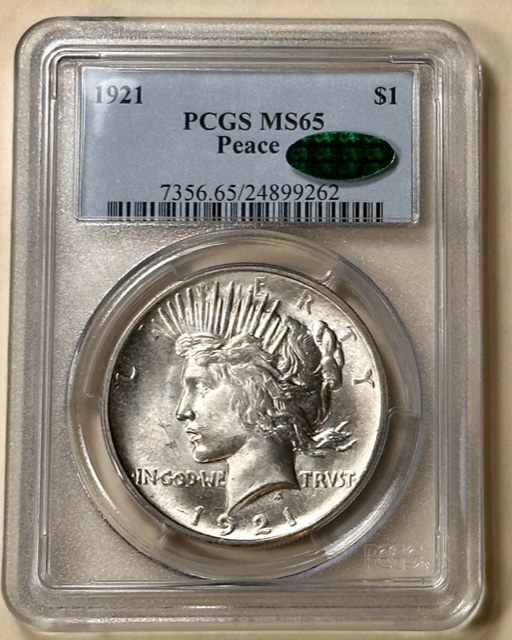
The coin was designed by Anthony de Francisci. The obverse features a left-facing portrait of an allegorical
Liberty, figure wearing "a tiara of light rays." The motto "LIBERTY" is presented near the top rim.
The reverse design features a bald eagle perched atop a mountain; it holds an olive branch in its talons. The eagle is shown facing right, waiting for the rising sun whose rays are just becoming visible - the eagle waits for the dawning of a new day.
Just over 1 million of the coins were struck in December 1921. The first-year-issue coins were struck in higher relief vs. the coins of following years and thus represent a series variety.
1921 Peace Dollar
 (Image Credit: Heritage Auctions. Fair use, education.)
For other of my posts about commemorative coins and medals, check out:
Read More: Commems Collection.








 Posted 06/26/2023 11:03 am





