I've previously presented a series of brief notes about the 1924 Huguenot-Walloon Tercentenary Half Dollar (see links below), but wanted to return to the coin with two more interesting facets of its history.
Tidbit #8I've written before about the criticisms of Dr. Frederick J. Zwerlein, professor of history at St. Bernard's Theological Seminary. One of his complaints about the coin was the fact that the Netherlands was not named on the coin. He felt that it was "the nation to whom the colony belongs" and that it was ignored on the coin. Considering Dr. Zwerlein's extensive study of New Netherland, his view of the coin's designs is somewhat surprising (to me at least).
While it's true that the Netherlands isn't literally identified on the coin, its reverse design does feature the sailing ship
Nieuw Nederlandt (English:
New Netherland) under full sail. The ship sailed under the auspices of the Dutch West India Company, a company chartered by the States General of the Netherlands and granted trading rights and colonization authority within the Netherlands New World territorial claims. Also, the coin's authorizing legislation states that the coins were to be struck "in commemoration of the three hundredth anniversary of the settling of New Netherland, the Middle States, in 1624, by Walloons, French and Belgian Huguenots, under the
Dutch West India Company." (Emphasis added.)
So, from my perspective, the coin is true to its enabling legislation with symbolic nods to the Dutch West India Company and, by extension, the Netherlands itself via the
Nieuw Nederlandt.
Tidbits #9In March 1924, the
Central New Jersey Home News out of New Brunswick, NJ, published a Letter to the Editor from John A. Manley that commented on Dr. Zwerlein's published address. It was a little difficult, however, to understand which side of the issue Mr. Manley favored.
For example, he agrees with Zwerlein in believing "there is no disputing the fact that the striking or minting of this coin is a great mistake on the part of our government." He further stated "I can see no reason why such action [the striking of the coins] should be taken in this case and am of the opinion that this sets a precedent for future attacks on the coinage of the United States." He continued, "It is a mistake to start any such course in connection with the coinage of money and if it is necessary or desirable to coin special coins they should be circulated through the regular channels and at their face value."
So, Mr. Manley appears adamantly opposed to commemorative coins in general, but especially to those produced for private organizations and sold at a premium...but he went on to mention that he purchased four of the coins for $1.00 each at his local bank. So much for taking a steadfast opposing stand!
1924 Huguenot-Walloon Tercentenary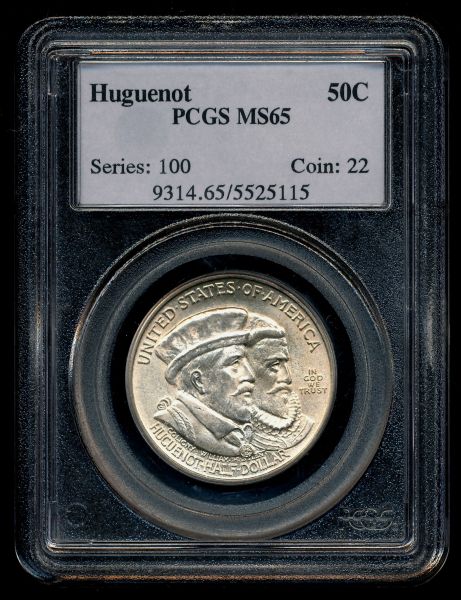

For my previous posts of Huguenot-Walloon Half Dollar Tidbits, see
-
1924 Huguenot-Walloon Tercentenary - Revisited-
1924 Huguenot-Walloon Tercentenary - Revisited #2For other of my posts about commemorative coins and medals, including more about the Huguenot-Walloon coin, see:
Commems Collection.







 Posted 07/07/2023 12:01 pm





