On the same day (November 9, 1997) the Senate approved the 50 States Commemorative Coin Program Act which included provisions for a new dollar coin that was to "be golden in color, have a distinctive edge, have tactile and visual features that make the denomination of the coin readily discernible", Olympia J. Snowe (R-ME) introduced a Senate Resolution that would have authorized the United States ("US") Mint "to mint and circulate $1 coins bearing a likeness of Margaret Chase Smith."
Note: Implementation of the Resolution was contingent on a new $1 coin being approved via a separate bill - the Resolution did not propose a new $1 coin.Smith was born in Skowhegan, Maine on December 14, 1897. She graduated from Skowhegan High School in 1916, taught for seven months at a nearby school, then went to work for Maine Telephone and Telegraph Company as a telephone operator. In 1919, she went to work for Skowhegan's weekly newspaper - the
Independent Reporter - as a reporter. During her time there she took on roles of increasing responsibility, which led to a position as the paper's Circulation Manager. She met her future husband, Clyde Smith, at the newspaper - he was a co-owner.
She was active in local business groups while at the newspaper, organizing the Skowhegan chapter of the Business and Professional Women's Club in 1922 and serving as the president of the Maine Federation of the Business and Professional Women's Clubs beginning in 1923.
After eight years at the newspaper, she went to work for the Daniel E. Cummings Company, a local textile (wool) mill, as its Office Manager.
Margaret married Clyde in 1930, and actively supported his public service efforts and political campaigning. She served as his secretary in Washington, DC after Clyde was elected to the House of Representatives ("House") in 1936. She served as his secretary until his death in April 1940.
Margaret won a special election to succeed Clyde and finish his terrm. She won election to the four succeeding sessions of Congress in the House and then followed them with four terms in the Senate representing Maine.
House Swearing In Ceremony for Margaret Chase Smith - June 10, 1940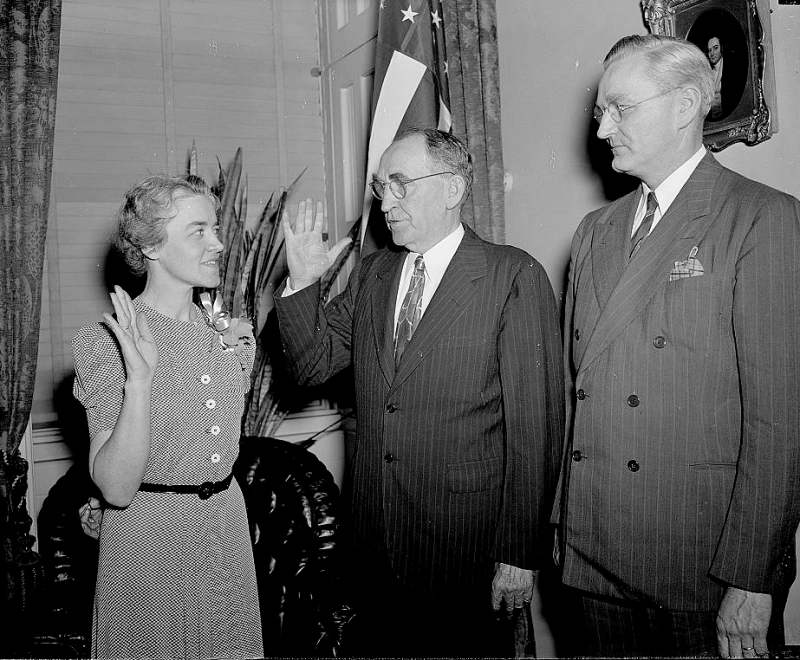 (Image Credit: Library of Congress, Prints and Photographs Division. Public Domain.)Note: From left to right in the image: Margaret Chase Smith, Speaker William Bankhead and Maine Representative, James C. Oliver (R-ME), Smith's sponsor.
The text of the Snowe's Senate Resolution includes more biographical details:
Senate Resolution"To express the sense of the Senate that if a new $1 coin is minted, the Secretary of the Treasury should be authorized to mint and circulate $1 coins bearing a likeness of Margaret Chase Smith.
"Whereas in 1940, Margaret Chase Smith became a Member of the House of Representatives, commencing 32 years of public service to the State of Maine and to the United States:
"Whereas Margaret Chase Smith was elected to the Senate in 1948, becoming the first woman to be elected to the Senate, as well as the first woman to be elected to both the House of Representatives and the Senate;
"Whereas on June 1, 1950, Margaret Chase Smith delivered an address entitled "Declaration of Conscience", which was a defense of the basic principles of Americanism, including the right to criticize, the right to hold unpopular beliefs, the right to protest, and the right to independent thought;
"Whereas Margaret Chase Smith was the first woman to become the ranking member of a congressional committee;
"Whereas Margaret Chase Smith was the first woman to serve on the Committee on Armed Services and the Committee on Appropriations of the Senate;
"Whereas in 1964, Margaret Chase Smith was the first woman to have her name placed in nomination for the presidency by either major political party;
"Whereas Margaret Chase Smith was the first civilian woman to sail on a United States destroyer during wartime;
"Whereas Margaret Chase Smith was the first woman to break the sound barrier in a United States Air Force F-100 Super Sabre;
"Whereas until 1981, Margaret Chase Smith held the all-time consecutive rollcall voting record of the Senate, totaling 2,941 votes over 13 years;
"Whereas Margaret Chase Smith died at the age of 97, and, during her lifetime, was given 95 honorary degrees and was awarded the Presidential Medal of Freedom by President Bush in 1989;
"Whereas Margaret Chase Smith was a teacher, a telephone operator, a newspaperwoman, an office manager, a secretary, a wife, a Congresswoman, and a Senator;
"Whereas Margaret Chase Smith was a leader, a Nation's conscience, a visionary, and a woman of endless firsts;
"Whereas the achievements of Margaret Chase Smith are an inspiration to millions of young girls and women, showing that through the use of one's talents, abilities, and energies that opportunities for women do exist and that the door to elected office can be open to all women; and
"Whereas Margaret Chase Smith served with pride and humility, and her epitaph aptly reads, "She served people."
"Resolved, That it is the sense of the Senate that if a new $1 coin is minted, the Secretary of the Treasury should be authorized to mint and circulate $1 coins bearing a likeness of Margaret Chase Smith."
Quite an impressive resume and, IMO, a person worthy of being honored on a US coin. Nothing against Sacagawea, but as a modern-age woman with such distinguished accomplishments, I think Margaret Chase Smith would have been a worthy subject for the then soon-to-be-released US $1 coin.
The Resolution was referred to the Senate Committee on Labor and Human Resources, but no further action was taken.
The 50 States Commemorative Coin Program Act did not specify designs for the new $1 coin it established, so the Treasury assembled an advisory panel to consider options. While Margaret Chase Smith was considered, the panel ultimately selected Sacagawea - the Shoshone guide who was to represent Native American heritage and contributions to US history along with general female empowerment.
For other of my posts about commemorative coins and medals, including other What If? stories, see: [b]
Commems Collection







 Replies: 1 / Views: 58


 Posted Today 9H 53M ago


