At the suggestion of nickelsearcher...
The classic-era series of United States ("US") commemorative coins has certainly depicted its fair share of animals - a badger, multiple bears, a beaver, a calf, dolphins, eagles, a "generic" fish, a horse, a moose, an owl and oxen have all been depicted.
For links to stories about these animals, see:
-
US Commemorative Coins Depicting An Eagle-
US Commemorative Coins Depicting Other Animals-
Quick Bits 134 - 1934 Maryland Tercentenary / FishIn addition, a pair of classic commemorative coins included a sea animal within their design that also included a rider of said animal. One of the coin designs combines allegory and mythology, the other brings together mythology and real life.
First up, Allegory and Mythology...
The obverse of the 1915 Panama-Pacific International Exposition Gold Quarter Eagle presents an allegorical figure of
Columbia - the personification of the United States - seated on a hippocampus - a fictitious animal that dates to the times of Greek mythology (and other ancient cultures, e.g., the Romans); a hippocampus was said to be an animal that combined the front quarters of a horse with the body and tail of a fish.
Hippocampus Statue, Fountain at Caesars Palace Hotel and Casino in Las Vegas, Nevada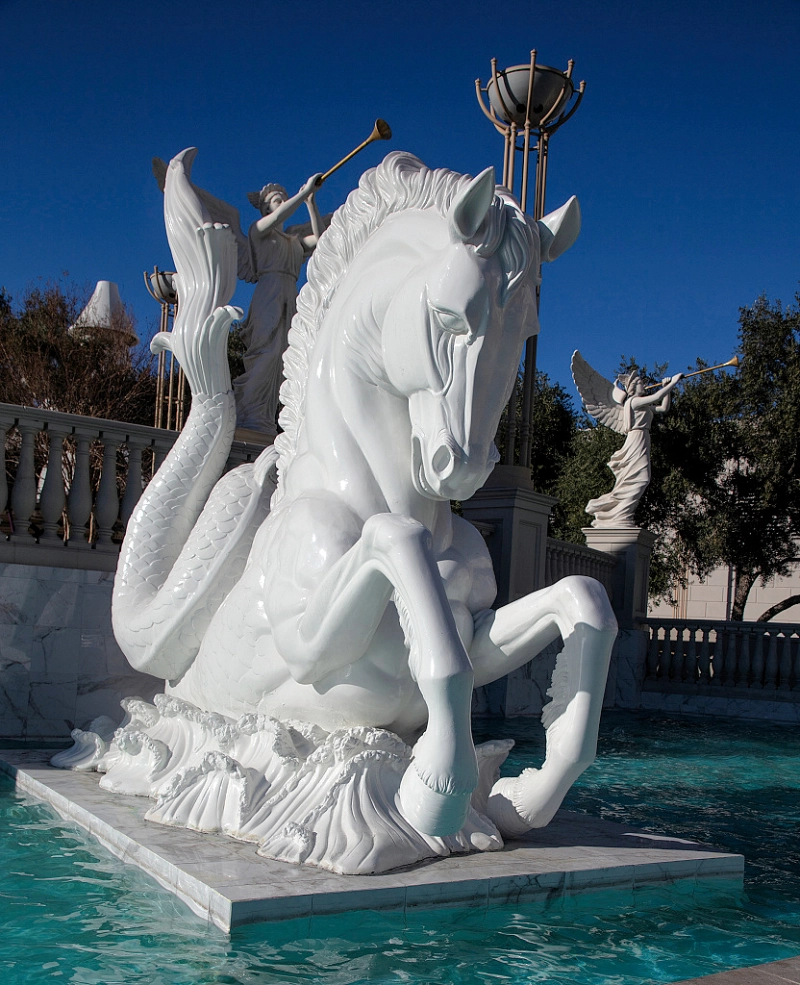 (Image Credit: Library of Congress, Prints and Photographs Division. Public Domain.)
The hippocampus is more typically associated with the ancient Roman god
Neptune or Greek god
Poseidon vs. the relatively modern
Columbia. The decision to pair
Columbia with a hippocampus is thus an interesting one, and one that reflects knowledge of classical mythology as well as modern allegory.
The design was by
Charles Barber.
1915 Panama-Pacific International Exposition Gold Quarter Eagle

Next up, Mythology and Real Life...
The 1935 Hudson, NY Sesquicentennial Half Dollar combines mythology and real-life on its reverse to create one of the more unusual designs (some call it 'whimsical') of the entire classic-era series: the mythological Roman god of the sea -
Neptune is shown riding backwards on a real-life whale while holding a trident in his right hand. The design is an adaptation of the original City of Hudson, NY Seal.
For a discussion of the Hudson, NY Seal, see:
-
Official Seals On Classic US Commemoratives - Part IIINeptune riding a whale is meant to be symbolic of
Neptune's total authority over the sea and all its marine life. The symbolism dates to the 16th Century (during the Renaissance); in ancient Roman times,
Neptune was typically depicted with hippocampi or dolphins.
The coin's design is the work of Chester Beach.


For other of my posts about commemorative coins and medals, including other Quick Bits stories, see:
Commems Collection 






 Posted Today 6H 29M ago


