| Author |
 Replies: 7 / Views: 352 Replies: 7 / Views: 352 |
|
|
CCF Master Historian of Commemorative Coins
 United States
12640 Posts |
I recently posted about a proposed metric system based coinage for the United States ("US") that included a provision for the striking of a silver five-cent coin (see it here: What If? 1884 US Metric System Coinage). Proposing a silver five-cent coin was not new in 1884, however. A standalone proposal for a silver five-cent piece was introduced in the House of Representatives ("House") in January 1878 by Samuel Sullivan Cox (D-NY). The bill was to authorize "the coinage of a five-cent piece of standard silver, and to discontinue the coinage of five-cent nickel-copper coins." The bill was referred to the Committee on Coinage, Weights, and Measures. The silver five-cent coin was to be 1/10th the weight of the half-dollar coin (i.e., 1.25 grams or ~0.04 troy ounces) and was to be legal tender "not exceeding five dollars in any one payment "to conform to the subsidiary silver coin provisions of the Coinage Act of 1873. The bill did not specify a start date for the new circulating coin, but did state that once the bill was enacted the striking of the nickel-copper five-cent coins was to stop immediately. The bill did not progress past its Committee assignment/review, and so the Mint continued to atrike the 75% copper / 25% nickel five-cent piece (i.e, Shield design) then in use. 1878 Shield Design Five-Cent Coin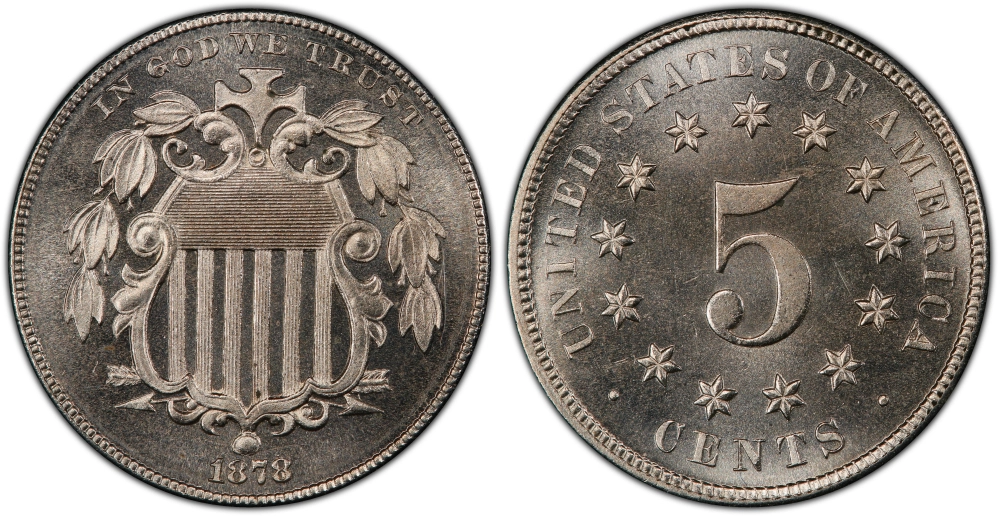 (Image Credit: PCGS CoinFacts.) (Image Credit: PCGS CoinFacts.)For other of my posts about US and World coins and medals (though mostly US and/or Canada), see: Commems CollectionCollecting history one coin or medal at a time! (c) commems. All rights reserved.
|
|
|
|
Bedrock of the Community
United States
27514 Posts |
Inordinately fascinated by bits of metal with strange markings and figures
|
|
CCF Master Historian of Commemorative Coins
 United States
12640 Posts |
Quote:So in a sense the bill aimed to revive the Half Dime which had been discontinued after 1873. It's certainly possible - I wondered about the same potential objective for the new proposal. It's plausible to believe that the overall coin specifications would have been very similar, though the new silver five-cent coin would have been very slightly heavier than the previous silver Half Dime. The bill makes no reference to a " Half Dime" just "Five-Cent piece". However, the " Half Dime" name could certainly have been applied later in the transition process. Thanks for engaging in the discussion! Collecting history one coin or medal at a time! (c) commems. All rights reserved.
|
|
Pillar of the Community
United States
3863 Posts |
Very interesting "What If?". A bit of a curious proposal since, as HondoB mentioned, the silver half-dimes had only been discontinued a few years before.
|
|
Moderator
United States
110516 Posts |
Than you for the commentary commems
|
|
Bedrock of the Community
United States
12011 Posts |
This reflected a battle between rich industrialists in the late 1800's. East Coast industrialist Joseph Wharton lobbied Congress for decades to be able to sell his nickel production out of his mines in New Jersey to the U.S. Mint. He finally succeeded in 1857 with the introduction of the 88% copper/12% nickel small cents into maistream coin production. This came about as silver was scarce and hoarded before and during the Civil War. White copper-nickel coinage was introduced in 1866. Things began to change in 1859 when Henry Comstock was credited for a broad set of silver and gold discoveries near Virginia City, NV, leading to a series of silver and gold rushes. This eventually led to statehood for Nevada. The Comstock Lode was largest silver discovery in North America. By the 1870s, silver went from scarce to so abundant that it crashed the global price of the metal. Comstock yielded 192 million pure ounces of silver and 8.3 million ounces of gold. This was the source for the hundreds of millions of Trade and Morgan silver dollars produced in the latter part of the 19th century. The proposal for a 5 cent silver coin pitted Wharton, an Eastern nickel industrialist who also was a founder of Bethlehem Steel and the Wharton Business School at the University of Pennsylvania against the Western silver mining interests that were both lobbying the Mint for purchases of their metals. In the end, silver was so abundant here from the 1870s to the end of the century that silver interests were more keen to have large $ cartwheel and half $ production for their silver than the minor coinage that would require vastly smaller amounts. Wharton eventually lost the economic fight, retaining small 5c coinage production, while the western silver interest won the bulk of the economic fight at the Mint, dominating the lion's share of coinage production. As an endnote, the Comstock gold strikes, at 8.3 million ounces, were almost as large as the 12 million ounces produced during the earlier California gold rush and much larger than the 1.25 million ounces produces during the Yukon gold rush in Alaska at the end of the 19th century. IN NECESSARIIS UNITAS - IN DUBIIS LIBERTAS - IN OMNIBUS CARITAS THE MAN IN THE ARENA, Theodore Roosevelt at the Sorbonne Paris on April 23, 1910: " It is not the critic who counts; not the man who points out how the strong man stumbles or where the doer of deeds could have done better. The credit belongs to the man who is actually in the arena, whose face is marred by dust and sweat and blood, who strives valiantly, who errs and comes up short again and again, because there is no effort without error or shortcoming, but who knows the great enthusiasms, the great devotions, who spends himself in a worthy cause; who, at the best, knows, in the end, the triumph of high achievement, and who, at the worst, if he fails, at least he fails while daring greatly, so that his place shall never be with those cold and timid souls who knew neither victory nor defeat." My coin website: https://fairfaxcoins.com |
|
Moderator
United States
16019 Posts |
Interesting proposal. Thanks for sharing it.
Nice commentary @NS - appreciate your contributions to the topic.
Take a look at my other hobby ... http://www.jk-dk.art |
|
Moderator
United States
198338 Posts |
Very interesting and thank you for sharing!  |
| |
Replies: 7 / Views: 352 |
|
To participate in the forum you must log in or register.
Disclaimer: While a tremendous amount of effort goes into ensuring the accuracy of the information contained in this site, Coin Community assumes no liability for errors. Copyright 2005 - 2026 Coin Community Family- all rights reserved worldwide. Use of any images or content on this website without prior written permission of Coin Community or the original lender is strictly prohibited.
Contact Us | Advertise Here | Privacy Policy / Terms of Use
|
| Coin Community Forum |
© 2005 - 2026 Coin Community Forums |
| It took 0.61 seconds to rattle this change. |
 |
|







 Posted 08/19/2026 3:43 pm


