






 Replies: 3 / Views: 164



 Posted Today 2H 16M ago


Hello and thank you for your question.
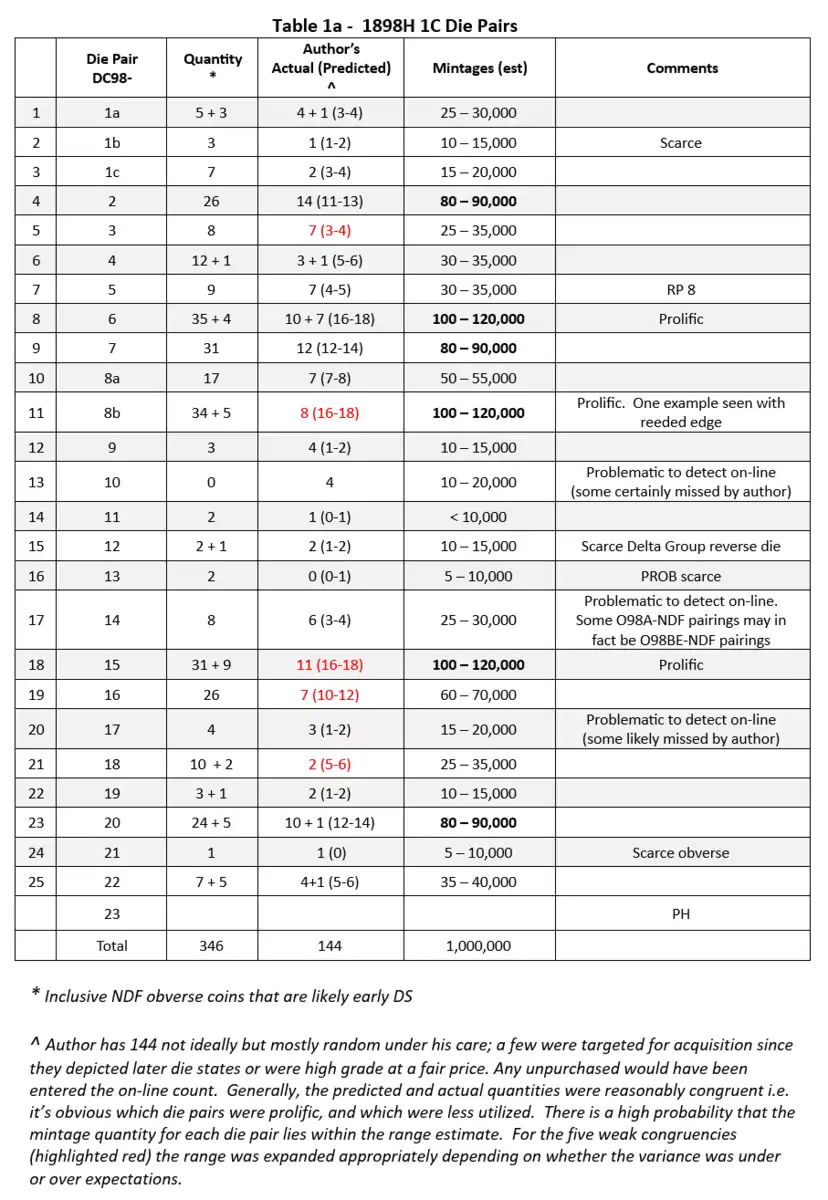
On this Table 1a, "Quantity" refers to the original study quantity of coins detected on-line and Author's Actual (Predicted) refers to how many coins of each die pair are under my care. What I statistically expected is in brackets based on the original on-line data obtained. For example, the on-line portion of the study sample had 31 x DC98-7 coins out of 346 total. Since I have 144 under my care I expected to have 31/346 x 144 = 12.9 (I chose a reasonable predicted range of 12-14). I ended up having 12, within the range.
The Die Pair Pair Matrix (Table 1) depicts the actual obverse/reverse die pairings. For Table 1a you may be wondering why some entries are "a+b". Well, in the case of DC98-6 where the entry is 35+4 , the 4 refers to die pairs where 4 of the coins have an obverse with no definable features (NDF). Based on the overall die pairs detected these were assessed as pre die fracture coins - many die pairs commenced striking not having fractured yet.
All reverses had unique features based on date attributes, stem 9 appearance and the position of the H mint mark. If the coin (either on-line image or in hand) was not overly corroded and in decent shape the reverse was 100% identifiable. Some, not all, obverses had unique die defining features that did not require a die break to identify.
As for "loaning", that was not required. Any collector that has several 1898H can access the obverse & reverse catalogues contained within the study and assess their coins. I am hoping this will occur. I have one well known collector who just subscribed today. Hopefully he will assess his collection and provide me feedback of his results. The beauty of SubStack is I can update the content in real time based on such feedback. If someone has discovered a new die pair it can easily be added to the study as long I obtain images of the coin.
Many of your "concerns" will be answered by accessing the full content. Table 1a above, although key, is insufficient to gauge the studies relevance. I'm not particularly impressed with the process SubStack puts people through but subscribing is free. You will not be inundated with emails either because I publish only 1 or 2 articles per month. I hope you reconsider your decision not to subscribe. I would very much appreciate how your collection of 1898s measures up against the study results. The more feedback I obtain the better the final product will be.
Thanks for your time, RD
On this Table 1a, "Quantity" refers to the original study quantity of coins detected on-line and Author's Actual (Predicted) refers to how many coins of each die pair are under my care. What I statistically expected is in brackets based on the original on-line data obtained. For example, the on-line portion of the study sample had 31 x DC98-7 coins out of 346 total. Since I have 144 under my care I expected to have 31/346 x 144 = 12.9 (I chose a reasonable predicted range of 12-14). I ended up having 12, within the range.
The Die Pair Pair Matrix (Table 1) depicts the actual obverse/reverse die pairings. For Table 1a you may be wondering why some entries are "a+b". Well, in the case of DC98-6 where the entry is 35+4 , the 4 refers to die pairs where 4 of the coins have an obverse with no definable features (NDF). Based on the overall die pairs detected these were assessed as pre die fracture coins - many die pairs commenced striking not having fractured yet.
All reverses had unique features based on date attributes, stem 9 appearance and the position of the H mint mark. If the coin (either on-line image or in hand) was not overly corroded and in decent shape the reverse was 100% identifiable. Some, not all, obverses had unique die defining features that did not require a die break to identify.
As for "loaning", that was not required. Any collector that has several 1898H can access the obverse & reverse catalogues contained within the study and assess their coins. I am hoping this will occur. I have one well known collector who just subscribed today. Hopefully he will assess his collection and provide me feedback of his results. The beauty of SubStack is I can update the content in real time based on such feedback. If someone has discovered a new die pair it can easily be added to the study as long I obtain images of the coin.
Many of your "concerns" will be answered by accessing the full content. Table 1a above, although key, is insufficient to gauge the studies relevance. I'm not particularly impressed with the process SubStack puts people through but subscribing is free. You will not be inundated with emails either because I publish only 1 or 2 articles per month. I hope you reconsider your decision not to subscribe. I would very much appreciate how your collection of 1898s measures up against the study results. The more feedback I obtain the better the final product will be.
Thanks for your time, RD


