| Author |
 Replies: 20 / Views: 7,556 Replies: 20 / Views: 7,556 |
|
|
|
Pillar of the Community
 United States
2605 Posts |
1996 two hundred escudos. 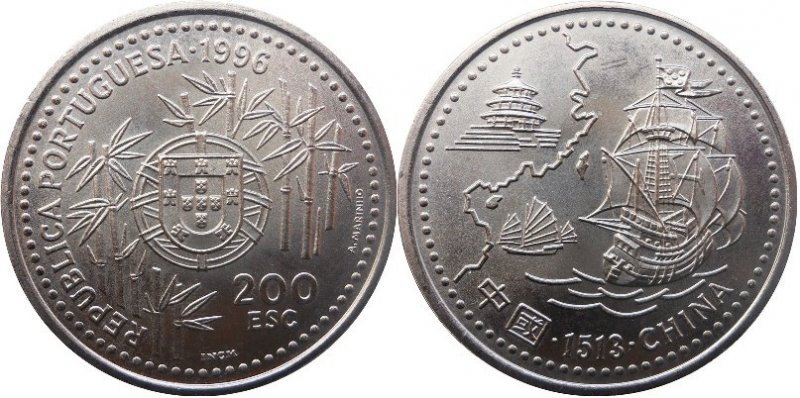 In May 1513 Jorge Álvares sailed under the Portuguese Malacca captain Rui de Brito Patalim in a fleet of junks from Pegu. Álvares made first contact on Asian soil in Guangdong, Southern China in May 1513. Upon landing, he raised a Padrão (a large stone cross inscribed with the coat of arms of Portugal that was placed as part of a land claim by numerous Portuguese explorers during the Portuguese Age of Discovery) from the king of Portugal, where they landed on Lintin Island in the Pearl River estuary. Based on information from their captain, they were to hope to find trade. Soon after this, Afonso de Albuquerque, the Viceroy of the Estado da India dispatched Rafael Perestrello, a cousin of Christopher Columbus, to seek trade relations with the Chinese. In a ship from Malacca, Rafael landed on the southern shores of Guangdong later that year in 1513, being the first to actually land on the coast of mainland China. Álvares later joined the venture of establishing the settlements in Tuen Mun, Hong Kong around 1513 to 1514. This visit was followed by the establishment of a number of Portuguese trading centres in the area, which were eventually consolidated in Macau. The first official visit of Fernão Pires de Andrade, a Portuguese merchant, pharmacist, and official diplomat, to Guangzhou (1517--1518) was fairly successful, and the local Chinese authorities allowed the embassy led by Tomé Pires, brought by de Andrade's flotilla, to proceed to Beijing. However, Fernão's brother Simão de Andrade, whose fleet came to Guangzhou in 1519, managed to quickly spoil the Sino-Portuguese relations, due to his disregard for the host country's laws and customs. Under the pretext of a threat from pirates, and without a permission from the local authorities, he built a fort in Tamão Island, behaving there as if it were Portuguese territory. (Particularly offensive to the Chinese sensibilities was his building a gallows there, and executing one of his own sailors there for some offense). He attacked a Chinese official who protested to the Portuguese captain's demands that his vessels should take precedence in trade with China before those from Asian countries. The worst, however, were his kidnappings of Chinese children and taking them abroad to be enslaved; (untrue) rumors spread that the disappearing children were cannibalized after being roasted by the Portuguese. ( from Wikipedia) Edited by svslav
06/19/2012 1:36 pm
|
|
Pillar of the Community
United States
2605 Posts |
1997 two hundred escudos. 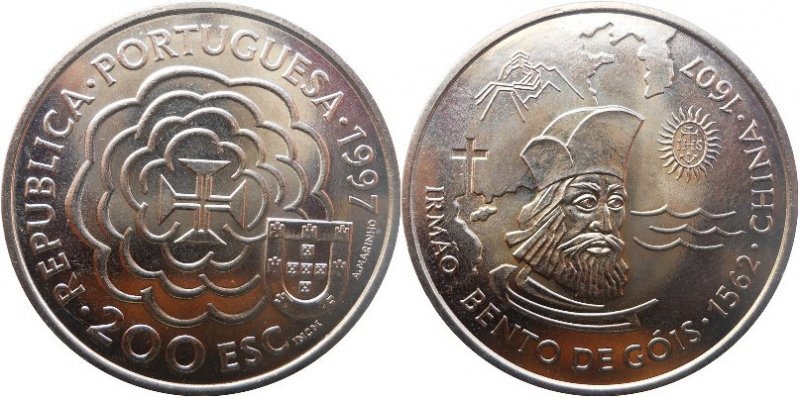 Bento de Góis, a Portuguese Jesuit Brother, Missionary and explorer. Born 1562, Azores, Portugal, died 1607, Suzhou, Gansu, China. Góis is best remembered for his long exploratory journey through Central Asia, under the garb of an Armenian merchant, in search of the Kingdom of Cathay. Generated by accounts made by Marco Polo, and later by the claims of Ruy Gonzales de Clavijo, reports had been circulating in Europe for over three centuries of the existence of a Christian kingdom in the midst of Muslim nations. After the Jesuit missionaries, led by Matteo Ricci, had spent over 15 years in south China and finally reached Beijing in 1598, they came to strongly suspect that China is Cathay; this belief was strengthened by the fact that all "Saracen" (i.e., Central Asian Muslim) travelers whom Ricci and his companions met in China told them that they are in Cathay. After some amount of communications between the Jesuit order's superiors in Goa and the authorities in Europe, it was decided to send an expedition overland from India to the Cathay about which visitors to the Mughals' Agra had told the Jesuits, to find out what that country really was. Góis was chosen as the most suitable person for this expedition, as a man of courage and good judgment, well familiar with the region's language and customs. When the caravan stayed in Cialis (located in modern Mongolia) for three months Bento met with another caravan, returning from Beijing to Kashgaria. As the luck would have it, during their stay in Beijing the Kashgarians had resided at the same facility for accommodating foreign visitors where Matteo Ricci, the first Jesuit to reach the Chinese capital, had been detained for a while. The returning Kashgarians told Bento Góis what they knew about this new, unusual species of visitors to China, and even showed him a piece of scrap paper with something written in Portuguese, apparently dropped by one of the Jesuits, which they had picked as a souvenir to show to their friends back home. Góis was overjoyed, now pretty sure that the China Jesuits had been right identifying Marco Polo's Cathay as China. ( from Wikipedia) Edited by svslav
06/22/2012 1:36 pm
|
|
Pillar of the Community
United States
2605 Posts |
1997 two hundred escudos. 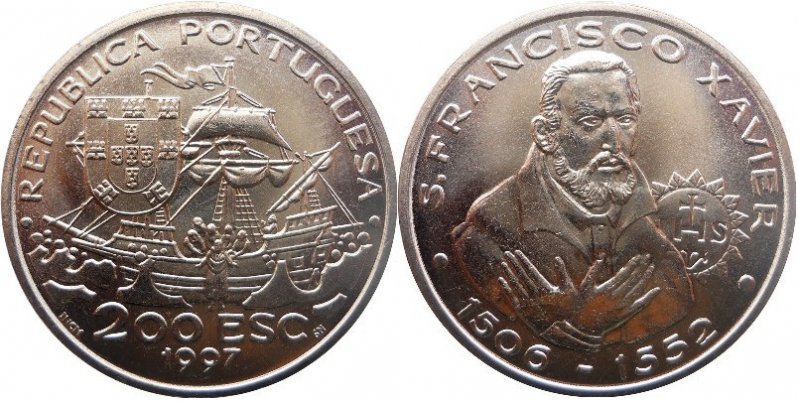 Francis Xavier, born Francisco de Jasso y Azpilicueta (1506 -- 1552) was a pioneering Roman Catholic missionary born in the Kingdom of Navarre (now part of Spain) and co-founder of the Society of Jesus. He was a student of Ignatius of Loyola and one of the first seven Jesuits, dedicated at Montmartre in 1534. Francis devoted much of his life to missions in Asia, after being appointed by King John III of Portugal to take charge as Apostolic Nuncio in Portuguese India, where the king believed that Christian values were eroding among the Portuguese. He was influential in the spreading and upkeep of Catholicism most notably in India, but also ventured into Japan, Borneo, the Moluccas, and other areas which had thus far not been visited by Christian missionaries. In these areas, being a pioneer and struggling to learn the local languages in the face of opposition, he had less success than he had enjoyed in India. It was a goal of Xavier to one day reach China. However, the government in China disliked most missionaries and many were killed. Francis Xavier is noteworthy for his missionary work, both as organizer and as pioneer. He is said to have converted more people than anyone else has done since Saint Paul. Francis Xavier is a Catholic saint. He was beatified by Paul V in 1619, and was canonized by Gregory XV in 1622. He is considered to be a patron saint of Roman Catholic missionaries in foreign lands. ( from Wikipedia) |
|
Pillar of the Community
United States
2605 Posts |
I feel that I'd like to add that while I'm enjoying these commemoratives I myself is not a big fan of Christian mission work, neither past nor present.
There's a very good novel, Things Fall Apart, by Nigerian author Chinua Achebe, an insider account of the Europeans changing the culture of a native universe. The title says it all.
|
|
Pillar of the Community
United States
2605 Posts |
1997 two hundred escudos. 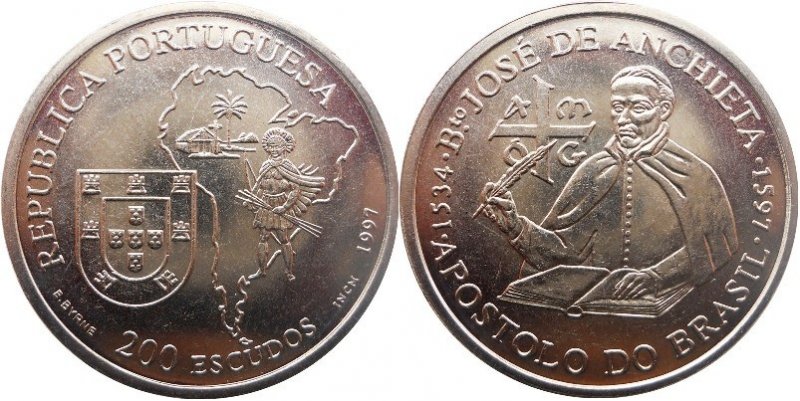 José de Anchieta (1534 -- 1597), a Spanish Jesuit missionary to Brazil. A highly influential figure in Brazil's history in the 1st century after its discovery on April 22, 1500 by a Portuguese fleet commanded by Pedro Álvares Cabral, Anchieta was one of the founders of São Paulo, in 1554, and Rio de Janeiro, in 1565. He was a writer and poet, and is considered the first Brazilian writer. Anchieta was also involved in the catechesis and conversion to the Catholic faith of the Indian population; his efforts at Indian pacification, together with another Jesuit missionary, Manuel da Nóbrega, were crucial to the establishment of stable colonial settlements in the country. |
| |
Replies: 20 / Views: 7,556 |
To participate in the forum you must log in or register.
 
- Definitive Test For Black Beauty Nickels
- My Last Purchase: A Bronze Greek Coin Representing The Poetess Sappho
- How Many Countries Do You Have Coins From?
- Post Your Coins With Coats Of Arms, Shields, Crests, Crowns, Etc.
- How Far Back Can We Go? Ninth Edition!
- 1966 Nickel Die Adjustment Strike?
- Post Your Stories & Pix Of Found Money
- 1885-Zs Mexico - 25 Centavos W/Arcing Die Crack, Tilted & Re-Punched Reverse Die
- 1934 Peace Dollar NGC MS-67+ At Auction
- Will Our Coins Ever Be Valuable?
- G L B 49's MS-70 Perfect Silver Coins
- ID Help - Roman Provincial Coin
- 1894 Fifty Cents - Grade This Coin. It May Or May Not Be TPG.
- 1847 Undecimo Edge Great Britain Gothic Crown, Gothic Type, NGC PF61
- Error Opinions, 1971-D DDO, 1955-D/S, 1996-P Quarter
- Post Your Coins Representing The Animal Kingdom.
- Post Your Bird Coins
- Post Your Coin Or Medal With Flora
- Continuing List To Show Everyones Latest Acquisitions
- Post Your Coins Of Steel (And Iron)!
Disclaimer: While a tremendous amount of effort goes into ensuring the accuracy of the information contained in this site, Coin Community assumes no liability for errors. Copyright 2005 - 2026 Coin Community Family- all rights reserved worldwide. Use of any images or content on this website without prior written permission of Coin Community or the original lender is strictly prohibited.
Contact Us | Advertise Here | Privacy Policy / Terms of Use
|
| Coin Community Forum |
© 2005 - 2026 Coin Community Forums |
| It took 0.33 seconds to rattle this change. |
 |
|






 First Page


 Posted 06/21/2012 2:10 pm


