The 1920 Maine Statehood Centennial half dollar features an adaptation of the Maine State Seal on its obverse. Within the Seal are two figures, a husbandman (at left) and a sailor, each of which is shown with a tool of his trade.
Note: Per Merriam-Webster, a husbandman is "one that plows and cultivates land : FARMER."
The farmer is shown with his left hand resting on a scythe, while his right hand rests on his hip. The sailor is depicted with his right hand on the center Shield and his left hand and arm resting on the stock of a ship's anchor.
Here is a larger image of the Maine Seal: The color image presents the hands of each figure more clearly.
The coin was modeled by Anthony de Francisci from design sketches by Maine artist Harry Cochrane.
The obverse of the 1925 Stone Mountain Monument Memorial commemorative half dollar presents an equestrian scene featuring the two most famous generals of the Confederate Army - Robert E. Lee and Thomas "Stonewall" Jackson.
General Lee is the forward of the two horseback figures and is using his hands to hold the reins of his mount; General Jackson is shown riding to Lee's right while facing him. In his right outstretched hand, the bareheaded Jackson holds his hat.
The coin was designed by Gutzon Borglum, the original architect for the Monument - he was later replaced by Augustus Lukeman after battling with the Stone Mountain Monumental Association, the sponsor of the mountain carving, on various operational and financial issues. Lukeman went on to change Borglum's design for the mountain-side memorial, but he had nothing to do with the designs used on the commemorative coin.
1925 Stone Mountain Memorial Half Dollar
I've made multiple posts about the Stone Mountain half dollar, you can check them out here: Read More:Commems Collection
The hands of the Greek goddess Nike, or Winged Victory, are on display on the reverse of the Texas Independence Centennial commemorative half dollars that were issued from 1934 through 1938.
On the coin's reverse, Winged Victory, with her wings fully spread and looking to her right (viewer's left), is shown kneeling and resting her left arm/hand on Texas' iconic Alamo, the site of an unsuccessful attempt at holding off Mexico's General Antonio Lopez de Santa Anna and his troops. The defeat at the Alamo became a symbol of Texas' resistance against Mexican authority along with its struggle for independence. It also gave rise to the now-famous rally cry of "Remember the Alamo!" which was shouted by Texans just over a month later as they attacked (and defeated) Santa Anna's troops at San Jacinto. In Winged Victory's right hand is seen an olive branch, symbolic of peace. Texas' victory over Mexico to gain its independence in 1836 is the inspiration behind the inclusion of Winged Victory in the design.
Pompeo Coppini was the designer/sculptor-modeler of the coin.
1934-38 Texas Independence Centennial Half Dollar
If you'd like to learn more about the Texas half dollar, check out:
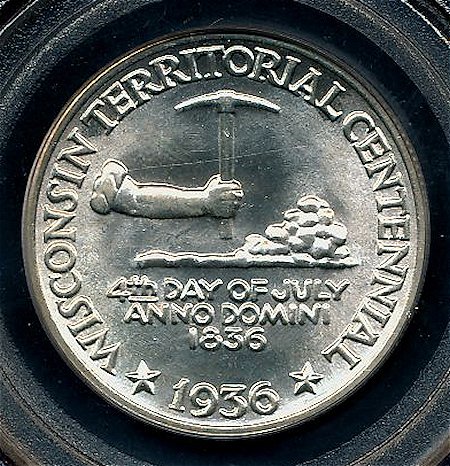
The 1936 Wisconsin Territorial Centennial half dollar holds a unique position within the classic US commemorative series - it is the only coin to include a disembodied arm and hand in its design!
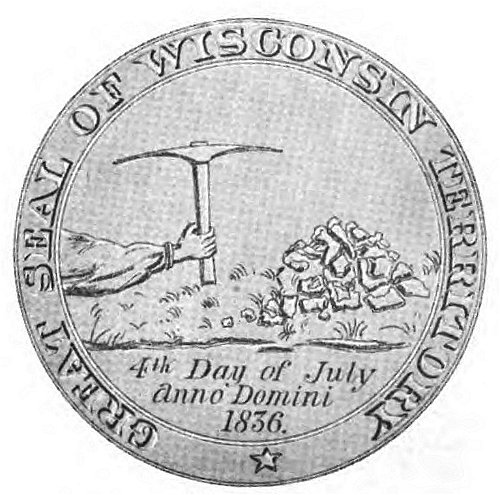
The arm/hand in question is found on the coin's obverse and is based on the miner's arm featured on the first Great Seal of the Wisconsin Territory; in its hand is seen a pickaxe. On the coin, a muscular arm is depicted with its shirt sleeve rolled up past the elbow, whereas on the original Seal, the arm is covered by a shirt sleeve to the wrist. For artistic balance, the coin places the arm more centrally within the design (vs. the Seal) such that it is essentially a "clock hand" in the 12 o'clock position with the pickaxe at the top; I think it works well on the coin vs. a straight duplication of the Seal.
The basic design for the coin and use of the Seal was suggested by the Wisconsin Centennial Commission. Benjamin Hawkins created the final models for the coin based on an initial interpretation of the Commission's design concepts by David Parsons.
Great Seal of Wisconsin Territory Image Credit: Wisconsin's emblems and sobriquet. Madison, WI: Wisconsin Historical Society. 1908. Public Domain.
1936 Wisconsin Territorial Centennial Half Dollar
You can read more about the Wisconsin Territory Centennial half dollar here:
The 1893 Isabella Quarter was issued to help provide financial support to the Board of Lady Managers of the World's Columbian Exposition held in Chicago in 1893. The piece is a member of the "Hands on Coins" club thanks to the symbolic female figure presented on its reverse.
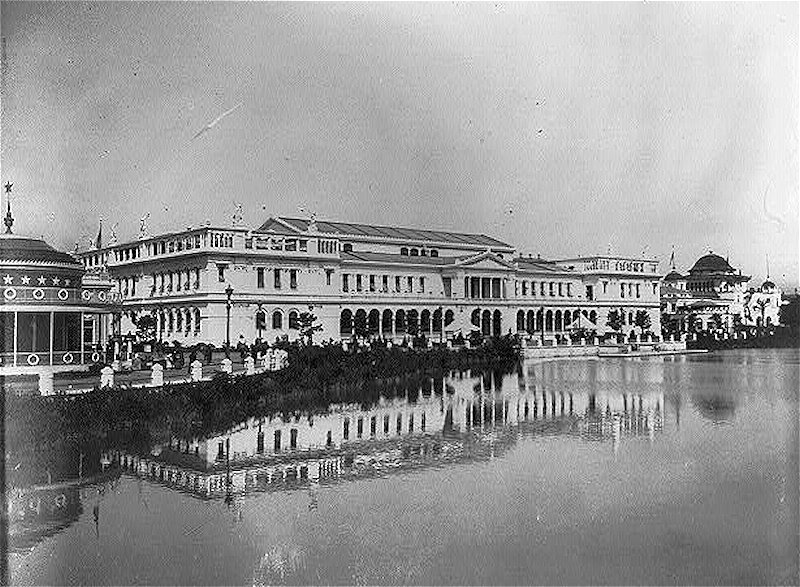
Women's Building at 1893 World's Columbian Exposition
The figure was not the original choice for the coin's reverse design - a depiction of the Exposition's Women's Building (above) had been previously suggested. The building design was rejected, however, due (among other issues) to the coin's small size and the difficulty of presenting such an expansive design element in such a small area. Instead, Charles Barber, sixth Chief Engraver of the US Mint and designer/modeler of the coin, created a symbolic female figure, kneeling, facing left and holding a distaff in her left hand linked to a spindle held in her right.
A distaff is (typically) a short staff that holds the unprocessed fibers of wool or flax that are to be spun into yarn or thread via use of a spun spindle (short rod). As women were significant producers of yarn and thread via this method in the past, the distaff became a symbol representing female industry. It should be noted, however, by the time of the Columbian Exposition in 1893, the manual spinning of single threads with a distaff and spindle had largely been replaced by machines that could spin dozens if not hundreds of threads simultaneously. Thus, though based in accurate historical events, it can be argued that Barber selected a symbol that was 100 years out of date!
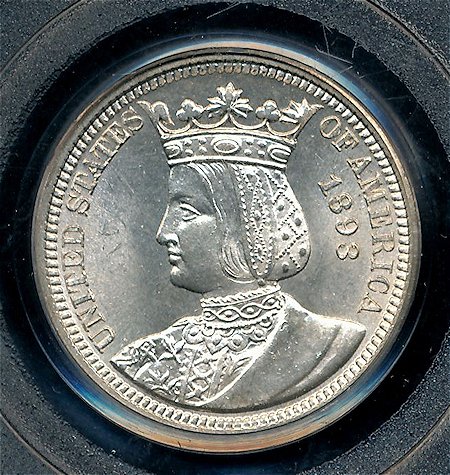
The obverse of the 1893 Isabella souvenir quarter features a portrait of the Spanish Queen, Isabella I of Castile; Isabella and her husband, King Ferdinand V, sponsored Christopher Columbus' 1492 voyage to the New World. She is depicted facing left and wearing a jeweled crown.
Minerva, the Roman goddess of wisdom and knowledge, is depicted on the 1935-36 California-Pacific International Exposition half dollar (aka, the "San Diego"); the design is based on the Great Seal of California and includes many of the same design elements. (Check out the link below for a discussion of the California Seal and its use on the Cal-Pac half dollar.)
On the coin, Minerva is shown supporting a shield with her left hand while holding a spear with her right; upon the shield is seen the face of Medusa and the word "EUREKA" (meaning "I Have Found It! - EUREKA being a nod to California's gold history).
It is interesting to note that the Seal and the half dollar portray Minerva in a somewhat militaristic pose with her wearing a soldier's helmet and body armor, plus using each of her hands to hold/support an instrument used in battle. Of course, in addition to being the goddess of "wisdom and statecraft" (1), Minerva had other "responsibilities" assigned to her within Roman mythology. She was also the goddess of the Liberal Arts, Polity (i.e., Civil Government), Trade and War (among other things). In this context, the helmet, armor, spear and shield all make more sense. I believe another contributing factor to Minerva's depiction is the fact that the Seal's original design was created in 1849 by Major Robert Selden Garnett of the US Army - it's not hard to imagine a US Army Major having a bias toward things having a military flavor in their appearance.
1935-S California-Pacific International Exposition Half Dollar
Disclaimer: While a tremendous amount of effort goes into ensuring the accuracy of the information contained in this site, Coin Community assumes no liability for errors. Copyright 2005 - 2026 Coin Community Family- all rights reserved worldwide. Use of any images or content on this website without prior written permission of Coin Community or the original lender is strictly prohibited. Contact Us | Advertise Here | Privacy Policy / Terms of Use






 First Page
 Previous Page


 Posted 04/11/2021 5:24 pm