| Author |
 Replies: 73 / Views: 12,098 Replies: 73 / Views: 12,098 |
|
|
|
Bedrock of the Community
United States
20753 Posts |
Quote:
You are yanking my chain, right? I thought hydrogenium was the metallic form of hydrogen, found (theoretically) in the cores of gas giant planets like Jupiter. It would take over a million atmospheres of pressure to create a hydrogenium coin, and it would last about a microsecond before vaporizing.
So what is your point. The way I look at it that is about how long my money lasts after taxes anyway. Now something like Hydrogenium would be a fantastic material to pay your taxes with. I always wondered why Latinum in not on that table. The Foringies use it all the time for money. Not sure if Foringies is spelt right either.  As we move to traveling into space most gasses could be used for money. Imagine a $100 bill made of Oxygen. |
|
Pillar of the Community
 United States
1910 Posts |
Add me to the list of those who have been fascinated by this topic and its side links. My dad collected elements. Not in a serious manner like a rare coin collector, but because he was a scientist, and had atypical access to odd substances. He was a PhD chemist during the days of the Manhattan Project. There was this curious basement *mad-scientist* laboratory at the you of IL.. and later, one in Oak Ridge.. I know very little about what went on in those places, although I have a vivid young-childhood memory of being passed through a basement window on a cold Chicago night in a snowstorm for some secret visit. And I also have these little cubes of machined U238, oddly emblematic of his passing via bodily decay. They have sat in an aluminum film canister for many years. I kind of remember their being eight of these, originally. They used to get passed around at family cocktail parties. Right now, only these two are locatable amid the clutter. Also missing is a little box of laboratory screw-top vials containing a number of rare elements and metals, small samples gleaned opportunistically during a lifetime laboratory career. Having read and thoroughly enjoyed this topic, I now conclude that the sentimental/symbolic value of these weighty samples is less than their potential trade value. In thalers, perhaps.. or something in coin form of equal character and difficulty in obtaining, perhaps a little oxidized.. or perhaps I should investigate having these cubes turned into flans in one of those arc ovens.. 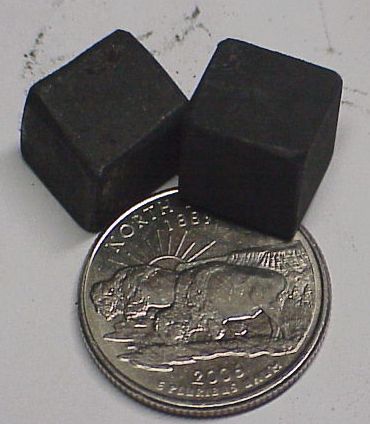 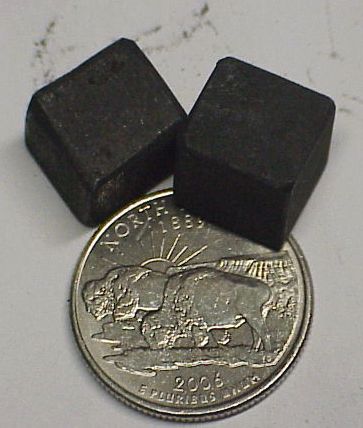 |
|
New Member
 United States
35 Posts |
Awesome photo! Those little cubes are definitely worth keeping for their sentimental and historical value, if there's even a chance they came from Oak Ridge or the Manhattan Project itself! However, yow! Handling them is probably not the safest thing. That black oxide rubs off easily - in fact, it looks like some of it has already rubbed off onto the paper it's sitting on. If you get any of that stuff inside your lungs it is very bad news, because each tiny little particle will sit there forever, quietly irradiating your delicate lung tissue with alphas until one day you end up with lung cancer. Please, please wash your hands thorougly after handling those! In fact, if they were mine, I'd consider cleaning them off once with an acid bath, taking the cleaning materials to a hospital or university radiation safety officer for proper disposal, then giving the cubes several thick coats of polyurethane lacquer. I don't know if that would lessen their historical value but they'd be a lot safer to handle. As for their monetary value as lumps of uranium, it looks like each cube is about 1 cubic centimeter, or 19 grams. On the rare occasions that United Nuclear has chunks for sale, they have lately been selling for $9/gram, so each cube is worth at least $171, probably more. I've seen tiny pieces sell on ebay for ten times that per gram... especially if you can find out more about their history and come up with a good backstory. Maybe they were used in Chicago Pile 1 (CP-1) the world's first artificial nuclear reactor! |
|
Pillar of the Community
United States
1910 Posts |
Unfortunately it's too late for asking questions pertaining to backstory. Dad passed away 5+ years ago, and his highly intelligent spouse, age 92, now has trouble remembering the names of close family members. Ask for birthdates and she is invariably months off. Also, I did avoid touching the cubes and their residue. They have gained some oxidation since that canister was last opened who knows how many years ago. I appreciate the information as to potential ebay value. However, I am hesitant to offer these via that route. I am an active seller of 'metals' on that site, but of a rather different sort- ! (user i.d. 'tagbarn' for the curious.) Listing these could induce any number of potential problems. Like, how do I convince bidders they are authentic, that my story is true? And there is always the possibility of unwanted official attention and uncomfortable questions. Ownership may be legal, but original source being questionable, paranoia is my natural reaction given the current state of national and world affairs. Historical value requires accurate provenance which I do not have, just vague family history. As for sentimental value, at this point, zilch; nada; nicht; there are plenty of family artifacts more meaningful than these dangerous chunks. I collect world silver coins 30mm+. Offers welcome. And thanks for the helpful reply. I will post pics of the other samples when I find them. |
|
Pillar of the Community
United Kingdom
2490 Posts |
This is without doubt, the most fascinating thread I've ever seen on CCF.
|
|
Valued Member
United States
183 Posts |
Wow. I just read all 4 pages in 1 go...very neat idea on collecting elements coins. Radioactive stuff would probably concern me for my safety more than the value to collect it though.
|
|
Valued Member
United States
335 Posts |
I know this pales to previous posts on the subject, but these are fairly neat. Not sure, but have any coins ever been made of magnets? That'd be something - http://www.earthmagnetjewelry.com/To the fellow poster up above w/the small Ur cubes, I certainly hope you store those in a lead container & use nitrile gloves to handle them with, not your bare hands. Edited by zookr
01/30/2011 12:36 pm
|
|
Bedrock of the Community
Australia
21792 Posts |
Plutonium is also very poisonous, as well as highly radioactive.
I have a book:
'Operation Morning Light' which documents the accidental de orbiting of a Soviet plutonium powered nuclear satellite that came down in the Canadian tundra. That caused quite some political stink!
You may wish to do a Google search for more info.
|
|
New Member
United States
35 Posts |
Plutonium's famed ultra-toxicity turns out to be an urban legend. Like most people I had always assumed that plutonium is incredibly poisonous in even the smallest quantities. However, after doing some googling and wiki'ing, I now see that the danger is way overblown and sensationalized by the media. I should have known. The wiki article on plutonium has mangled source reference numbers, but I was able to track down the following: From http://www.world-nuclear.org/info/inf15.htmlQuote:
Despite being toxic both chemically and because of its ionising radiation, plutonium is far from being "the most toxic substance on Earth" or so hazardous that "a speck can kill". On both counts there are substances in daily use that, per unit of mass, have equal or greater chemical toxicity (arsenic, cyanide, caffeine) and radiotoxicity (smoke detectors).
...
In the 1940s some 26 workers at US nuclear weapons facilities became contaminated with plutonium. Intensive health checks of these people have revealed no serious consequence and no fatalities that could be attributed to the exposure. In the 1990s plutonium was injected into and inhaled by some volunteers, without adverse effects. In the 1950s Queen Elizabeth II was visiting Harwell and was handed a lump of plutonium (presumably Pu-239) in a plastic bag and invited to feel how warm it was.
As with uranium and some other alpha-emitting radionuclides, the main health threat of Pu is inhalation, and the most likely form to be encountered in this way is the oxide, rather than the metal itself. There's this also: The Myth of Plutonium Toxicity http://russp.org/BLC-3.htmlI learn something new every day. :) |
|
Bedrock of the Community
United States
20753 Posts |
It's not that Plutonium is toxic so can not or should not be used for coinage, but just think of how easy it would be to track someone carrying a pocket full of those coins.  Then too there is always something good about everything. You loose some change in a dark place but it is made of Plutonium. Or Radium or any radioactive substance. You just look down and there it is glowing away so easy to fine. Ever wonder why so many elements end in IUM? |
|
Bedrock of the Community
United States
17884 Posts |
I'm kind of surprised Uranium trades for so much on ebay ($9 a gram or $4077 a pound) considering it trades as a commodity for around $70 a pound (kitco price quote) |
|
Bedrock of the Community
United States
20753 Posts |
Quote:I'm kind of surprised Uranium trades for so much on ebay ($9 a gram or $4077 a pound) considering it trades as a commodity for around $70 a pound (kitco price quote) Possibly due to where is produced. If it is stamped made in China, of course it is cheap. Might just be Lead. |
|
Pillar of the Community
United States
1374 Posts |
Fantastic thread. I never knew such a collection existed and I'm impressed. Thumbs up!
|
|
New Member
United States
35 Posts |
Quote:I'm kind of surprised Uranium trades for so much on ebay ($9 a gram or $4077 a pound) considering it trades as a commodity for around $70 a pound (kitco price quote) Well, uranium is one of the most common elements. The problem is finding someone who will sell to you. I approached several companies that fabricate DU items in the hope of scoring some DU sheets thin enough to make planchets from. They all laughed at me. None of them would even consider selling me any uranium unless I could prove that I was trained and licensed in the safe handling of nuclear materials. I finally found United Nuclear, but their stock is very sporadic, and sells like hotcakes whenever it's available. Supply and demand... |
|
Valued Member
United States
335 Posts |
I'd have my doubts about the so-called "safe handling" of radioactive materials (of any sort).
>>>>>>>>>>>>>>>>>>>>>>>>>>>>>>>>>>>>>>>>>>>>>>>>>>>
What was the cause of Marie Curie's death?
------------------------------------------
History of Science, Marie Curie -
She died from Aplastic Anemia I am quite sure you can guess that is was almost certainly from handing radioactive materials unsafely. Which they didn't really know the dangers about yet. There is also a story about radioactive materials in test tubes that she had in her desk because she like the nice glow they gave off.
Aplastic anemia is a condition where bone marrow does not produce sufficient new red blood cells to replenish the blood.
Marie Curie died in 1934, of what was described as an aplastic pernicious anaemia of rapid, feverish development. This was nearly identical a diagnosis given for the first reported radiation-related death of a radium dial painter. "Rapidly progressing anaemia of the pernicious type" (Martland 1925). It is argued that her death was not a result of Radium exposure because pernicious anaemia believed to be caused by radiation exposures. it is quite likely that her doctor had misdiagnosed her illness, Indeed, her daughter, Eve Curie, wrote (1937): "the abnormal symptoms, the blood tests, differing from those in any known case of pernicious anaemia, accused the true criminal: radium." Marie's eldest daughter and collaborator, Irene Curie, died in her mid-50s of leukaemia. Reference: Curie, E. Madame Curie. Doubleday; Garden City, NY; 1937. Paul Frame, CHP, Ph.D.
Edited by zookr
02/02/2011 11:05 am
|
| |
Replies: 73 / Views: 12,098 |








 First Page
 Previous Page


 Posted 01/29/2011 8:12 pm


