| Author |
 Replies: 92 / Views: 16,685 Replies: 92 / Views: 16,685 |
|
|
|
Pillar of the Community
 United States
3499 Posts |
bobbyhelmet- Awesome! I look forward to seeing how these turn out. I have a feeling that with a bit of soaking and scrubbing (I use a few Q-tips for this task) they should turn out nicely. Although I am not quite sure what affect the wax will have on the first coin's chances of recovery.
|
|
Pillar of the Community
United States
3499 Posts |
Well my small lot of uncleaned ancients arrived today. And I am sorry to say that I forgot to do some before scans of 3 of the 4. Two are larger, earlier coppers from ca. 50-200CE, and the two others are from the 3rd-4th centuries CE. Three of the four have already received a good scrubbing and soaking in water and a bit of peroxide. I wish that I had remembered the before pics since they already look MUCH better and I will be very curious to see what they turn out to be. But here is one of the larger, earlier coins. It certainly is uncleaned, and I fear that it may be lower grade. I can make out the silhouette of the bust on the obverse, but it appears that much of the brown areas are exposed copper. So I fear that it may already be very worn. I really hope that this one is not a lost cause. 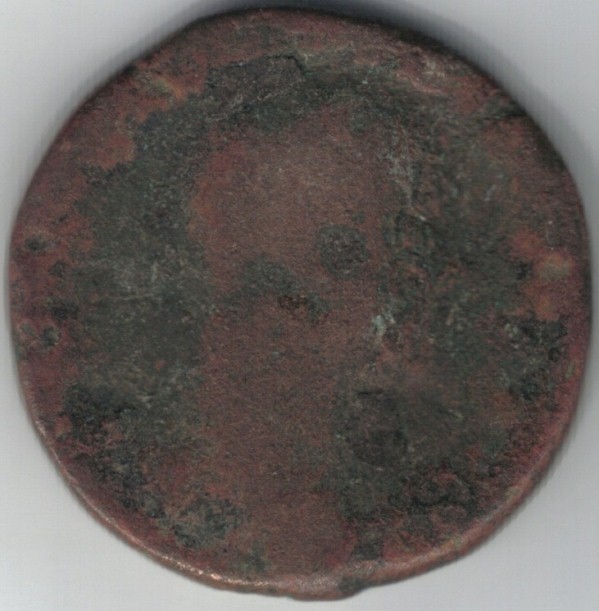 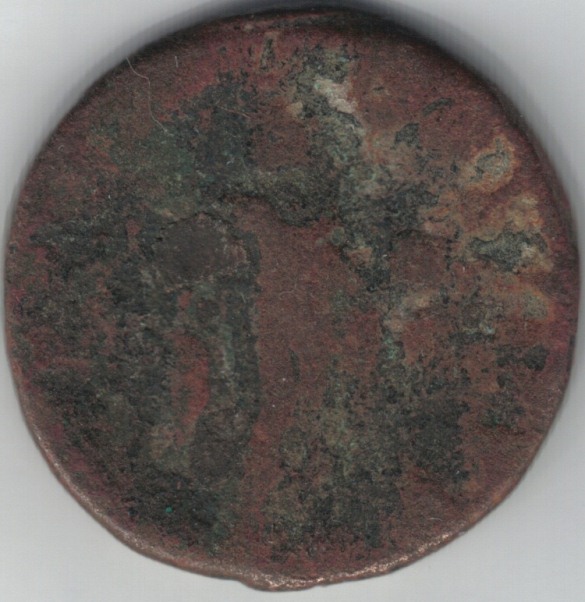 |
|
Pillar of the Community
United States
513 Posts |
Hi guys and gals, Your discussion encouraged me to try some h202 on my own coins. I previously posted that I have a lot of uncleaned ancients to work with. I made four lots of three coins each. Each lot has one crusty coin, one kinda-crusty coin, and one kinda-normal coin. One of these lots will receive h2o2 while one will receive the 'standard' treatment of distilled h2o and a toothbrush. The others will be a surprise. All lots will be treated the same. The toothbrushings and solution changings will be identical. I am posting this to keep myself honest! I've done all sorts of experiments that I didn't keep track of. This experiment should last a minimum of 3-4 days and a maximum of 7. I'm sure y'all will remind me! These are the before pix. I have higher resolution pix of both sides if that becomes necessary. -wheatiefan  |
|
Pillar of the Community
United Kingdom
2838 Posts |
Excellent wheatiefan - look forward to seeing the results and finding out what the surprise cleaning involves.
I'm hoping to start today too.
|
|
Pillar of the Community
United Kingdom
2838 Posts |
Well - no 'after' pictures yet but on first impressions it works. Coin 1 - the waxed one reacted as we expected, it did very little, to be honest this was more an experiment that anything else - I wanted to know if H2O2 would react with the wax, it didn't. I have some coins that could do with harsh treatment on one side but no treatment on the other, I now know how this can be easily achieved! I removed most of the wax by heating the coin for 10 mins in just boiled water and most of the wax came off when I gave it a scrub. I suggest using the reaiming boiled kettle to have a nice cup of tea and a piece of cake  The reaction when it went back into the H2O2 was visible but not rampant, its been sitting there now for about 24hrs and is cleaning but slowly. Coin 2 and 3 have just been put in and the crusty coin is bubbling away nicely and I can actually see the calcified deposits being striped away. I'll check them regularly and post the final results soon. I have also found heat is an excellent catalyst - not much heat either, dont bother with the microwave (possibly dangerous) or the light bulb as a sunny windowsill (for the lucky ones in nice climates) or even a radiator work fine. Anyone else got any mid-term thoughts? Edited by bobbyhelmet
10/14/2011 1:37 pm
|
|
Pillar of the Community
United States
842 Posts |
Still happily bubbling away.... |
|
Pillar of the Community
United States
3499 Posts |
bobbyhelmet- Really heating helps to speed the process? So is holding a desk lamp over a cup of peroxide enough to get the chemical really reactive?
|
|
Pillar of the Community
United Kingdom
2838 Posts |
Quote:
So is holding a desk lamp over a cup of peroxide enough to get the chemical really reactive? I guess this would be enough heat - I currently have mine sitting in a glass jar on my laptop transformer (which gets hot) are they are bubbling away much more than at room temperature. Just a little heat really seems to speed the process up. |
|
Valued Member
United States
132 Posts |
I formulated a solution earlier this year for cleaning ancients, and have had terrific results. I can't specifically mention it or suggest it here, but I would be more than happy to send anyone a free bottle to try out. In May I decided to offer it for sale, and I am amazed at how well it has done so far. The feedback from everyone has been positive, with the exception of a few who decided to try it out on their wheat pennies  I would really like to get some good, constructive feedback on the product at this stage from people who have experience collecting and restoring ancient coins. FYI, I am not trying to solicit anything at all, and try to skate around the forum rules. I truly want some detailed analysis of my product from people who's opinion I value greatly. If you're interested, just send me a message and I'll get the shipping details arranged. Thanks! |
|
Pillar of the Community
United States
513 Posts |
Mine are still plugging along. I'll give 'em a couple more days and try to fix some before and after pix. They are definitely bubbling a lot but I don't know yet if it's that much better than H20.
-wheatiefan
|
|
Rest in Peace
United States
1729 Posts |
I decided to experiment on some modern coins that I actually dug up from my yard - two dimes (Roosevelt), a Buffalo nickel (1914-S, no less), a Jeff nickel, a 1919 Wheat cent, and a rather eaten-up LMC. I dropped them into a 3% solution of hydrogen peroxide, refreshed the solution after a day, and then promptly forgot about the experiment so that the coins remained submerged in hydrogen peroxide for about 10 days while I was out of town. Today I discovered them (oops). All remained dark, but the organics (dirt) were easily-loosened, with most bubbling away. What was left I could easily scrape off with my thumbnail and then rub off with a soft cotton cloth. The LMC probably looked worse, as the hydrogen peroxide reacted with the zinc (no surprise) and left behind a white crust in the areas where the copper was originally eaten away. I can't tell that any so-called patina was disturbed; as I stated, all remained very dark after a number of years underground. I could even see some original lustre on the Wheat cent, although worn areas (like Lincoln's cheek) remained dark. Only the LMC appeared to be damaged, but no surprise and no loss on that one. Would I use hydrogen peroxide on ancients? Definitely, on brass, bronze, or silver coins. Other metals - probably not, and on zinc, definitely not. |
|
Pillar of the Community
United States
3499 Posts |
wheatiefan & pls- Great! I can't believe that I may have found something to replace good ol' olive oil. I hope that this method does prove to be great for ancients.
|
|
Pillar of the Community
United States
513 Posts |
OK all, Here are some composite images with before on the left and after on the right. There were four lots of coins. One each of: distilled water, h2o2 at room temperature, heated h2o2, and a control group of absolutely nothing. Each batch except the control had the solution changed every 1-2 days and at that time was brushed with a toothbrush for 20-30 seconds. The hot h2o2 was placed in the microwave for ~30s before placing the coins in, then cooled down naturally-no ongoing heat source like a lamp or radiator. I'm purposefully not telling you which batch was which, just to see if there is any noticeable difference between the methods. My thought is if there's a clear difference, then h2o2 may be the way to go. I invite comments and will wait a day or two and give you my own thoughts. -wheatiefan     |
|
Pillar of the Community
United States
3499 Posts |
wheatiefan- To be totally honest, for some odd reason I am not seeing much change. I wonder if this has something to do with the particular form of encrustation of your coins.
|
|
Pillar of the Community
United Kingdom
2838 Posts |
The only improvements I can see are on the 1st and 3rd batch and even then its not all three of the coins that have improved. I see little or no improvement to batches 2 and 4. I'll post pictures of one of mine shortly that has also been treated for about a week.
|
| |
Replies: 92 / Views: 16,685 |








 First Page
 Previous Page


 Posted 10/12/2011 12:01 am


