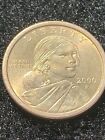
2000 P Goodacre Presentation Eagle Reverse Sacagawea - Native American Dollar

Welcome Guest! Registering and/or logging in will remove the anchor (bottom) ads. It's Free!
This page may contain links that result in small commissions to keep this free site up and running.
This page is dedicated exclusively to the 2000 P Goodacre Presentation Eagle Reverse Sacagawea - Native American Dollar. You will find a lot of information below such as mintages, specifications, and images. Be sure to visit our Sacagawea - Native American Dollar Forum if you need help. Also please visit our Sacagawea - Native American Dollar Grading Forum to help you establish a grade for your Sacagawea - Native American Dollar. All forums are completely free to register and participate.
2000 P Goodacre Presentation Eagle Reverse Sacagawea - Native American Dollar Specifications | |
Circulation Strikes:5,000Content:Cladding: 77% copper, 12% zinc, 7% manganese, 4% nickel Core: 100% copperWeight:8.1 gramsDiameter:26.5 millimeters |
Edge:PlainMint:Philadelphia, PAObverse Designer:Glenna GoodacreReverse Designer:Thomas D. Rogers Sr. |

 2000 P Goodacre Presentation Eagle Reverse Sacagawea - Native American Dollar
Free Sacagawea / Native American Dollar Help
Sacagawea / Native American Dollar ForumSacagawea / Native American Dollar Variety and Error Forum
Sacagawea / Native American Dollar Grading Forum
Additional Sacagawea / Native American Dollar Resources
Sacagawea / Native American Dollar FactsSacagawea / Native American Dollars for Sale
Cheap Sacagawea / Native American DollarsHot Sacagawea / Native American Dollars
Popular Sacagawea / Native American Dollars
Sacagawea / Native American Dollars on eBay
Sacagawea / Native American Dollar Books
2020 Red Book - Guide Book of United States CoinsCherrypickers Guide to Rare Die Varieties
ICG Press Release (December, 2000)
ICG is announcing that the US Mint has released two types of Goodacre Sacagawea Dollars. In addition to the commonly known burnished Specimens, ICG has found a little over 2% of the Goodacre Sacagaweas to be "unburnished." These coins did not receive the burnishing treatment given to all other Goodacre Dollars. These unburnished coins reveal special striking characteristics not found on regular Mint State Sacagawea Dollars. ICG is now referring to the unburnished and more rare Sacagawea Dollars as the Type One Goodacre Sacagaweas. The burnished Specimens are being referred to as the Type Two Goodacre Sacagaweas. At this time, ICG has only released the Type Two Sacagaweas and has used the Type One coins to better research the production process of all of these coins.
Notice the unburnished coins are referred to as Type One because all the coins were first created as Type One coins. The Type Two Sacagaweas came into existence at a later point in time when approximately 98% of the Goodacre Sacagaweas were burnished before being presented to Glenna Goodacre.
We are writing this article to inform readers of the ICG surface studies of these two types of Goodacre Specimens, and the conclusion that can be drawn regarding die and planchet preparation, striking pressure, and post-strike US Mint burnishing.
ICG became involved with the Goodacre coins in August of 2000. ICG was contracted by Sacagawea obverse designer Glenna Goodacre to certify 5,000 Sacagawea Dollars that were presented to her by the US Mint for payment of her design. This special situation called for ICG to certify that these were in fact the Sacagaweas that were presented to Goodacre and for ICG to number the holders between 1 and 5,000. Before receiving the special Sacagaweas, ICG had noted in earlier Coin World reports the US Mint had proudly declared the coins had been "burnished and rinsed in an antioxidant solution" before being presented to Goodacre. The prospect that these coins were in fact burnished meant that most likely ICG would be unable to grade the Goodacre Specimens. ICG was left with two tasks. One was to certify that these coins were the specific coins presented to Goodacre. The second was to determine what the US Mint had done to these coins. The language of the US Mint indicated the US Mint had created a whole new collectible Sacagawea.
ICG received the coins from Goodacre in the original mint packaging. Two things became immediately obvious. The first was the coins were indeed very "shiny" and had the characteristics of burnishing. Secondly the coins seemed incredibly well struck compared to the regular mint state Sacagawea' s the ICG graders had previously seen.
ICG considers it important to address and offer evidence regarding the following points:
1. The Goodacre coins were struck on specially prepared burnished planchets similar to those used on Proof coins.
2. The Goodacre coins were struck with higher than normal die pressure.
3. The Goodacre coins were struck from dies that were finely polished previous to striking.
4. The Type 2 Goodacre coins received post-strike burnishing at the US Mint.
5. The Goodacre coins received special post-strike handling that resulted in very few contact marks.
The Goodacre coins were struck on specially prepared burnished planchets similar to those used on Proof coins.
In the striking of most coins, there is an area that does not completely strike up. In this area of unstruck planchet one can find original planchet texture and/or color. On the Sacagawea Dollar this area is found on the blanket between the babies head and the designer initials. The best way to ascertain if the planchets were burnished is to find this area on the Goodacre coins and look for original planchet color and texture. The problem with the Type 2 (burnished) coins was even if there was an unstruck area of planchet on the coins, this area would most likely have been burnished during the post-strike burnishing (although areas of light pitting on the original planchet could escape post-strike burnishing). The Type 1 (unburnished) coins gives us an insight. The unstruck planchet on business strikes normally displays very small light colored pitting and is best seen with magnification. The area of unstruck planchet on the Type 1 coins appears to be shiny and polished in contrast to the satiny surfaces found on the rest of the coin. This is a clear indication that the Goodacre Sacagaweas were struck from specially prepared burnished planchets.
The Goodacre coins were struck with higher than normal die pressure.
Comparison of the regular business strikes and a Goodacre specimen's edges show differences in striking pressure. The edge beveling is a good indication of this striking pressure. It is the area near the juncture of the collar and dies during striking. On proofs this area is squared and sharp, on business strikes it is more rounded and beveled. The Goodacre specimen's edges are much sharper than you would see on regular circulation strike mint state specimens. These sharp edges can only be associated with high die pressure that indicates a special striking situation. Additionally, the dies could not have been in service very long due to the lack of die erosion.
The Goodacre coins were struck from special dies.
The Type 1 Goodacres reveal what could conservatively be called special surfaces. First of all there is crisp and distinct die-polish exhibited on each Type 1 coin. This die-polish is so obvious that it can be seen on some of the Type 2 coins despite the post strike burnishing these coins have received. ICG has charted die characteristics and can conclude only one set of dies was used. The lack of die erosion even on a run of coins as limited as these 5,000 is not unusual as some finely polished mirrored proof dies can strike up to 1,000 coins without traces of die erosion.
The Type 2 Goodacre coins received post-strike burnishing before being released.
Burnishing can be determined in a number of ways. The best is to find areas of the coin that would normally have a different texture than the fields or devices a coin. Two of these types of areas are bagmarks or areas of unstruck planchet on a coin. The Type 2 Goodacre Sacagawea Dollars display characteristics that are only consistent with post-strike burnishing. The salient issue is the lack of contrast and texture between the fields and the bagmarks. Light will reflect differently from the bagmarks and the fields of a non-burnished coin. Only post-strike burnishing can cause these bagmarks and the field to have similar textures and therefore reflect light in a similar manner. In the case of the Type 2 Sacagawea Dollars, it is obvious that there are bagmarks that reflect light in a similar manner as the fields.
The Goodacre coins received special post-strike handling that resulted in very few contact marks.
Consistent evidence of minimal contact marks is evidence of special handling. All of the Goodacre coins are minimally marked, and based on marks alone, most range from 66 to 69 on the 70-point scale. Most business strikes average 3 to 5 points lower. The mint had to have treated the Goodacre Dollars with extreme care to achieve such results.
ICG was fortunate to be able to compare the Type 1 (unburnished) and Type 2 coins. Other than the US Mint employees that made the Goodacre Sacagaweas, ICG is the only other observer of these groups out of ICG holders. This helped ICG to address the aforementioned issues and derive what we believe to be accurate conclusions. In summary, the Goodacre coins involved:
1. Specially prepared and polished planchets
2. Specially prepared new die pair
3. High striking pressure
4. Special handling of struck coins resulting in very few contact marks
5. Type 2 coins were burnished before being released to Glenna Goodacre
Additionally ICG wanted to address why ICG did not discover the Type 1 Goodacre Sacagaweas for over three months. ICG received the Goodacre Sacagaweas in the original mint packaging that consisted of five separate groups of 1,000 coins each. ICG did not immediately holder all the Goodacre coins as Glenna Goodacre wanted to wait and use the new Lucent Intercept Shield Gasket for the coins she was keeping personally. ICG had sealed and shipped 2,000 coins before the Type I unburnished varieties were found in the third mint container. Thirteen coins were found dispersed throughout that container. A search of the remaining two containers revealed another 110 Type 1 coins for a total of 123 Type I Goodacres. These coins were intermittently dispersed throughout these three boxes with no particular "groups" necessarily together.
ICG considers both types of the Sacagawea Dollars to be Specimen coins that meet all requirements of being Proof except for the generally accepted requirement of being struck twice. Whether the general numismatic community refers to these as Proof or Specimen is really open for debate, but we encourage numismatists to study both Type 1 and Type 2 coins and regular mint state issues before reaching conclusions. ICG considers the Type 1 Goodacre Sacagawea to be the pinnacle of the mint's art form, reminiscent of the satin proofs that showed the emerging works of Augustus Saint Gaudens nearly a century ago.
Check out the Most Watched Early Commemoratives on eBay below.




Contact Us | Advertise Here | Privacy Policy / Terms of Use




