El Yunque National Forest

Welcome Guest! Registering and/or logging in will remove the anchor (bottom) ads. It's Free!
This page may contain links that result in small commissions to keep this free site up and running.
El Yunque National Forest, formerly known as the Luquillo National Forest and the Caribbean National Forest, is located on the United States territory of Puerto Rico. It is commonly known as only El Yunque, a Spanish approximation of the aboriginal Taino word "Yu-ke," thought by scholars to mean "White Lands." However the lightning storms that occur there were to the Spaniards the sound of a giant hammer hitting an anvil (yunque in Spanish). It is also the name of the second highest mountain peak in the Forest (see El Yunque, Puerto Rico). El Yunque is the only tropical rain forest in the United States National Forest System.
Geography
The forest is located on the slopes of the Sierra de Luquillo Mountains in Puerto Rico, and encompasses 28,000 acres (43.753 mi² or 113.32 km²) of land, making it the largest block of public land on the island of Puerto Rico. El Toro, the highest mountain peak in the forest rises 1,065 meters (3,537 ft) above sea level.
In descending order of land area the forest is located in the municipalities of Río Grande, Naguabo, Luquillo, Ceiba, Canóvanas, Las Piedras, Fajardo, and Juncos.
Forest headquarters are located in Río Grande, Puerto Rico. El Yunque rain forest is the only tropical rain forest in the US forest system. Ample rain fall (Over 200 inches a year in some areas) creates a jungle-like setting- with lush foliage, crags, waterfalls and rivers. Hike along trails that cover miles of the breathtaking, enchanting terrain. The rain forest is located in the north-east part of Puerto Rico, with the main entrance of Río Grande, just off of Route 3, on Highway 191.
History
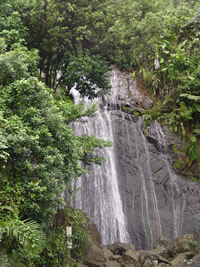
Coca Falls
The forest region was initially set aside in 1876 by the King Alfonso XII of Spain, and represents one of the oldest reserves in the Western Hemisphere. It was established as the Luquillo Forest Reserve on 17 January 1903 by the General Land Office with 65,950 acres (266.9 km2), and became a National Forest in 1906. It was renamed Caribbean National Forest on 4 June 1935. It is home to over 200 species of trees and plants, 23 of which are found nowhere else. The critically endangered Puerto Rican Amazon (Amazona vittata), with an estimated wild population of 30 individuals, occurred exclusively in this forest until 19 November 2006, when another wild population was released by the Department of Natural Resources in the municipality of Utuado's Rio Abajo State Forest.
An Executive Order signed by President George W. Bush on 2 April 2007 changed the name of the Caribbean National Forest to El Yunque National Forest, better reflecting the cultural and historical feelings of the Puerto Rican people. Because Puerto Rico is south of the Tropic of Cancer, it has a tropical climate. There is no distinct wet or dry season in the El Yunque; it rains year round. The temperature and length of daylight remain fairly constant throughout the year. All of these factors provide a year-round growing season.
Flora and fauna
Typical yearly rainfall can be up to 6 m (240 inches) per year, which constitutes more than 380,000,000 m³ (100 billion US gallons) spread over the forest. The forest contains hundreds of species of trees, orchids, plants, and a few animals. You will hear the Coqui frogs and see large snails as they are enjoying the moisture of the forest. The rain helps to create the perfect ecosystem for the frogs and snails and some other creatures in the habitat. You will also hear many birds singing as you walk the trails.
El Yunque is composed of four different forest vegetation areas: Tabonuco Forest, Palo Colorado Forest, Sierra Palm Forest, and Dwarf Forest. El Yunque is also renowned for its unique Taíno petroglyphs.
El Portal Rain Forest Center
Opened in 1996, the El Portal Rain Forest Center is designed to give visitors an introduction to the rain forest. A walkway set at 60 feet above the ground allows for a view of the tops of trees, and another walkway winds along tree bases. Exhibits at the center focus on the plants and animals of the rain forest, the importance of rain forests around the world, and threats to rain forests and efforts to conserve them.
Check out the Most Watched on eBay below.








Contact Us | Advertise Here | Privacy Policy / Terms of Use




